StartseiteMCPWorkbenchSkills
StartseiteWorkbenchBenachrichtigungenMein Bereich
llms.txt · MCP-AnleitungDatenschutz · Nutzungsbedingungen · Supportv1.8.0
  1. Startseite
  2. /Reaktion

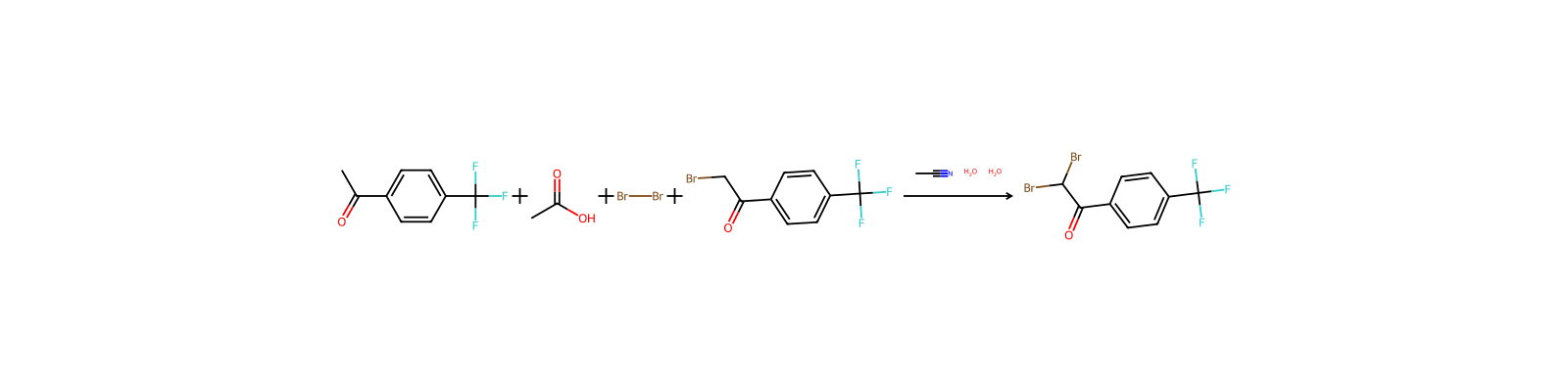
Acetic Acid → 2,2-Dibromo-1-[4-(trifluoromethyl)phenyl]ethanone

HRID 352565
Notizen
Druckvorschau

Reaktionsgleichung

Reaktionsgleichung von HRID 352565
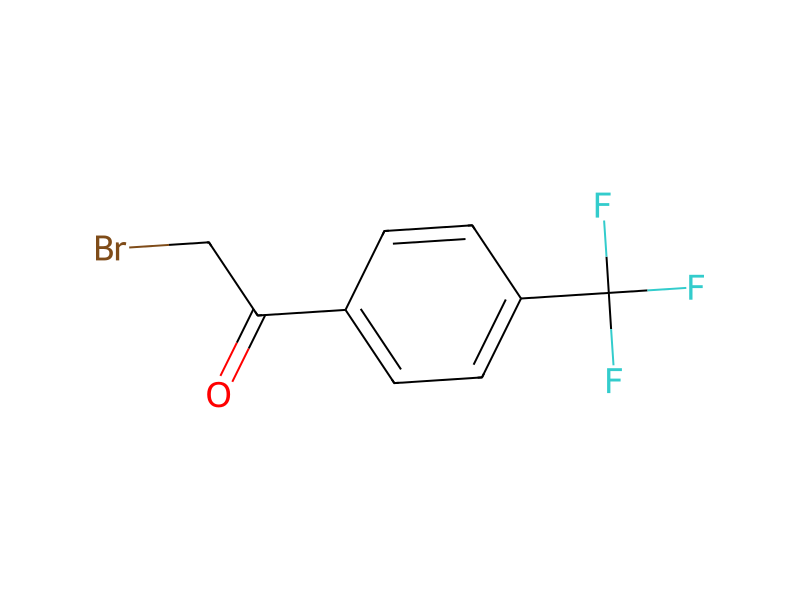
FC(F)(F)C1C=CC(C(=O)C)=CC=1.C(O)(=O)C.[Br:18]Br.[Br:20][CH2:21][C:22]([C:24]1[CH:29]=[CH:28][C:27]([C:30]([F:33])([F:32])[F:31])=[CH:26][CH:25]=1)=[O:23]>C(#N)C.O.O>[Br:20][CH:21]([Br:18])[C:22]([C:24]1[CH:29]=[CH:28][C:27]([C:30]([F:31])([F:32])[F:33])=[CH:26][CH:25]=1)=[O:23]
KomponentenVersuchsvorschriftAufarbeitungQuellen und NachweiseNotizen zur Reaktion

Komponenten

7

Edukt 4

HCID 176Acetic AcidHCID 24408BromineHCID 697311-(4-(Trifluoromethyl)phenyl)ethan-1-oneHCID 3219792-Bromo-4'-(trifluoromethyl)acetophenone

Produkt 1

HCID 102154262,2-Dibromo-1-[4-(trifluoromethyl)phenyl]ethanone

Reagenzien, Katalysatoren, Lösungsmittel 2

HCID 962
Water
Lösungsmittel
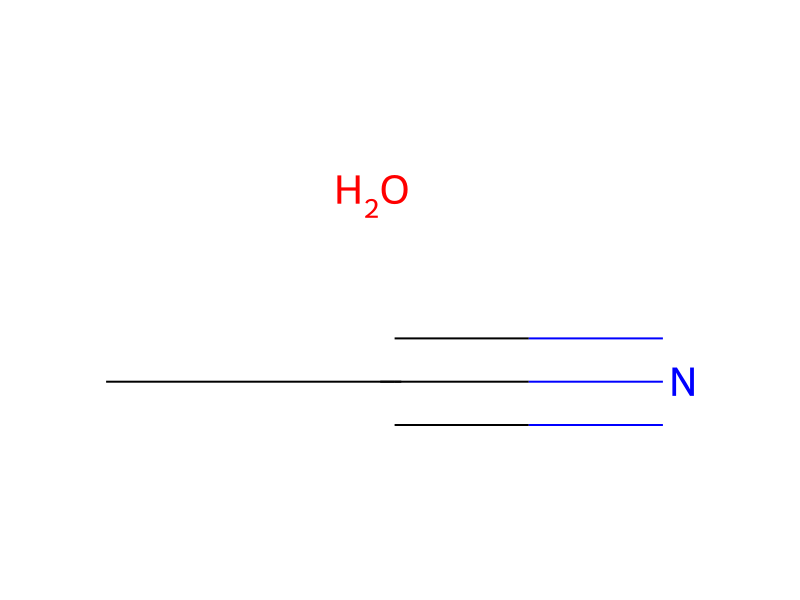
HCID 18373917Acetonitrile--water (1/1)Lösungsmittel

Versuchsvorschrift

This compound was synthesised by the general procedure represented in Scheme 2, a stirred solution of 1-(4-trifluoromethyl-phenyl)-ethanone (1 g, 5.3 mmol) ) and acetic acid (50 ml) was refluxed 1 h, then bromine (0.35 ml, 6.9 mmol) was added dropwise and the mixture refluxed 3 h. After cooling at room temperature, water (50 ml) was added and the mixture extracted with CH2Cl2 (50 ml), the organic layer was washed with water (50 ml), a solution of NaHCO3 saturated (50 ml) and finally with NaCl solution (50 ml), the organic layer was dried over sodium sulphate and the solvent evaporated under reduced pressure. The resulting residue was purified by column chromatography, using a mixture of ethyl acetate:hexane (1:8) as eluent giving two compounds, the titled compound 41 as a yellow solid (45%) m.p.: 40-41° C., 1H-NMR (CDCl3): δ8.2 (d, J=8.3 Hz, 2H, Ar), 7.8 (d, J=8.3 Hz, 2H, Ar), 6.6 (s, 1H, CH); 13C-NMR (CDCl3): δ184.1 (CO), 134.7 (q, J=272.9 Hz, C—CF3), 132.7 (C—CO), 129.2 (CH), 124.8 (CH), 119.5 (q, J=33.09, CF3), 38.2 (CH); M/z (EI): 348, 346, 344 (M+, 1, 6, 1%), 173 (M-CHBr2, 100%); HPLC: Column μ Bondapack C18, 5 μm, 300 A, (300×3.9 mm), Purity 97%, r.t.=9.96 min, acetonitrile/H2O (0.05% H3PO4+0.04% Et3N) 50/50. The second compound was identified as 2-bromo-1-(4-trifluoromethyl-phenyl)-ethanone (0,6%), described as the example 40.

Aufarbeitung

  1. customThis compound was synthesised by the general procedure
  2. temperaturethe mixture refluxed 3 h
  3. extractionthe mixture extracted with CH2Cl2 (50 ml)
  4. washthe organic layer was washed with water (50 ml)
  5. dry with materiala solution of NaHCO3 saturated (50 ml) and finally with NaCl solution (50 ml), the organic layer was dried over sodium sulphate
  6. customthe solvent evaporated under reduced pressure
  7. customThe resulting residue was purified by column chromatography
  8. additiona mixture of ethyl acetate:hexane (1:8) as eluent
  9. customgiving two compounds

Quellen und Nachweise

ORD-Eintrag
ord-111ac77bdba34578bbd5644f2a94a6b3
Quelldatensatz
uspto-grants-2004_06
DOI
10.6084/m9.figshare.5104873.v1
Patentnummer
US06747057B2

Notizen zur Reaktion

Wird geladen…

Auf dieser SeiteKomponentenVersuchsvorschriftAufarbeitungQuellen und NachweiseNotizen zur Reaktion