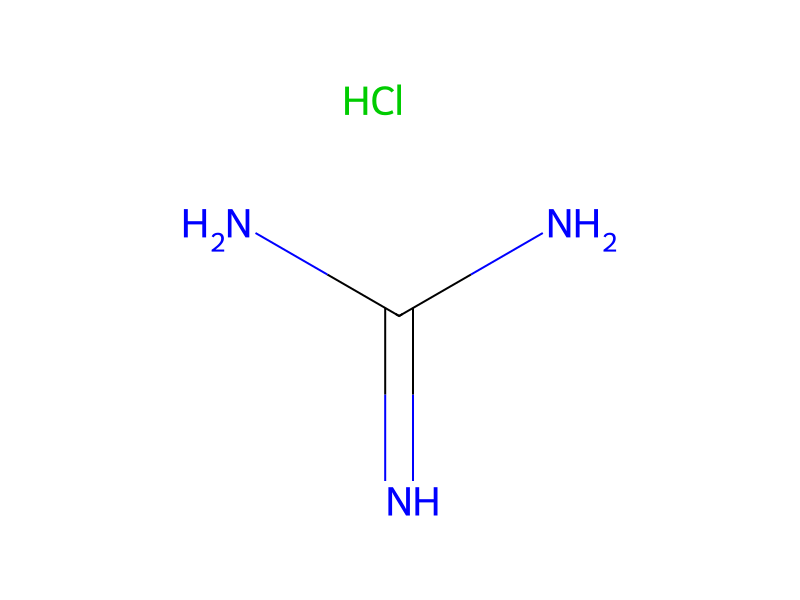
[ClH:1].[NH2:2][C:3]([NH2:5])=[NH:4].C[O-].[Na+].[C:9]1([C:15]2[CH:16]=[C:17]([CH:22]=[CH:23][CH:24]=2)[C:18](OC)=[O:19])[CH:14]=[CH:13][CH:12]=[CH:11][CH:10]=1.C(OCC)(=O)C>CO.O>[ClH:1].[C:9]1([C:15]2[CH:16]=[C:17]([CH:22]=[CH:23][CH:24]=2)[C:18]([N:4]=[C:3]([NH2:5])[NH2:2])=[O:19])[CH:10]=[CH:11][CH:12]=[CH:13][CH:14]=1To a solution of guanidine hydrochloride (2.7 g) in methanol (12 ml) was added sodium methoxide (5.13 g, 28% in methanol) and the mixture was stirred for 15 minutes under nitrogen. To this mixture was added a solution of methyl 3-phenylbenzoate (1.20 g) in methanol (2 ml) and the mixture was stirred for 6 hours. The reaction mixture was poured into a mixture of ethyl acetate (100 ml) and water (50 ml). The organic layer was successively washed with 5N-sodium hydroxide aqueous solution and brine, dried over magnesium sulfate and evaporated in vacuo. The residue was purified by column chromatography on alumina (100 ml) and eluted with chloroform-methanol (10:1). The fractions containing the desired product were collected and evaporated in vacuo. The residue was crystallized from 4N-hydrogen chloride-ethyl acetate. The crystalline was recrystallized from ethanol to afford 2-[3-phenylbenzoyl]guanidine hydrochloride (274.0 mg).
Wird geladen…