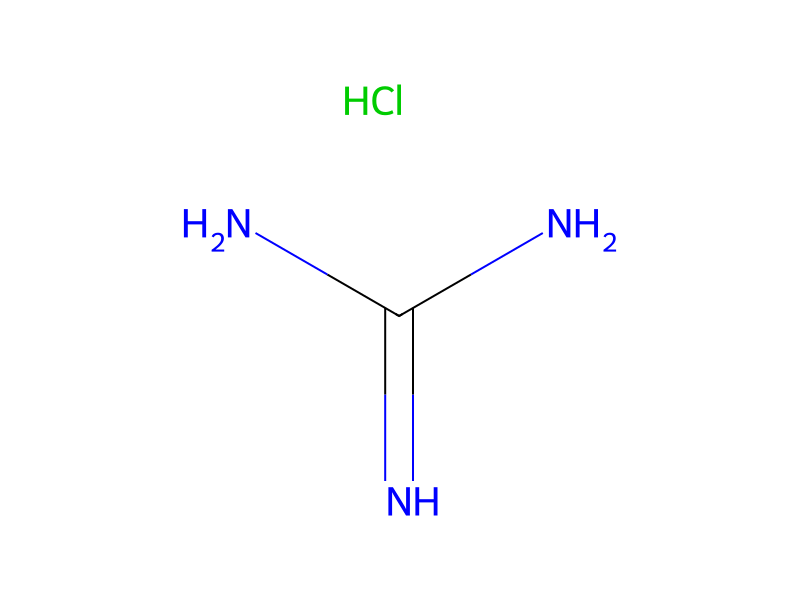
A mixture of (2,5-diiodo-phenoxy)-acetonitrile (1.15 g, 2.99 mmol) and tert-butoxybis(dimethylamino)methane (Bredrick's reagent, 2.08 g, 11.95 mmol) was heated to 100° C. under nitrogen for 18 hours. The reaction mixture was cooled and concentrated under reduced pressure. To the residue was added aniline hydrochloride (1.162 g, 8.97 mmol) and EtOH (20 mL). The resulting mixture was heated to reflux for 20 hours under nitrogen atmosphere. The reaction mixture was cooled to room temperature and concentrated under reduced pressure. A mixture of guanidine hydrochloride (1.43 g, 14.95 mmol) and 25% NaOCH3 in methanol (3.3 mL, 14.95 mmol) in 7 mL ethanol was added to the residue, and the resulting mixture was heated to reflux under nitrogen for 18 hours. The reaction mixture was cooled, poured into water and extracted with EtOAc. The combined organic layers were washed with water and brine, dried over Na2SO4, filtered and concentrated under reduced pressure. The residue was chomatographed on silica gel (30% CH2Cl2 in hexanes with 0.1% NH4OH) to give 0.64 g of 5-(2,5-diiodo-4-methoxy-phenoxy)-pyrimidine-2,4-diamine, MP=136-138° C. MS (M+H)=455.