Reaktionsgleichung

Cl[C:2]1[CH:7]=[C:6]([F:8])[CH:5]=[CH:4][N:3]=1.[C:9](=[O:16])([O:11][C:12]([CH3:15])([CH3:14])[CH3:13])[NH2:10].[OH-].[Na+].O>O1CCOCC1.C([O-])(=O)C.[Pd+2].C([O-])(=O)C.CC1(C)C2C(=C(P(C3C=CC=CC=3)C3C=CC=CC=3)C=CC=2)OC2C(P(C3C=CC=CC=3)C3C=CC=CC=3)=CC=CC1=2>[F:8][C:6]1[CH:5]=[CH:4][N:3]=[C:2]([NH:10][C:9](=[O:16])[O:11][C:12]([CH3:15])([CH3:14])[CH3:13])[CH:7]=1Komponenten
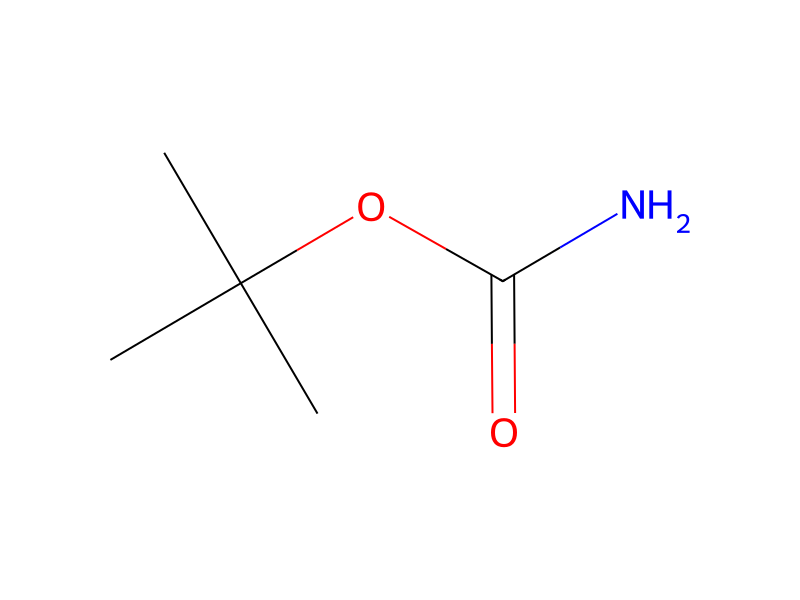
Edukt 4



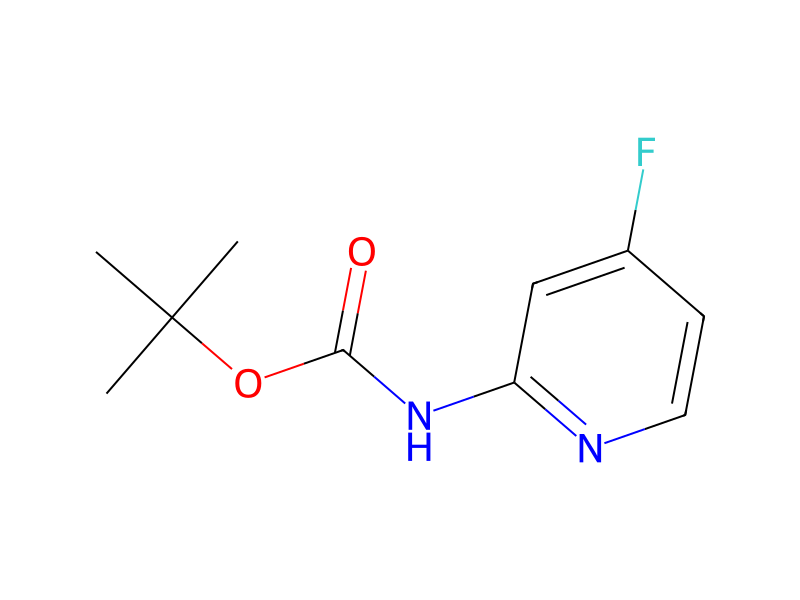
Produkt 1
Reagenzien, Katalysatoren, Lösungsmittel 3



Reaktionsbedingungen
- Temperatur
- 100 °C
Versuchsvorschrift
Palladium (II) acetate (1.69 g, 7.53 mmol) and Xantphos (8.71 g, 15.05 mmol) were dissolved/suspended in degassed 1,4-dioxane (1200 mL) in a nitrogen atmosphere. 2-Chloro-4-fluoropyridine (99 g, 753 mmol) and tert-butyl carbamate (97 g, 828 mmol) in 1,4-dioxane (550 mL) were added, followed by sodium hydroxide (45.2 g, 1.12 mol) and water (20 mL). The resulting mixture was heated at 100° C. for 2 h. The mixture was cooled to ambient temperature and filtered over celite. The residue was washed with 1,4-dioxane and the filtrate was concentrated to afford a yellow solid (206 g). The crude material was recrystallized from 2-propanol (400 mL) and dried to afford the title compound (120.8 g) as a white solid. LCMS 213 [M+H], RT 1.96 minutes, purity 94%.
Aufarbeitung
- temperatureThe mixture was cooled to ambient temperature
- filtrationfiltered over celite
- washThe residue was washed with 1,4-dioxane
- concentrationthe filtrate was concentrated
Quellen und Nachweise
- ORD-Eintrag
- ord-f1c130313d444180b5c320f703a122dd
- Quelldatensatz
- uspto-grants-2016_04
- Patentnummer
- US09309243B2
Verknüpfte Notizen
Wird geladen…