Reaktionsgleichung

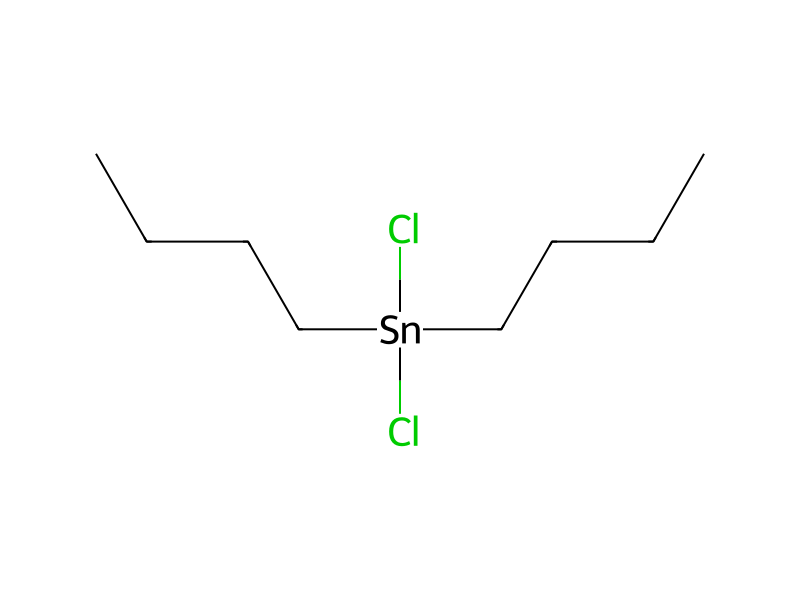
[CH2:1]([Sn:5]([Cl:11])(Cl)[CH2:6][CH2:7][CH2:8][CH3:9])[CH2:2][CH2:3][CH3:4].O.[NH4+].[Cl-].[CH2:15](Br)[C:16]1[CH:21]=[CH:20][CH:19]=[CH:18][CH:17]=1>O1CCCC1.[Zn]>[CH2:15]([Sn:5]([Cl:11])([CH2:1][CH2:2][CH2:3][CH3:4])[CH2:6][CH2:7][CH2:8][CH3:9])[C:16]1[CH:21]=[CH:20][CH:19]=[CH:18][CH:17]=1Komponenten
Edukt 4



Produkt 1

Reagenzien, Katalysatoren, Lösungsmittel 2


Versuchsvorschrift
In a round-bottom two-necked flask equipped with a condenser and a dropping funnel, 31.25 mmol (9.5 g) of dibutyltindichloride were dissolved in 25 ml of tetrahydrofurane (THF). Then 125.1 mmol (8.18 g) of zinc (zinc granules: −30+100 mesh, Sigma-Aldrich) and 50 ml of water saturated with NH4Cl were added. With vigorous stirring 125.1 mmol (21.4 g) of benzylbromide (in 1:1 stoichometric ratio with respect to zinc) were added drop wise at a rate sufficient to keep temperature below 27° C. The reaction flask was cooled down with ice. First a brown benzyldibutyltin chloride was formed as an intermediate. The addition took about 30 min. The resulting heterogeneous colorless mixture was stirred for a further 60-120 min to complete disappearance of Zn powder. The organic layer was separated, washed with saturated aqueous NaCl and dried over MgSO4. Solvent was removed by distillation under reduced pressure up to 45° C. for 5 hours. An oil like liquid remained, which was distilled under vacuum to afford the pure compound.
Aufarbeitung
- customIn a round-bottom two-necked flask equipped with a condenser and a dropping funnel
- additionwere added drop wise at a rate sufficient
- customtemperature below 27° C
- temperatureThe reaction flask was cooled down with ice
Quellen und Nachweise
- ORD-Eintrag
- ord-df8e5aa4604e48dbb46fbd1895d4837c
- Quelldatensatz
- uspto-grants-2014_09
- Patentnummer
- US08822622B2
Verknüpfte Notizen
Wird geladen…