
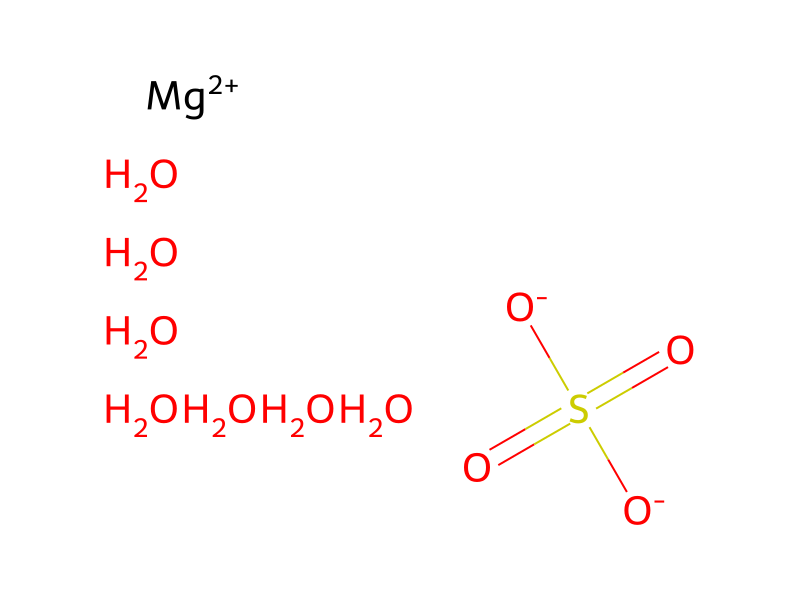
Basic information
- CAS
10034-99-8- Standard SMILES
O.O.O.O.O.O.O.O=S(=O)([O-])[O-].[Mg+2]- InChIKey
WRUGWIBCXHJTDG-UHFFFAOYSA-L- Molecular formula
- Mg.S.O4.7H2O
- Average molar mass
- 246.48 g/mol
- Monoisotopic mass
- 246.01072397
Overview
Magnesium sulfate heptahydrate is a hydrate that is the heptahydrate form of magnesium sulfate. It has a role as a laxative and a cathartic. It is a magnesium salt and a hydrate. It contains a magnesium sulfate.
Names & identifiers
- Preferred name
- Magnesium Sulfate Heptahydrate
- IUPAC
- magnesium;sulfate;heptahydrate
- English name
- Magnesium sulfate heptahydrate
- Molecular formula
- Mg.O4S.7H2O
- Molecular weight
- 246.47
Names & synonyms
Magnesium sulfate heptahydrate10034-99-8Epsom saltmagnesium sulphate heptahydrateMagnesia sulphuricaMagnesium sulfate (1:1) heptahydrateEpsom salt(heptahydrate)Bitter saltSulfuric acid magnesium salt (1:1), heptahydrateSK47B8698TMagnesii sulfatis heptahydrasCHEBI:31795
Show more names
MgSOEPSOM SALTSSULFURIC ACID MAGNESIUMMagnesiumsulfatMAGNESIUM SULFATE 7HYD XTLMAGNESIUM SULPHATE 7-HYDRATECrystalline magnesium sulfateMagnesium sulfate heptahydrate, 99%, for analysis
Magnesium Sulfate, HeptahydrateTheraworx ReliefHumco Epson SaltCVS muscle reliefRelief Epsom SaltNuValu Epsom SaltAssured Epsom SaltEpsom Salts Relief
Database identifiers
- CAS
10034-99-8、14457-55-7- PubChem CID
- 24843
- DTXSID
DTXSID5040544- ChEBI
CHEBI:31795- UNII
- SK47B8698T
- EC Number
- 600-073-4、913-387-4
Properties
Computed structural properties
- Topological polar surface area
- 95.6 Ų
- Hydrogen bond donors
- 7
- Hydrogen bond acceptors
- 11
- Rotatable bonds
- 0
- Heavy atoms
- 13
- Formal charge
- 0
- Complexity
- 62.2
Experimental & physicochemical properties
Density1.68 @25 °C
Physical DescriptionLiquid; Large Crystals; Dry Powder
Physicochemical properties
- Melting point
- 1124 °C · 1124°C
- Density
- 2.66 · 2.66
- bulk density
- 900 kg/m3 · 900kg/m3
- vapor density
- 0.01 · <0.01 (vs air)
- vapor pressure
- 0.1 mm · <0.1 mm Hg ( 20 °C)
- refractive index
- 1.433 · 1.433
- storage temp.
- 5 °C · Store at +5°C to +30°C.
- solubility
- 2 O: · H2O: 1 M at 20 °C, clear, colorless
- form
- Solid
- Specific Gravity
- 1.68 · 1.68
- color
- White
- PH
- 5 · 5.0-8.0 (25℃, 50mg/mL in H2O)
- Odor
- Odorless
- Water Solubility
- Soluble in in water and acid. Slightly soluble in alcohol and glycerol.
- λmax
- 260 nm · λ: 260 nm Amax: 0.010λ: 280 nm Amax: 0.010
- Merck
- 14 · 14,5691
- Dielectric constant
- 8.2 · 8.2(Ambient)
- Stability
- Stable. Non-flammable. May slowly deteriorate in contact with air.
- Cosmetics Ingredients Functions
- BULKING
- InChI
- 1S/Mg.H2O4S.7H2O/c;1-5(2,3)4;;;;;;;/h;(H2,1,2,3,4);7*1H2/q+2;;;;;;;;/p-2
- InChIKey
- WRUGWIBCXHJTDG-UHFFFAOYSA-L
- SMILES
- O.O.O.O.O.O.O.[Mg++].[O-]S([O-])(=O)=O
- LogP
- -1.031 · -1.031 (est)
- CAS DataBase Reference
- 10034 · 10034-99-8(CAS DataBase Reference)
- Substances Added to Food (formerly EAFUS)
- MAGNESIUM SULFATE
- FDA 21 CFR
- 310.545 · 310.545; 558.311
- SCOGS (Select Committee on GRAS Substances)
- Magnesium sulfate
- EWG's Food Scores
- 1 · 1
- NCI Dictionary of Cancer Terms
- magnesium sulfate
- FDA UNII
- 47 B8698T · SK47B8698T
- ATC code
- 6 AD04,A12CC02,B05XA05,D11AX05,V04CC02 · A06AD04,A12CC02,B05XA05,D11AX05,V04CC02
- NIST Chemistry Reference
- magnesium sulfate heptahydrate(10034-99-8)
- EPA Substance Registry System
- Magnesium sulfate heptahydrate (10034-99-8)
- UNSPSC Code
- 41116107 · 41116107
- NACRES
- 24 · NB.24
- Symbol(GHS)
- 7 · GHS07
- Signal word
- Warning
- Hazard statements
- 302 · H302-H315-H319-H335
- Precautionary statements
- 261 · P261-P301+P312-P302+P352-P304+P340-P305+P351+P338
- Hazard Codes
- Xi
- Risk Statements
- 36 · 36/37/38
- Safety Statements
- 24 · 24/25-36-26
- WGK Germany
- 1 · 1
- RTECS
- 4508000 · OM4508000
- TSCA
- Yes
- HS Code
- 28332100 · 28332100
- Storage Class
- 13 · 13 - Non Combustible Solids
- Toxicity
- 183 mg/kg/4H-I · man,TDLo,oral,183mg/kg/4H-I (183mg/kg),GASTROINTESTINAL: "HYPERMOTILITY, DIARRHEA",Journal of Toxicology, Clinical Toxicology. Vol. 20, Pg. 107, 1983.
Safety & regulation
GHS classification
GHS Classification
This chemical does not meet GHS hazard criteria for 100% (424 of 424) of all reports.
Not Classified
Aggregated GHS information provided per 424 reports by companies from 2 notifications to the ECHA C&L Inventory.
This chemical does not meet GHS hazard criteria for 100% (2 of 2) of all reports.
Not Classified
Aggregated GHS information provided per 2 reports by companies from 1 notifications to the ECHA C&L Inventory.
Hazard information
Regulatory Information
Chemical: Sulfuric acid, magnesium salt, heptahydrate
Sulfuric acid magnesium salt (1:1), heptahydrate is listed on the EPA's Chemical Data Reporting (CDR) system. Manufacturers and importers of Sulfuric acid magnesium salt (1:1), heptahydrate are required to report information about their production and use of this chemical to the EPA under the Toxic Substances Control Act (TSCA). (40 eCFR Part 711)
Sulfuric acid magnesium salt (1:1), heptahydrate: Does not have an individual approval but may be used under an appropriate group standard
Other Safety InformationIMAP assessments - Sulfuric acid, magnesium salt, heptahydrate: Human health tier I assessment
EPA Safer ChemicalChemical: Magnesium sulfate, heptahydrate
Hazard Classes and Categories
Not Classified
Not Classified
Safety & protection
Protective Action Criteria (PAC)
1.2 [mg/m3]
13 [mg/m3]
81 [mg/m3]
Safety data
- wgk
- 1
- tsca
- Yes
- rtecs
- OM4508000
- hs_code
- 28332100
- Toxicity
- man,TDLo,oral,183mg/kg/4H-I (183mg/kg),GASTROINTESTINAL: "HYPERMOTILITY, DIARRHEA",Journal of Toxicology, Clinical Toxicology. Vol. 20, Pg. 107, 1983.
- risk_code
- 36/37/38
- Signal word
- Warning
- Symbol(GHS)
- GHS07
- hazard_code
- Xi
- safety_code
- 24/25-36-26
- Storage Class
- 13 - Non Combustible Solids
- Hazard statements
- H302-H315-H319-H335
- Precautionary statements
- P261-P301+P312-P302+P352-P304+P340-P305+P351+P338
Chemistry & industry
Pharmacology
FDA Pharmacological Classification
50% MAGNESIUM SULFATE
Increased Large Intestinal Motility [PE]; Stimulation Large Intestine Fluid/Electrolyte Secretion [PE]; Inhibition Small Intestine Fluid/Electrolyte Absorption [PE]; Magnesium Ion Exchange Activity [MoA]; Osmotic Laxative [EPC]; Inhibition Large Intestine Fluid/Electrolyte Absorption [PE]; Osmotic Activity [MoA]; Calculi Dissolution Agent [EPC]
EPSOM SALT
Calculi Dissolution Agent [EPC]; Osmotic Activity [MoA]; Inhibition Large Intestine Fluid/Electrolyte Absorption [PE]; Osmotic Laxative [EPC]; Magnesium Ion Exchange Activity [MoA]; Inhibition Small Intestine Fluid/Electrolyte Absorption [PE]; Stimulation Large Intestine Fluid/Electrolyte Secretion [PE]; Increased Large Intestinal Motility [PE]
MAGNESIA SULPHURICA
Calculi Dissolution Agent [EPC]; Osmotic Activity [MoA]; Inhibition Large Intestine Fluid/Electrolyte Absorption [PE]; Osmotic Laxative [EPC]; Magnesium Ion Exchange Activity [MoA]; Inhibition Small Intestine Fluid/Electrolyte Absorption [PE]; Stimulation Large Intestine Fluid/Electrolyte Secretion [PE]; Increased Large Intestinal Motility [PE]
MeSH Pharmacological Classification
Compounds capable of relieving pain without the loss of CONSCIOUSNESS.
Agents capable of inducing a total or partial loss of sensation, especially tactile sensation and pain. They may act to induce general ANESTHESIA, in which an unconscious state is achieved, or may act locally to induce numbness or lack of sensation at a targeted site.
Agents used for the treatment or prevention of cardiac arrhythmias. They may affect the polarization-repolarization phase of the action potential, its excitability or refractoriness, or impulse conduction or membrane responsiveness within cardiac fibers. Anti-arrhythmia agents are often classed into four main groups according to their mechanism of action: sodium channel blockade, beta-adrenergic blockade, repolarization prolongation, or calcium channel blockade.
Drugs used to prevent SEIZURES or reduce their severity.
A class of drugs that act by selective inhibition of calcium influx through cellular membranes.
Drugs that prevent preterm labor and immature birth by suppressing uterine contractions (TOCOLYSIS). Agents used to delay premature uterine activity include magnesium sulfate, beta-mimetics, oxytocin antagonists, calcium channel inhibitors, and adrenergic beta-receptor agonists. The use of intravenous alcohol as a tocolytic is now obsolete.
Uses & manufacturing
U.S. Production2023: 250,000 - <400,000 lb
Consumer UsesSoil amendments (fertilizers)
Industry UsesFlocculating agent
Household ProductsInformation on 24 consumer products that contain Magnesium sulfate heptahydrate in the following categories is provided:
Use Classification
EPA Safer Chemical Functional Use Classes -> Processing Aids and Additives
Safer Chemical Classes -> Green circle - The chemical has been verified to be of low concern
General Manufacturing InformationPesticide, Fertilizer, and Other Agricultural Chemical Manufacturing
Applications
Uses1. It can be used for catharsis with its saturated solution subject to topical administration. It has anti-inflammatory, detumescence, detoxification, analgesic effect, and can inhibit the effect of central nervous system, anti-traction and antispasmodic; used as the weighing agent of printing fine cotton, cotton, silk and the filler for kapok products; it can be used for the manufacturing of grass, fertilizers, porcelain, pigments, matches, explosives and fireproof materials; can be used as the medium component in the microbial industry; supplying the magnesium for brewing additives; used as filler to enhance the thermal resistance in the leather industry; used for the production of fresh yeast, monosodium glutamate and the stabilizer of dicalcium phosphate used in toothpaste production; can also be used in cement coagulant; pulp industry, rayon and silk industry, etc. Product containing a small amount of crystal water or no crystal water can be used for the synthesis of product that contains low water content and mixed ingredients. In organic chemical industry, it can be used for desiccant and dehydrating agent for printing thin cotton, silk, as the aggravating agent of cotton and filler of kapok products. 2. It can be used for leather industry, fertilizer, porcelain, matches, explosives, printing and dyeing, pharmaceutical and other industries 3. It can be used for steelmaking and ironmaking 4. Magnesium sulfate is a feed nutrition enhancer. 5. It can be used as laxative, cholagogue, for cathartic and duodenal diversion 6. It can be used as analysis reagents and mordant 7. It can be used as food fortifier. China provides that it can be used for dairy products with the usage amount of 3~7 g/kg; usage amount in the beverages and milk beverages is 1.4~2.8g/kg; the maximum dose in mineral drinks should be 0.05g/kg. 8. It can be used as nutritional supplements, curing agents, flavor enhancers, processing aids. Brewing additives for supplement the magnesium of brewing water; as a source of nutrients during fermentation to enhance the fermentation capacity; improve the flavor of synthetic wine (usage amount of 0.002%). Adjust the water hardness. In Europe for the production of "Bolton" type of beer. 9. It is often used in combination with the calcium salt for the yeast-purpose water. Addition of 4.4g/100 water being able to increase the hardness of 1 degree with multi-use producing bitter and producing hydrogen sulfide odor. 10. This product can be used as tanning filler. In the printing and dyeing industry, it can be used as the aggravating agent of the thin cotton. Used as paper sizing agent. 11. U
DescriptionIn addition to its use in foods as a flavor enhancer, nutrient supplement and processing aid, magnesium sulfate (as Epsom salt) is employed in over-the-counter preparations as a laxative. As a legend (prescription drug) it has been used as an anticonvulsant and electrolyte replenisher.
UsesUsed in preparation of magnesium standard solutions
UsesMagnesium Sulfate is a nutrient and dietary supplement. It is soluble in water and its solutions are neutral. It exists as crystals with a cooling, saline, bitter taste. It is also termed epsom salt.
UsesMagnesium sulfate heptahydrate has been used:as a component in Kreb′s Ringer bufferas a component in minimal medium to culture Ralstonia solanacearumin the preparation of maceration solution for Lamb′s lettuce cell isolation and isotonic glucose buffer
General DescriptionMagnesium sulfate heptahydrate is hydroscopic and is vulnerable to warm temperatures.
Upstream & downstream products
Upstream raw materials
Downstream products
Suppliers100 total
国药集团化学试剂有限公司86-21-63210123 · [email protected]
上海阿拉丁生化科技股份有限公司400-6206333 13167063860 · [email protected]
上海麦克林生化科技股份有限公司021-50706066 15221275939 · [email protected]
河北永泰供应链管理有限公司15130657697 15130657697 · [email protected]
上海毕合生物化学技术有限公司13816464724 · [email protected]
大连美仑生物技术有限公司0411-62910999 13889544652 · [email protected]
阿法埃莎(中国)化学有限公司400-6106006 · [email protected]
安耐吉化学&3A(安徽泽升科技股份有限公司)400-0056266 · [email protected]
北京绿百草科技发展有限公司010-61136123 · [email protected]
上海瀚鸿科技股份有限公司021-54306202 13764082696 · [email protected]
池州捷峰生物科技有限公司0566-8928158 · [email protected]
上海泰坦科技股份有限公司400-6009262 15618770481 · [email protected]
天津金汇太亚化学试剂有限公司022-59582624 18622766592 · [email protected]
南京美博生物科技有限公司025-58619198 · [email protected]
山东西亚化学有限公司13355009207 13355009207 · [email protected]
玛雅试剂+86 (573) 82222445 (0)18006601000 452520369 · [email protected]
四川库利南科技有限公司400-1166-196 18981987031 · [email protected]
天津希恩思生化科技有限公司400 638 7771 · [email protected]
湖南汇百侍生物科技有限公司0731-85526065 13308475853 · [email protected]
斯百全化学(上海)有限公司021-021-021-67601398-809-809-809 15221380277 · [email protected]
上海源叶生物科技有限公司13636370518 · [email protected]
艾科试剂4008-755-333 18080918076 · [email protected]
赛默飞世尔科技(中国)有限公司800-810-5118 · [email protected]
北京伊诺凯科技有限公司400-810-7969 010-59572699 · [email protected]
南京诺利斯医药科技有限公司13901585132 · [email protected]
南京杜莱生物技术有限公司025-84699383-8003;025-846993838003-8003 18013301590 · [email protected]
南京生利德生物科技有限公司025-57798810 18652991625 · [email protected]
山东博洛达生物科技有限公司0531-68659041 · [email protected]
湖北威德利化学试剂有限公司186-02735115 18602735115 · [email protected]
北京环宇世纪化学科技有限公司hysj_bj.com
上海将来实业股份有限公司400-0066400 13621662912 · [email protected]
上海将来实业股份有限公司021-61552785 · [email protected]
HBCChem, Inc.+1-510-219-6317 · [email protected]
安倍医疗器械贸易(上海)有限公司400-1500-680 021-62402299 · [email protected]
成都零六生物科技有限公司400-1166-196 13458535857 · [email protected]
广拓化学(上海)有限公司021-60899189-8001 18918189673 · [email protected]
上海创赛科技有限公司400-6087598 15021221957 · [email protected]
天津锦耀翔承科技有限公司18822227517 18822227517 · [email protected]
成都润泽本土化工有限公司13096311329 028-88469284 616445927 · [email protected]
湖北巨胜科技有限公司027-59599241 18871490274 · [email protected]
池州凯隆进出口贸易有限公司[email protected]
Sigma-Aldrich西格玛奥德里奇(上海)贸易有限公司021-61415566 800-8193336 · [email protected]
桦特昇生物科技(武汉)有限公司027-59207879 1972026995 18140587686 · [email protected]
上海皓之翔生物科技有限公司(原上海拓青化工有限公司)526763801 13301653310 · [email protected]
九鼎化学(上海)科技有限公司4009209199 · [email protected]
尤尼威尔化学品(上海)有限公司021-61932772 13012862996 · [email protected]
杭州鼎燕化工有限公司0571-87157530-8003 18267553885 · [email protected]
上海岚克医药科技发展有限公司0086-21-58956006
南京艾比克斯生化科技有限公司025-87193546 18652950785 · [email protected]
北京华威锐科化工科技有限公司89508211 18501085097 · [email protected]
Additional notes
DefinitionEpsomite: a mineral form of magnesiumsulphate heptahydrate,MgSO4.7H2O.
Related reactions
28 records


Compound notes
Loading…