
Butyric anhydride
Completing data — refresh the page later to see the latest
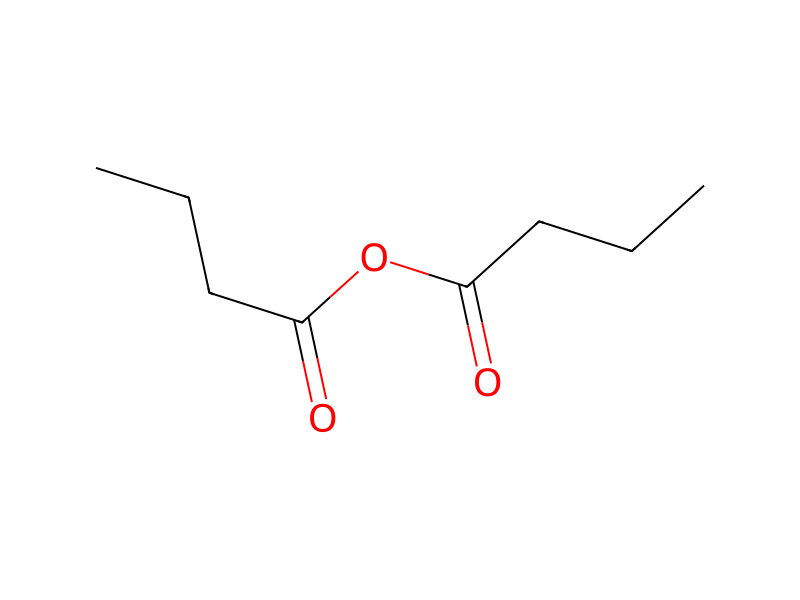
Basic information
- CAS
106-31-0- Standard SMILES
CCCC(=O)OC(=O)CCC- InChIKey
YHASWHZGWUONAO-UHFFFAOYSA-N- Molecular formula
- C8H14O3
- Average molar mass
- 158.19 g/mol
- Monoisotopic mass
- 158.09429431
Overview
Butyric anhydride is a water-white liquid with an odor of rancid butter. Corrosive to metals and tissue. Low toxicity.
Names & identifiers
- Preferred name
- Butyric anhydride
- IUPAC
- butanoyl butanoate
- English name
- Butyric anhydride
- Molecular formula
- C8H14O3
- Molecular weight
- 158.2
Names & synonyms
BUTYRIC ANHYDRIDEn-Butyric anhydrideButanoic anhydridebutanoyl butanoateButanoic acid, anhydrideButyric acid anhydrideButyryl oxiden-Butyric acid anhydrideButyranhydridButyric anhydride NButyranhydrid [Czech]Caswell No. 132A
Show more names
butyricButyrloxidebutric anhydridebutylic anhydrideAKOS BBS-00004317
Anhydrid kyseliny maselnen-Butanoic anhydrideButanoic acid, 1,1'-anhydrideDTXSID8026729HSDB 5369Anhydrid kyseliny maselne [Czech]EINECS 203-383-4UNII-A88LE742VX
Database identifiers
- CAS
106-31-0- PubChem CID
- 7798
- DTXSID
DTXSID8026729- ChEMBL
CHEMBL1566369- UNII
- A88LE742VX
- EC Number
- 203-383-4
- Nikkaji
- J5.050D
Properties
Computed structural propertiesFilling in
- XLogP
- 1.6
- Topological polar surface area
- 43.4 Ų
- Hydrogen bond donors
- 0
- Hydrogen bond acceptors
- 3
- Rotatable bonds
- 6
- Heavy atoms
- 11
- Formal charge
- 0
- Complexity
- 124
Experimental & physicochemical properties
Chemical Classes
Other Classes -> Acid Anhydrides, Other
Corrosives
SpringerMaterials PropertiesBoiling point
LogPlog Kow = 1.39 /estimated; value theoretical due to hydrolysis in water/
OdorPUNGENT ODOR
Density0.9668 at 20 °C/4 °C
Viscosity1.59 cP at 20 °C
Color/FormWater-white liquid
SolubilitySoluble in water and alcohol with decomposition; soluble in ether
Flash Point
180 °F (NFPA, 2010)
180 °F (54 °C) (closed cup)
Boiling Point200 °C
DecompositionWhen headed to decomposition it emits acrid smoke and irritating vapors.
Melting Point-75 °C
Physicochemical properties
- Melting point
- -75 · -75--66 °C (lit.)
- Boiling point
- 198 · 198-199 °C (lit.)
- Density
- 0.967 g/mL · 0.967 g/mL at 25 °C (lit.)
- vapor density
- 5.45 · 5.45 (vs air)
- vapor pressure
- 10 mm · 10 mm Hg ( 79.5 °C)
- refractive index
- 20 · n20/D 1.413(lit.)
- Flash point
- 190 °F · 190 °F
- storage temp.
- 30 °C · Store below +30°C.
- solubility
- alcohol: soluble (with decomposition)(lit.)
- form
- Liquid
- color
- Clear colorless to light yellow
- Odor
- butter
- biological source
- synthetic
- explosive limit
- 1.1 %, · 1.1%, 104°F
- Water Solubility
- Decomposes
- Specific Heat Capacity
- 1.79 J/ · Cp(liquid): 1.79 J/(g·K), at 25℃
- Sensitive
- Moisture Sensitive
- Merck
- 14 · 14,1594
- BRN
- 1099474 · 1099474
- Dielectric constant
- 12 · 12.0(Ambient)
- InChI
- 1S/C8H14O3/c1-3-5-7(9)11-8(10)6-4-2/h3-6H2,1-2H3
- InChIKey
- YHASWHZGWUONAO-UHFFFAOYSA-N
- SMILES
- CCCC(=O)OC(=O)CCC
- LogP
- 1.39 · 1.390
- CAS DataBase Reference
- 106 · 106-31-0(CAS DataBase Reference)
Safety & regulation
Safety information is for reference only and does not replace the supplier’s Safety Data Sheet (SDS), applicable regulations, or professional assessment.
GHS classification
GHS Classification
This chemical does not meet GHS hazard criteria for 4.8% (21 of 437) of reports.
Danger
H302 (63.4%): Harmful if swallowed [Warning Acute toxicity, oral]
P260, P264, P264+P265, P270, P280, P301+P317, P301+P330+P331, P302+P361+P354, P304+P340, P305+P354+P338, P316, P317, P321, P330, P363, P405, and P501 (click each P-code to see the statement)
Aggregated GHS information provided per 437 reports by companies from 10 notifications to the ECHA C&L Inventory. Each notification may be associated with multiple companies.
Danger
Hazard information
Regulatory Information
Chemical: Butanoic acid, anhydride
Butanoic acid, 1,1'-anhydride is listed on the EPA's Chemical Data Reporting (CDR) system. Manufacturers and importers of Butanoic acid, 1,1'-anhydride are required to report information about their production and use of this chemical to the EPA under the Toxic Substances Control Act (TSCA). (40 eCFR Part 711)
Status: Active Update: 01-08-2022 https://echa.europa.eu/registration-dossier/-/registered-dossier/12002
Butyric anhydride: Does not have an individual approval but may be used under an appropriate group standard
The New Jersey Worker and Community Right to Know Act requires public and private employers to provide information about hazardous substances at their workplaces. (N.J.S.A. 34:5A-1 et. seq.)
DOT LabelCorrosive
Fire Hazards
Excerpt from ERG Guide 156 [Substances - Toxic and/or Corrosive (Combustible / Water-Sensitive)]:
· Combustible material: may burn but does not ignite readily.
Health Hazards
Excerpt from ERG Guide 156 [Substances - Toxic and/or Corrosive (Combustible / Water-Sensitive)]:
· TOXIC and/or CORROSIVE; inhalation, ingestion or contact (skin, eyes) with vapors, dusts or substance may cause severe injury, burns or death.
Hazards Summary
A skin and eye irritant; [HSDB] A corrosive substance that can react with moisture in the respiratory tract to form butyric acid; Can cause permanent eye damage; Inhalation of high concentrations may cause pulmonary edema; [CHEMINFO] A corrosive substance that can cause injury to the skin, eyes, mucous membranes, and respiratory tract; May cause chemical pneumonitis if inhaled; [MSDSonline]
DOT ID and Guide2739 156
Reactive GroupAnhydrides
TSCA Requirements
Section 8(a) of TSCA requires manufacturers of this chemical substance to report preliminary assessment information concerned with production, exposure, and use to EPA as cited in the preamble in 51 FR 41329. Effective date: 9/30/91; Reporting date: 11/27/91.
Pursuant to section 8(d) of TSCA, EPA promulgated a model Health and Safety Data Reporting Rule. The section 8(d) model rule requires manufacturers, importers, and processors of listed chemical substances and mixtures to submit to EPA copies and lists of unpublished health and safety studies. Butyric anhydride is included on this list. Effective date: 9/30/91; Sunset date: 12/19/95.
Reactivity Profile
BUTYRIC ANHYDRIDE reacts exothermically with water. The reaction is usually slow, but might become violent if local heating accelerates their rate. Acids accelerate the reaction with water. Incompatible with acids, strong oxidizing agents, alcohols, amines, and bases.
Atmospheric Standards
This action promulgates standards of performance for equipment leaks of Volatile Organic Compounds (VOC) in the Synthetic Organic Chemical Manufacturing Industry (SOCMI). The intended effect of these standards is to require all newly constructed, modified, and reconstructed SOCMI process units to use the best demonstrated system of continuous emission reduction for equipment leaks of VOC, considering costs, non air quality health and environmental impact and energy requirements. Butyric anhydride is produced, as an intermediate or a final product, by process units covered under this subpart.
Flammable LimitsLower flammable limit: 0.9% by volume; Upper flammable limit: 5.8% by volume
DOT Emergency Guidelines
/GUIDE 156: SUBSTANCES - TOXIC and/or CORROSIVE (Combustible/Water-Sensitive)/ Fire or Explosion: Combustible material: may burn but does not ignite readily. Substance will react with water (some violently) releasing flammable, toxic or corrosive gases and runoff. When heated, vapors may form explosive mixtures with air: indoors, outdoors and sewers explosion hazards. Most vapors are heavier than air. They will spread along ground and collect in low or confined areas (sewers, basements, tanks). Vapors may travel to source of ignition and flash back. Contact with metals may evolve flammable hydrogen gas. Containers may explode when heated or if contaminated with water.
/GUIDE 156: SUBSTANCES - TOXIC and/or CORROSIVE (Combustible/Water-Sensitive)/ Health: TOXIC; inhalation, ingestion or contact (skin, eyes) with vapors, dusts or substance may cause severe injury, burns or death. Contact with molten substance may cause severe burns to skin and eyes. Reaction with water or moist air will release toxic, corrosive or flammable gases. Reaction with water may generate much heat that will increase the concentration of fumes in the air. Fire will produce irritating, corrosive and/or toxic gases. Runoff from fire control or dilution water may be corrosive and/or toxic and cause pollution.
/GUIDE 156: SUBSTANCES - TOXIC and/or CORROSIVE (Combustible/Water-Sensitive)/ Public Safety: CALL Emergency Response Telephone Number on Shipping Paper first. If Shipping Paper not available or no answer, refer to appropriate telephone number listed on the inside back cover. As an immediate precautionary measure, isolate spill or leak area in all directions for at least 50 meters (150 feet) for liquids and at least 25 meters (75 feet) for solids. Keep unauthorized personnel away. Stay upwind. Keep out of low areas. Ventilate enclosed areas.
/GUIDE 156: SUBSTANCES - TOXIC and/or CORROSIVE (Combustible/Water-Sensitive)/ Protective Clothing: Wear positive pressure self-contained breathing apparatus (SCBA). Wear chemical protective clothing that is specifically recommended by the manufacturer. It may provide little or no thermal protection. Structural firefighters' protective clothing provides limited protection in fire situations ONLY; it is not effective in spill situations where direct contact with the substance is possible.
For more DOT Emergency Guidelines (Complete) data for BUTYRIC ANHYDRIDE (8 total), please visit the HSDB record page.
Safety & protection
Fire FightingExcerpt from ERG Guide 156 [Substances - Toxic and/or Corrosive (Combustible / Water-Sensitive)]:
Accidental Release Measures
· CALL 911. Then call emergency response telephone number on shipping paper. If shipping paper not available or no answer, refer to appropriate telephone number listed on the inside back cover.
· ELIMINATE all ignition sources (no smoking, flares, sparks or flames) from immediate area.
First Aid
Excerpt from ERG Guide 156 [Substances - Toxic and/or Corrosive (Combustible / Water-Sensitive)]:
General First Aid:
Firefighting Hazards
... Substance will react with water (some violently) releasing flammable, toxic or corrosive gases and runoff. When heated, vapors may form explosive mixtures with air: indoors, outdoors and sewers explosion hazards. ... Vapors may travel to source of ignition and flash back. Contact with metals may evolve flammable hydrogen gas. Containers may explode when heated or if contaminated with water.
Exposure Control and Personal Protection· Wear positive pressure self-contained breathing apparatus (SCBA).
Fire Fighting Procedures
Use water in flooding quantities as fog. Solid streams of water may be ineffective. Cool all affected containers with flooding quantities of water. Apply water from as far a distance as possible. Use "alcohol" foam, dry chemical or carbon dioxide. Use water spray to knock-down vapors.
Nonfire Spill ResponseExcerpt from ERG Guide 156 [Substances - Toxic and/or Corrosive (Combustible / Water-Sensitive)]:
Disposal Methods
SRP: The most favorable course of action is to use an alternative chemical product with less inherent propensity for occupational harm/injury/toxicity or environmental contamination. Recycle any unused portion of the material for its approved use or return it to the manufacturer or supplier. Ultimate disposal of the chemical must consider: the material's impact on air quality; potential migration in soil or water; effects on animal and plant life; and conformance with environmental and public health regulations.
Toxicology
Interactions
Whole unfractionated heparin can modestly decrease tumor growth, but the dose of heparin is limited by its anticoagulant properties. To overcome this limitation... the chemical structure of heparin /was modified/ and a heparin derivative /was prepared/ by O-acylating low molecular weight heparin with butyric anhydride, producing a more potent antiproliferative compound, which is only weakly anticoagulant so that the dose may be escalated without threat of hemorrhage. ...this study... investigated the effect of this chemically modified heparin, butanoylated heparin, on the growth of lung cancer in vitro and in vivo. /It was/ found that butanoylated heparin a) significantly inhibited lung cancer cell proliferation in vitro and lung cancer growth in mice and rats; b) had very low anticoagulant effect; c) had no significant toxicity on heart, liver, kidney and lung; d) significantly although modestly induced apoptosis and decreased expression of the cell proliferation pathway consisting of mutant p53, phospho-Rb and E2F1 expression in the tumor tissues. /It was/ also found that butanoylated heparin significantly inhibited CXCL12 and CXCR4 expression, suggesting that CXCL12/CXCR4 axis may be involved in regulation of tumor growth inhibition by heparin. /It was/ concluded that chemically modified butanoylated heparin has potent antiproliferative activity against lung cancer and may represent a new chemical therapeutic agent for cancer patients.
Environmental Fate
TERRESTRIAL FATE: Based on a classification scheme(1), an estimated Koc value of 10(SRC), determined from a structure estimation method(2), indicates that butyric anhydride is expected to have very high mobility in soil(SRC). However, butyric anhydride hydrolyzes to butyric acid in water(3); the neutral hydrolysis half-life at 25 °C is about 4.3 minutes based on analogy to similar anhydrides(2). Therefore leaching in soil due to rain or runoff is not expected to be an important fate process. The potential for volatilization of butyric anhydride from dry soil surfaces may exist(SRC) based upon a vapor pressure of 0.3 mm Hg at 25 °C(4) and its existence as a liquid at ambient temperatures(3).
AQUATIC FATE: Hydrolysis is the dominant fate process for butyric anhydride in water(SRC). In water, butyric anhydride hydrolyzes to butyric acid(1). Based on analogy to similar anhydrides(SRC), the neutral aqueous hydrolysis half-life of butyric anhydride at 25 °C is about 4.3 minutes(2). A base-catalyzed second-order hydrolysis rate constant of 3440 L/mole-sec(SRC) was estimated using a structure estimation method(3); this corresponds to half-lives of 17 and 1.7 minutes at pH values of 7 and 8, respectively(SRC). Due to hydrolysis, bioconcentration and volatilization are not expected to be important fate processes(SRC).
Regulatory information
TSCA Requirements
Section 8(a) of TSCA requires manufacturers of this chemical substance to report preliminary assessment information concerned with production, exposure, and use to EPA as cited in the preamble in 51 FR 41329. Effective date: 9/30/91; Reporting date: 11/27/91.
Pursuant to section 8(d) of TSCA, EPA promulgated a model Health and Safety Data Reporting Rule. The section 8(d) model rule requires manufacturers, importers, and processors of listed chemical substances and mixtures to submit to EPA copies and lists of unpublished health and safety studies. Butyric anhydride is included on this list. Effective date: 9/30/91; Sunset date: 12/19/95.
Atmospheric Standards
This action promulgates standards of performance for equipment leaks of Volatile Organic Compounds (VOC) in the Synthetic Organic Chemical Manufacturing Industry (SOCMI). The intended effect of these standards is to require all newly constructed, modified, and reconstructed SOCMI process units to use the best demonstrated system of continuous emission reduction for equipment leaks of VOC, considering costs, non air quality health and environmental impact and energy requirements. Butyric anhydride is produced, as an intermediate or a final product, by process units covered under this subpart.
Safety data
- F
- 13
- PPE
- Faceshields, Gloves, Goggles, type ABEK (EN14387) respirator filter
- wgk
- 1
- tsca
- TSCA listed
- rtecs
- ET7090000
- ridadr
- UN 2739
- hs_code
- 29159000
- Toxicity
- LD50 orally in Rabbit: 8790 mg/kg LD50 dermal Rabbit 6400 mg/kg
- risk_code
- 14-34
- Signal word
- Danger
- Symbol(GHS)
- GHS05
- hazard_code
- C
- safety_code
- 26-36/37/39-45
- hazard_class
- 8
- Storage Class
- 8A - Combustible corrosive hazardous materials
- packing_group
- III
- Hazard statements
- H314-H227-H290
- Limited Quantities
- 5.0 L (1.3 gallons) (liquid) or 5.0 kg (11 lbs) (solid)
- Excepted Quantities
- Max Inner Pack (30g or 30ml) and Max Outer Pack (1Kg or 1L)
- REACH Registrations
- Active
- Hazard Classifications
- Acute Tox. 4 OralEye Dam. 1Skin Corr. 1B
- Autoignition Temperature
- 535 °F
- Precautionary statements
- P501-P210-P234-P264-P280-P370+P378-P390-P303+P361+P353-P301+P330+P331-P363-P304+P340+P310-P305+P351+P338+P310-P403+P235-P406-P405
- Hazardous Substances Data
- 106-31-0(Hazardous Substances Data)
Chemistry & industry
Uses & manufacturing
Uses
Used to make drugs, tanning agents, and other organic chemicals; [HSDB]
Manufacture of butyrates, drugs, and tanning agents.
CHEM INT FOR CELLULOSE ACETATE BUTYRATE RESINS
CHEM INT FOR FLAVORING AGENTS, EG, ISOPENTYL BUTYRATE
CHEM INT FOR PERFUMES, EG, GERANYL BUTYRATE
CHEM INT FOR SODIUM TYROPANOATE (ORAL CHOLECYSTOGRAPHIC)
U.S. Exports
(1979) No Data
(1981) No Data
U.S. Imports
(1979) No Data
(1981) No Data
U.S. Production
2023: 150,000,000 - <500,000,000 lb
(1979) PROBABLY GREATER THAN 2.27X10+6 GRAMS
(1981) PROBABLY GREATER THAN 2.27X10+6 GRAMS
Butanoic acid, anhydride is listed as a High Production Volume (HPV) chemical (65FR81686). Chemicals listed as HPV were produced in or imported into the U.S. in >1 million pounds in 1990 and/or 1994. The HPV list is based on the 1990 Inventory Update Rule. (IUR) (40 CFR part 710 subpart B; 51FR21438).
Production volumes for non-confidential chemicals reported under the Inventory Update Rule. [Table#5379]
Production volume for non-confidential chemicals reported under the 2006 Inventory Update Rule. Chemical: Butanoic acid, 1,1'-anhydride. Aggregated National Production Volume: 100 to < 500 million pounds.
Consumer UsesNot Known or Reasonably Ascertainable
Industry UsesNot Known or Reasonably Ascertainable
Methods of Manufacturing
Manufactured by catalytic hydrogenation of crotonic acid.
REACTION OF BUTYRIC ACID OR METHYL BUTYRATE WITH ACETIC ANHYDRIDE OR KETENE
Formulations/PreparationsGrades: Technical; 98%
General Manufacturing Information
All Other Basic Organic Chemical Manufacturing
Butanoic acid, 1,1'-anhydride: ACTIVE
Applications
DescriptionButyric anhydride, or Butanoic anhydride, is a chemical compound with the formula (CH3CH2CH2CO)2O.It is a colorless liquid that smells strongly of butyric acid, formed by its reaction with the moisture in the air.
UsesButyric anhydride is used in the preparation of amidoamine dendron-based co-adsorbents, which finds application in dye- sensitized solar cells improvement. It is also used in the synthesis of butyrate ester, which is used as a perfume and flavor. Further, it acts as a fumigant to drive bees from their hives. In addition to this, it is used in food additives, textile auxiliaries, varnishes, perfumes, pharmaceuticals and disinfectants.
UsesButyric anhydride can be used to prepare various flavor & fragrance compounds like neryl butyrate, geranyl butyrate, and butyl butyrllactate.
UsesManufacture of butyrates, drugs, and tanning agents.
General DescriptionWater-white liquid with an odor of rancid butter. Flash point 190°F. Density 8.0 lb / gal. Corrosive to metals and tissue. Low toxicity.
Preparation methods
PreparationTo a cooled flask containing 88 gm (1.0 mole) of η-butyric acid at 10°C is added dropwise 28.0 gm (0.5 mole) of methoxyacetylene over a 1-hr period. After stirring the reaction mixture for 16 hr at 20°C the contents are distilled to afford the following three fractions: (1) b.p. 56°C, η& 1.3628, 23 gm (62%), methyl acetate; (2) b.p. 72-73°C (18 mm Hg), n% 1.3990, 10.0 gm (11%), butyric acid; (3) b.p. 91-92°C (18mmHg), 1.4118, 48.0 gm (61%), butyric anhydride.
Upstream & downstream products
Upstream raw materials
Downstream products
Related reactions
67 records


Compound notes
Loading…