
Stearyltrimethylammonium chloride
Completing data — refresh the page later to see the latest
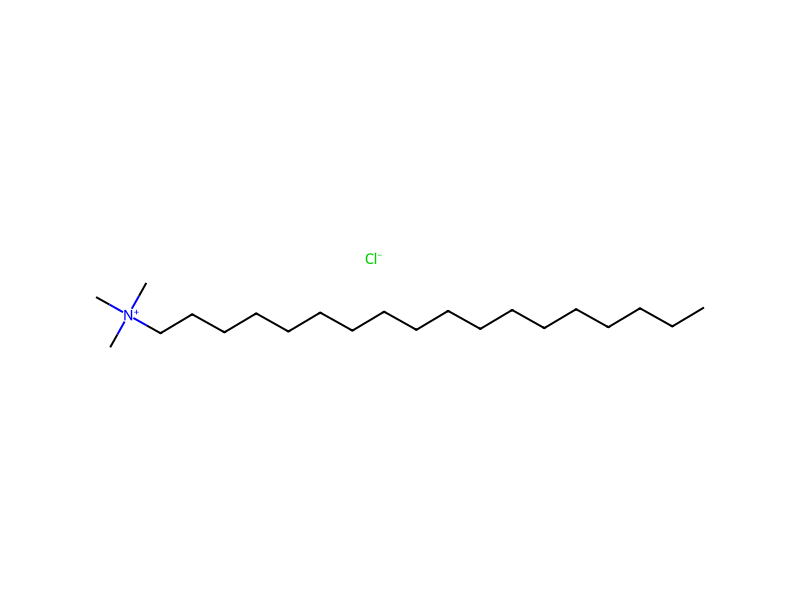
Basic information
- CAS
112-03-8- Standard SMILES
CCCCCCCCCCCCCCCCCC[N+](C)(C)C.[Cl-]- InChIKey
VBIIFPGSPJYLRR-UHFFFAOYSA-M- Molecular formula
- C21H46N.Cl
- Average molar mass
- 348 g/mol
Overview
Stearyltrimethylammonium chloride is an organic molecular entity.
Names & identifiers
- Preferred name
- Stearyltrimethylammonium chloride
- IUPAC
- trimethyl(octadecyl)azanium chloride
- English name
- Trimethylstearylammonium Chloride
- Molecular formula
- C21H46ClN
- Molecular weight
- 348.06
Names & synonyms
112-03-8Trimethylstearylammonium chlorideStacCation ABAliquat 7Stearyltrimethylammonium chlorideNissan cation ABQuaternium-10Arquad 18Stearyl trimethyl ammonium chlorideArquad 18-50Monostearyl trimethyl ammonium chloride
Show more names
1831Steartrimonium chlorideOTACOctadecy trimethyl ammonium chlorideTC-8
N,N,N-Trimethyl-1-octadecanaminium chlorideCZ70647U92trimethyl(octadecyl)azanium chlorideRefChem:871332N,N,N-trimethyloctadecan-1-aminium chlorideTrimethyloctadecylammonium chlorideOCTADECYLTRIMETHYLAMMONIUM CHLORIDE1-Octadecanaminium, N,N,N-trimethyl-, chloride
Database identifiers
- CAS
112-03-8- PubChem CID
- 8155
- DTXSID
DTXSID1026902- ChEMBL
CHEMBL118745- ChEBI
CHEBI:81710- UNII
- CZ70647U92
- EC Number
- 203-929-1
Properties
Computed structural propertiesFilling in
- Topological polar surface area
- 0 Ų
- Hydrogen bond donors
- 0
- Hydrogen bond acceptors
- 1
- Rotatable bonds
- 17
- Heavy atoms
- 23
- Formal charge
- 0
- Complexity
- 204
Experimental & physicochemical properties
Cosmetics
Cosmetic ingredients (Steartrimonium Chloride) -> CIR (Cosmetic Ingredient Review)
Preservative; Hair conditioning
Physical DescriptionCBI; Large Crystals
Physicochemical properties
- Boiling point
- 249 ℃[at · 249℃[at 101 325 Pa]
- Density
- 0.91 · 0.91[at 20℃]
- vapor pressure
- 0 Pa · 0Pa at 25℃
- storage temp.
- Inert atmosphere,Room Temperature
- form
- powder to crystal
- color
- White
- PH
- 5.5 · 5.5-8.5 (20℃, 0.05% in H2O)
- Water Solubility
- 1.759 mg/L · Soluble in water 1.759 mg/L @ 25°C.
- λmax
- 225 nm · λ: 225 nm Amax: ≤0.08λ: 260 nm Amax: ≤0.06λ: 280 nm Amax: ≤0.04λ: 340 nm Amax: ≤0.02
- BRN
- 3917847 · 3917847
Safety & regulation
Safety information is for reference only and does not replace the supplier’s Safety Data Sheet (SDS), applicable regulations, or professional assessment.
GHS classification
GHS Classification
This chemical does not meet GHS hazard criteria for 3.7% (10 of 268) of reports.
Danger
H302 (88.1%): Harmful if swallowed [Warning Acute toxicity, oral]
P260, P262, P264, P264+P265, P270, P273, P280, P301+P317, P301+P330+P331, P302+P352, P302+P361+P354, P304+P340, P305+P354+P338, P316, P317, P321, P330, P361+P364, P362+P364, P363, P391, P405, and P501 (click each P-code to see the statement)
Aggregated GHS information provided per 268 reports by companies from 19 notifications to the ECHA C&L Inventory. Each notification may be associated with multiple companies.
Warning
Hazard information
Regulatory Information
Chemical: 1-Octadecanaminium, N,N,N-trimethyl-, chloride
1-Octadecanaminium, N,N,N-trimethyl-, chloride (1:1) is listed on the EPA's Chemical Data Reporting (CDR) system. Manufacturers and importers of 1-Octadecanaminium, N,N,N-trimethyl-, chloride (1:1) are required to report information about their production and use of this chemical to the EPA under the Toxic Substances Control Act (TSCA). (40 eCFR Part 711)
Status: Active Update: 21-12-2021 https://echa.europa.eu/registration-dossier/-/registered-dossier/10127
Octadecyltrimethylammonium chloride: Does not have an individual approval but may be used as a component in a product covered by a group standard. It is not approved for use as a chemical in its own right.
Other Safety InformationIMAP assessments - Cationic surfactants: Human health tier II assessment
Hazard Classes and Categories
Acute Tox. 4 (88.1%)
Acute toxicity - category 4
Acute toxicity (Oral) - Category 4
Toxicology
Chemistry & industry
Pharmacology
Metabolism/MetabolitesNitrosamines can enter the body via ingestion, inhalation, or dermal contact. Once in the body, nitrosamines are metabolized by cytochrome P-450 enzymes, which essentially activates them into carcinogens. (A2878, A2879)
Uses & manufacturing
Uses
CIR ingredient: Steartrimonium Chloride
Quaternium-10 is a quaternary ammonium salt found in numerous cosmetics. (L1890)
U.S. Production2023: <75,000 lb
Household ProductsInformation on 43 consumer products that contain Steartrimonium chloride in the following categories is provided:
Use ClassificationCosmetics -> Preservative; Hair conditioning
General Manufacturing Information1-Octadecanaminium, N,N,N-trimethyl-, chloride (1:1): ACTIVE
Applications
UsesEmulsion (main components are high polymeric and cyclic silicones); forms a protective film to coat split ends; conditioning agent for rinses and shampoos; glazing agent for hair.
Upstream & downstream products
Upstream raw materials
Related reactions
12 records


Compound notes
Loading…