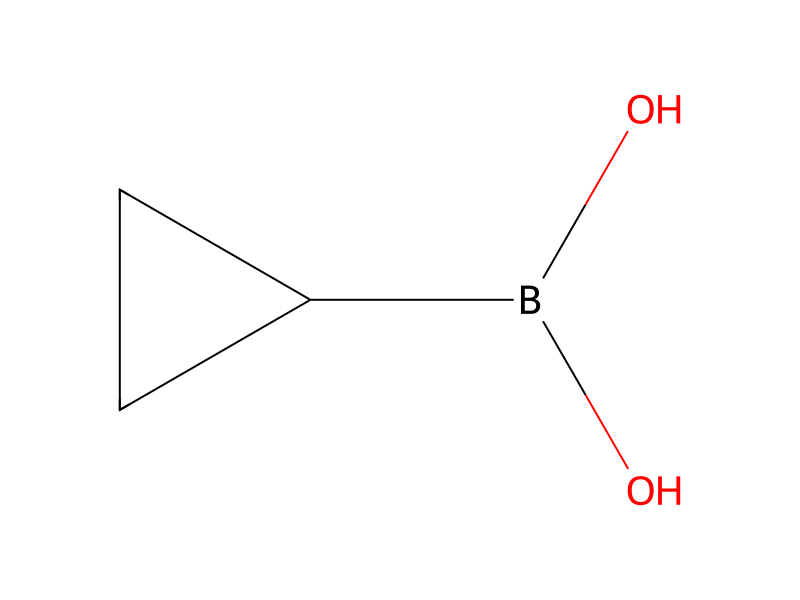
A mixture of 2,4-dichloro-7H-pyrrolo[2,3-d]pyrimidine (210 mg, 1.12 mmol) in methylene chloride (4.86 mL) was treated with triethylamine (314 μL, 2.26 mmol), copper(II) acetate monohydrate (232 mg, 1.16 mmol) and cyclopropylboronic acid (95.9 mg, 1.12 mmol). The reaction was stirred at room temperature overnight. At this time, the reaction was warmed to 70° C. for 3 h. At this time, the reaction was treated with additional triethylamine (314 μL, 2.26 mmol), copper(II) acetate monohydrate (232 mg, 1.16 mmol) and cyclopropylboronic acid (95.9 mg, 1.12 mmol). The reaction was allowed to stir overnight at room temperature. At this time, the reaction was filtered through a plug of Celite®, washing with a 10% methanol/methylene chloride solution. The filtrate was concentrated in vacuo onto silica gel. Flash chromatography (24 g silica gel column, 2-20% ethyl acetate/hexanes) afforded 2,4-dichloro-7-cyclopropyl-7H-pyrrolo[2,3-d]pyrimidine as an off-white solid (70 mg, 27.5%). 1H NMR (300 MHz, DMSO-d6) δ ppm 0.82-1.28 (m, 4H) 3.62 (s, 1H) 6.66 (d, J=3.58 Hz, 1H) 7.73 (d, J=3.39 Hz, 1H). LC-MS calcd. for C9H8Cl2N3 [(M+H)+] 228, obsd. 227.9.