HomeMCPWorkbenchSkills
HomeWorkbenchNotificationsMe
llms.txt · MCP GuidePrivacy Policy · Terms of Service · Supportv1.8.0
  1. Home
  2. /Reaction

1,8-Diazabicyclo(5.4.0)undec-7-ene → {1-[4-(7-carbamoyl-4-oxo-2-phenyl-4H-chromen-3-yl)-phenyl]-cyclobutyl}-carbamic acid tert-butyl ester

HRID 1037198
Notes
Print preview

Reaction equation

HRID 1037198 reaction equation
[C:1]([O:5][C:6](=[O:36])[NH:7][C:8]1([C:12]2[CH:17]=[CH:16][C:15]([C:18]3[C:27](=[O:28])[C:26]4[C:21](=[CH:22][C:23](Br)=[CH:24][CH:25]=4)[O:20][C:19]=3[C:30]3[CH:35]=[CH:34][CH:33]=[CH:32][CH:31]=3)=[CH:14][CH:13]=2)[CH2:11][CH2:10][CH2:9]1)([CH3:4])([CH3:3])[CH3:2].Cl.N[OH:39].F[B-](F)(F)F.C(P(C(C)(C)C)C(C)(C)C)(C)(C)C.C1C[CH2:67][N:66]2C(=NCCC2)CC1.CCN(C(C)C)C(C)C>O1CCOCC1.CC1C(P(C2C([CH2-])=CC=CC=2)C2C(C)=CC=CC=2)=CC=CC=1.CC1C(P(C2C([CH2-])=CC=CC=2)C2C(C)=CC=CC=2)=CC=CC=1.CC(O)=O.CC(O)=O.[Pd].[Pd].[C-]#[O+].[C-]#[O+].[C-]#[O+].[C-]#[O+].[C-]#[O+].[C-]#[O+].[Mo]>[C:1]([O:5][C:6](=[O:36])[NH:7][C:8]1([C:12]2[CH:17]=[CH:16][C:15]([C:18]3[C:27](=[O:28])[C:26]4[C:21](=[CH:22][C:23]([C:67](=[O:39])[NH2:66])=[CH:24][CH:25]=4)[O:20][C:19]=3[C:30]3[CH:35]=[CH:34][CH:33]=[CH:32][CH:31]=3)=[CH:14][CH:13]=2)[CH2:11][CH2:10][CH2:9]1)([CH3:4])([CH3:3])[CH3:2]
ParticipantsConditionsProcedureWorkupSources & evidenceReaction notes

Participants

9

Reactant 5

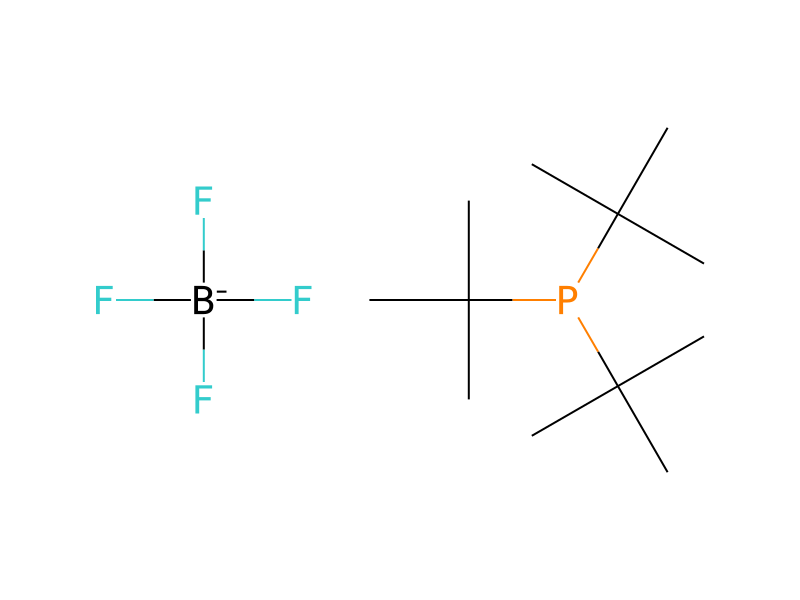
HCID 811841,8-Diazabicyclo(5.4.0)undec-7-eneHCID 81531DiisopropylethylamineHCID 443297Hydroxyamine hydrochlorideHCID 44558591Tri-t-butylphosphine fluoroborateHCID 67067747{1-[4-(7-Bromo-4-oxo-2-phenyl-4H-chromen-3-yl)-phenyl]-cyclobutyl}-carbamic acid tert-butyl ester

Product 1

HCID 67067692
{1-[4-(7-carbamoyl-4-oxo-2-phenyl-4H-chromen-3-yl)-phenyl]-cyclobutyl}-carbamic acid tert-butyl ester
Yield 60.1%

Reagents, catalysts & solvents 3

HCID 98885Molybdenum carbonyl (Mo(CO)6)CatalystHCID 11104995trans-Bis(acetato)bis[2-[bis(2-methylphenyl)phosphino]benzyl]dipalladium(II)CatalystHCID 312751,4-DioxaneSolvent

Conditions

Temperature
150 °C

Procedure

To a solution of {1-[4-(7-bromo-4-oxo-2-phenyl-4H-chromen-3-yl)-phenyl]-cyclobutyl}-carbamic acid tert-butyl ester (81 mg, 0.15 mmol) in 1,4-dioxane (3.0 mL) in a microwave vial was added hydroxylamine hydrochloride (21 mg, 0.3 mmol), molybdenum hexacarbonyl (20 mg, 0.075 mmol), Herrmann's catalyst (7 mg, 0.0075 mmol) and tri-tert-butylphosphine tetrafluoroborate (4 mg, 0.015 mmol), followed by DBU (22 μL, 0.15 mmol) and DIPEA (51 μL, 0.30 mmol). The vial was sealed, evacuated and flushed twice with nitrogen. The mixture was heated in a microwave at 150° C. for 30 min. The resulting mixture was partitioned between ethyl acetate (40 mL) and water (20 mL) and the phases were separated. The organic layer was washed with brine (20 mL), dried (Na2SO4), filtered and concentrated in vacuo. The resulting residue was subjected to flash chromatography (SiO2, gradient 50-60% ethyl acetate in cyclohexane) to afford the title compound as a white solid (46 mg, 60%). LCMS (Method B): RT=4.57 min, [M+H]+=511.

Workup

  1. customThe vial was sealed
  2. customevacuated
  3. customflushed twice with nitrogen
  4. customThe resulting mixture was partitioned between ethyl acetate (40 mL) and water (20 mL)
  5. customthe phases were separated
  6. washThe organic layer was washed with brine (20 mL)
  7. dry with materialdried (Na2SO4)
  8. filtrationfiltered
  9. concentrationconcentrated in vacuo

Sources & evidence

ORD record
ord-9f8490df424246668450a1fb5905a0f5
Source dataset
uspto-grants-2013_10
DOI
10.6084/m9.figshare.5104873.v1
Patent number
US08546376B2

Reaction notes

Loading…

On this pageParticipantsConditionsProcedureWorkupSources & evidenceReaction notes