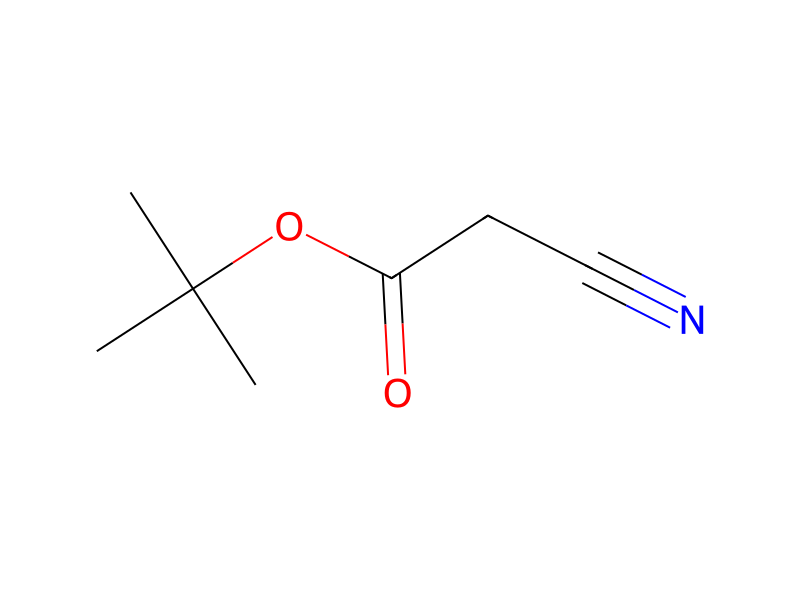
Cl[C:2]1[C:7]([C:8]([F:11])([F:10])[F:9])=[CH:6][C:5]([N+:12]([O-:14])=[O:13])=[CH:4][N:3]=1.C([O-])([O-])=O.[K+].[K+].[C:21]([CH2:23][C:24]([O:26][C:27]([CH3:30])([CH3:29])[CH3:28])=[O:25])#[N:22].CC(=O)OCC>C1COCC1>[C:21]([CH:23]([C:2]1[C:7]([C:8]([F:11])([F:10])[F:9])=[CH:6][C:5]([N+:12]([O-:14])=[O:13])=[CH:4][N:3]=1)[C:24]([O:26][C:27]([CH3:30])([CH3:29])[CH3:28])=[O:25])#[N:22]To a solution of 2-chloro-5-nitro-3-(trifluoromethyl)pyridine (5 g, 22.07 mmol) and K2CO3 (6.10 g, 44.1 mmol) in THF (150 mL) was added tert-butyl 2-cyanoacetate (3.74 g, 26.5 mmol). The resulting mixture was stirred at 70° C. overnight under N2. After TLC analysis (PE/EA=10/1) showed the starting material was consumed, the solvent was removed in vacuo. The residue was dissolved in EA (100 mL) and washed with H2O (50 mL) and brine (50 mL). The organic layer was dried over Na2SO4, filtered and concentrated to yield a solid of tert-butyl 2-cyano-2-(5-nitro-3-(trifluoromethyl)pyridin-2-yl)acetate (7 g, 21.13 mmol, 96% yield): 1H NMR (400 MHz, CD3OD) δ 9.08 (s, 1H), 8.59 (br. s., 1H), 4.63 (br. s., 1H), 1.55 (s, 9H); ES-LCMS m/z: 332.1 (M+H).