Reaction equation

[Cl-].[CH:2]1[C:7](N)=[CH:6][C:5]2[C:9]([O:11][C:12]3([C:22]4[CH:23]=[CH:24][C:25]([OH:27])=[CH:26][C:21]=4[O:20][C:14]4[CH:15]=[C:16]([OH:19])[CH:17]=[CH:18][C:13]3=4)[C:4]=2[CH:3]=1)=[O:10].CO.C1C=CC=CC=1>C1COCC1.N1C=CC=CC=1>[CH:2]1[CH:7]=[CH:6][C:5]([C:9]([OH:11])=[O:10])=[C:4]([C:12]2[C:13]3[CH:18]=[CH:17][C:16]([OH:19])=[CH:15][C:14]=3[O:20][C:21]3[C:22]=2[CH:23]=[CH:24][C:25]([CH:26]=3)=[O:27])[CH:3]=1Participants
Reactant 3


Product 1
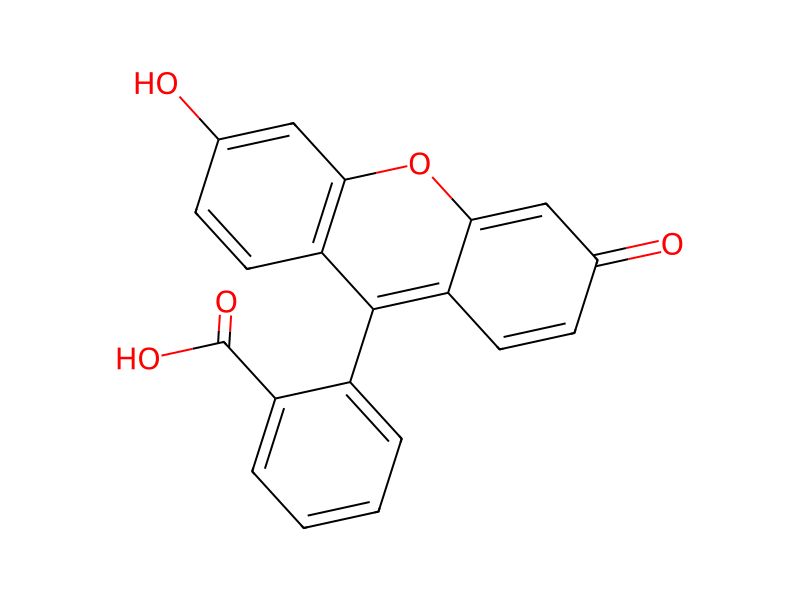
Reagents, catalysts & solvents 2


Procedure
A solution of myristoryl chloride (2.18 g, 8.83 mmol) in THF was added to a solution of fluoresceinamine-isomer 1 from Aldrich Chemical Co. (3.07 g, 8.85 mmol) in dry pyridine (dried over basic alumina) dropwise with stirring at room temperature over a 12 hour period. TLC on silica with 20% MeOH/benzene showed conversion to a less polar product. The reaction was poured into ice water and the solid precipitate isolated by filtration to give 4 g of solid orange material Column chromatography with 10% MeOH/benzene afforded 500 mg of the pure product as an orange solid: mp 185-190° C.; 1H NMR (CDCl3)δ 0.88 (t, 3H), 1.27 (m, 20H), 1.74 (m, 2H), 2.42 (t, 2H), 6.54-8.32 (m, 9H); 13C NMR (CDCl3) δ 13.05, 22.27, 25.34, 28.90, 29.01, 29.17, 29.31, 31.61, 36.65, 101.00, 110.25, 112.43, 114.93, 124.41, 126.58, 127.86, 128.77, 140.41, 147.00, 152.89, 160.28, 169.96, 173.65; MS (FAB) m/e (rel intensity) 558 (10, M+1), 402 (14.7), 388 (14.2), 374 (12.5), 348 (28.1), 302 (35.2), 213 (36.4), 165 (36.4), 133 (50). The properties of 3 are in agreement with those described for the commercially available material from Molecular Probes, Inc. ##STR28##
Workup
- customthe solid precipitate isolated by filtration
Sources & evidence
- ORD record
- ord-4698824a0d904215ba2c4e8ab6e12e8b
- Source dataset
- uspto-grants-1991_04
- Patent number
- US05004565
Linked notes
Loading…