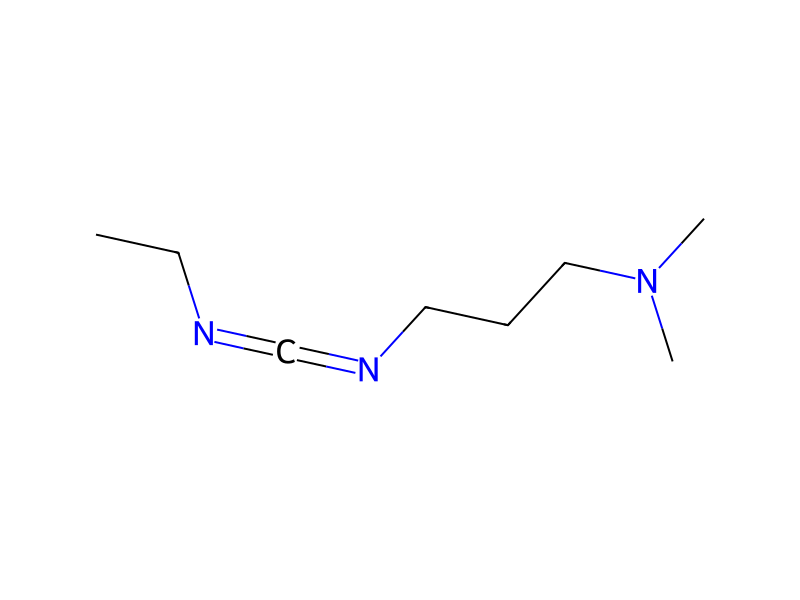
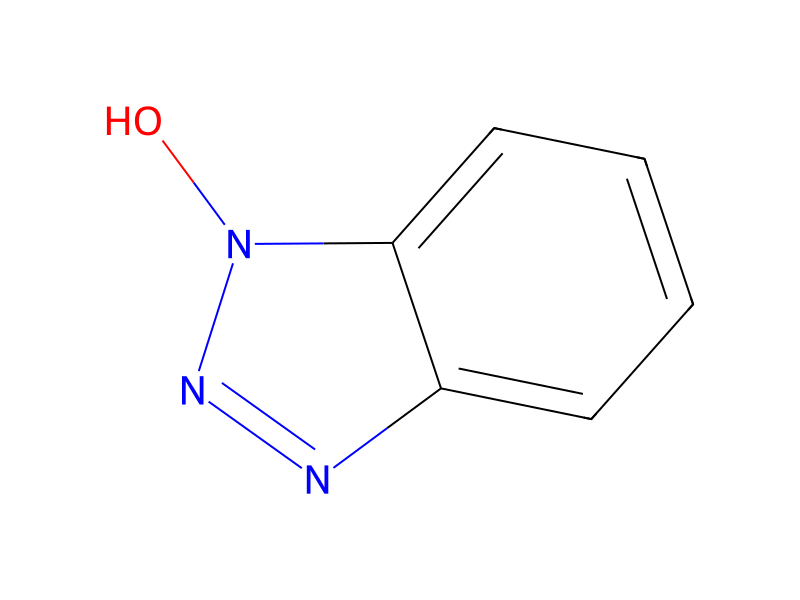
[CH3:1][N:2]1[C:6](=[O:7])[CH2:5][N:4]([CH2:8][C:9]2[CH:17]=[CH:16][C:12]([C:13]([OH:15])=O)=[CH:11][CH:10]=2)[C:3]1=[O:18].[CH3:19][CH2:20][N:21]=[C:22]=[N:23][CH2:24][CH2:25][CH2:26][N:27](C)C.[CH:30]1[CH:31]=[CH:32]C2N(O)N=NC=2[CH:35]=1.[CH3:40][N:41]1CCOCC1>CN(C=O)C>[CH3:1][N:2]1[C:6](=[O:7])[CH2:5][N:4]([CH2:8][C:9]2[CH:10]=[CH:11][C:12]([C:13]([NH:27][C:26]3[CH:35]=[CH:30][C:31]([CH3:32])=[C:24]([NH:23][C:22]4[N:21]=[CH:20][CH:19]=[CH:40][N:41]=4)[CH:25]=3)=[O:15])=[CH:16][CH:17]=2)[C:3]1=[O:18]To a solution of Example H (200 mg, 0.81 mmol) in DMF (10 mL) were added EDCI (200 mg, 1.0 mmol), HOBt (150 mg, 1.5 mmol), NMM (0.5 mL) and Reagent BB (300 mg, 1.5 mmol). After being stirred at RT overnight, the solvent was removed under vacuum. The resulting residue was purified by preparative HPLC to yield pure 4-((3-methyl-2,4-dioxoimidazolidin-1-yl)methyl)-N-(4-methyl-3-(pyrimidin-2-ylamino)phenyl)benzamide (20 mg). 1H NMR (DMSO-d) δ:10.14 (s, 1H), 8.87 (s, 1H),8.35 (d, J=4.8 Hz, 2H), 7.91 (d, J=8 Hz, 2 H), 7.84 (d, J=1.6 Hz, 1H), 7.45 (dd, J=8.4, 2.0 Hz, 1H), 7.41 (d, J=7.7 Hz, 2H), 7.15 (d, J=8.0 Hz, 1H), 6.75 (t, J=4.8 Hz, 1H), 4.56 (s, 2H), 3.89 (s, 2H), 2.87 (s, 3H), 2.15 (s, 3H); MS (ESI) m/e: 431 (M++1).