HomeMCPWorkbenchSkills
HomeWorkbenchNotificationsMe
llms.txt · MCP GuidePrivacy Policy · Terms of Service · Supportv1.8.0
  1. Home
  2. /Reaction

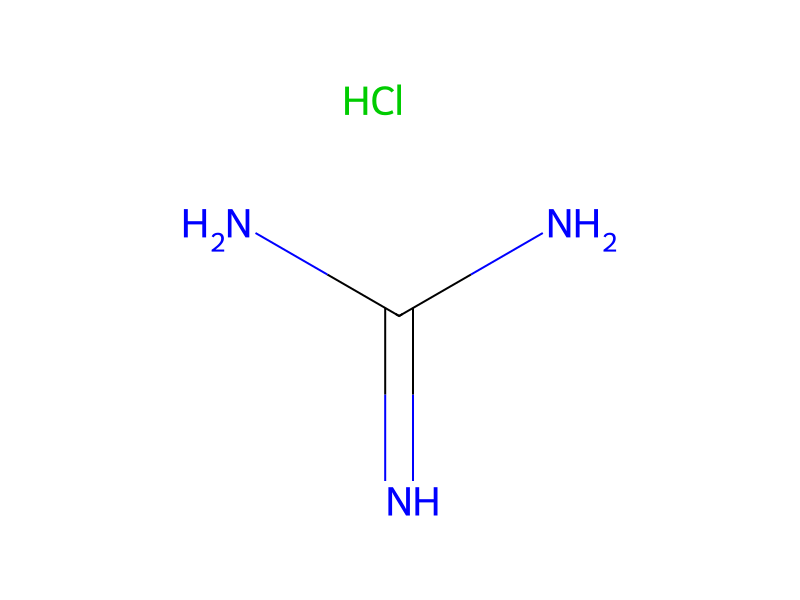
Guanidine Hydrochloride → HCID 178480038, compound

HRID 1184670
Notes
Print preview

Reaction equation

HRID 1184670 reaction equation
C(Cl)(=O)C(Cl)=O.[CH3:7][N:8]1[CH:12]=[C:11]([C:13]2[CH:22]=[CH:21][CH:20]=[C:19]3[C:14]=2[CH:15]=[CH:16][C:17]([C:23]([OH:25])=O)=[CH:18]3)[CH:10]=[N:9]1.Cl.[NH2:27][C:28]([NH2:30])=[NH:29].[OH-].[Na+]>ClCCl.CN(C)C=O>[CH3:7][N:8]1[CH:12]=[C:11]([C:13]2[CH:22]=[CH:21][CH:20]=[C:19]3[C:14]=2[CH:15]=[CH:16][C:17]([C:23]([NH:29][C:28]([NH2:30])=[NH:27])=[O:25])=[CH:18]3)[CH:10]=[N:9]1
ParticipantsProcedureWorkupSources & evidenceReaction notes

Participants

7

Reactant 4

HCID 5742Guanidine HydrochlorideHCID 14798Sodium HydroxideHCID 65578Oxalyl chlorideHCID 685128445-(1-methyl-1H-pyrazol-4-yl)-2-naphthoic acid

Product 1

HCID 178480038HCID 178480038, compoundYield 83.2%

Reagents, catalysts & solvents 2

HCID 6228
Dimethylformamide
Catalyst
HCID 6344DichloromethaneSolvent2×

Procedure

Oxalyl chloride (1.1 mL, 13 mmol) was added to a solution of 5-(1-methyl-1H-pyrazol-4-yl)-2-naphthoic-acid (1.19 g, 4.71 mmol) in anhydrous dichloromethane (200 mL (which was added in portions during the reaction to effect dissolution)) containing dimethylformamide (2 drops) under nitrogen and the mixture was stirred at room temperature for 4.25 hours. The reaction mixture was then heated for 1 hour at 40° C., before being concentrated under reduced pressure. The resulting crude acid chloride was suspended in anhydrous tetrahydrofuran (50 mL) and this mixture was added dropwise to a solution of guanidine hydrochloride (2.09 g, 21.9 mmol) in 2M aqueous sodium hydroxide (15 mL, 30 mmol) and the reaction mixture was then stirred for 30 minutes. The organic phase was separated, and the aqueous phase was extracted with chloroform (3×30 mL) followed by ethyl acetate (3×30 mL). The combined organic extracts were washed sequentially with 1M aqueous sodium hydroxide (60 mL) and water (40 mL), then dried Na2SO4) and concentrated in vacuo to give a glassy solid (1.45 g after dying under high vacuum). This solid was dissolved in dichloromethane which was then allowed to evaporate slowly to give 5-(1-methyl-1H-pyrazol-4-yl)-2-naphthoylguanidine as a yellow solid (1.15 g, 83%).

Workup

  1. additionwas added in portions during the reaction to effect dissolution))
  2. temperatureThe reaction mixture was then heated for 1 hour at 40° C.
  3. concentrationbefore being concentrated under reduced pressure
  4. stirringthe reaction mixture was then stirred for 30 minutes
  5. customThe organic phase was separated
  6. extractionthe aqueous phase was extracted with chloroform (3×30 mL)
  7. washThe combined organic extracts were washed sequentially with 1M aqueous sodium hydroxide (60 mL) and water (40 mL)
  8. concentrationdried Na2SO4) and concentrated in vacuo
  9. customto give a glassy solid (1.45 g after dying under high vacuum)
  10. customto evaporate slowly

Sources & evidence

ORD record
ord-395a81c41308484284f170c89dc7e3f4
Source dataset
uspto-grants-2014_03
DOI
10.6084/m9.figshare.5104873.v1
Patent number
US08669280B2

Reaction notes

Loading…

On this pageParticipantsProcedureWorkupSources & evidenceReaction notes



