HomeMCPSkillsWorkbenchOpenChem
HomeWorkbenchNotificationsMe
llms.txt · skill.md · MCP GuidePrivacy Policy · Terms of Service · Supportv1.8.4
  1. Home
  2. /Reaction

Phthalimide → HCID 19899204, compound

HRID 1196630
Print

Reaction equation

N(C(OC(C)C)=O)=NC(OC(C)C)=O.O[CH2:16][CH2:17][CH:18]1[CH2:22][C:21]2[C:23]([CH3:37])=[C:24]([O:29][CH2:30][C:31]3[CH:36]=[CH:35][CH:34]=[CH:33][CH:32]=3)[C:25]([CH3:28])=[C:26]([CH3:27])[C:20]=2[O:19]1.C1(P(C2C=CC=CC=2)C2C=CC=CC=2)C=CC=CC=1.[C:57]1(=[O:67])[NH:61][C:60](=[O:62])[C:59]2=[CH:63][CH:64]=[CH:65][CH:66]=[C:58]12>O1CCCC1>[CH2:30]([O:29][C:24]1[C:25]([CH3:28])=[C:26]([CH3:27])[C:20]2[O:19][CH:18]([CH2:17][CH2:16][N:61]3[C:57](=[O:67])[C:58]4=[CH:66][CH:65]=[CH:64][CH:63]=[C:59]4[C:60]3=[O:62])[CH2:22][C:21]=2[C:23]=1[CH3:37])[C:31]1[CH:32]=[CH:33][CH:34]=[CH:35][CH:36]=1
ParticipantsProcedureWorkupSources & evidenceReaction notes

Participants

6

Reactant 4

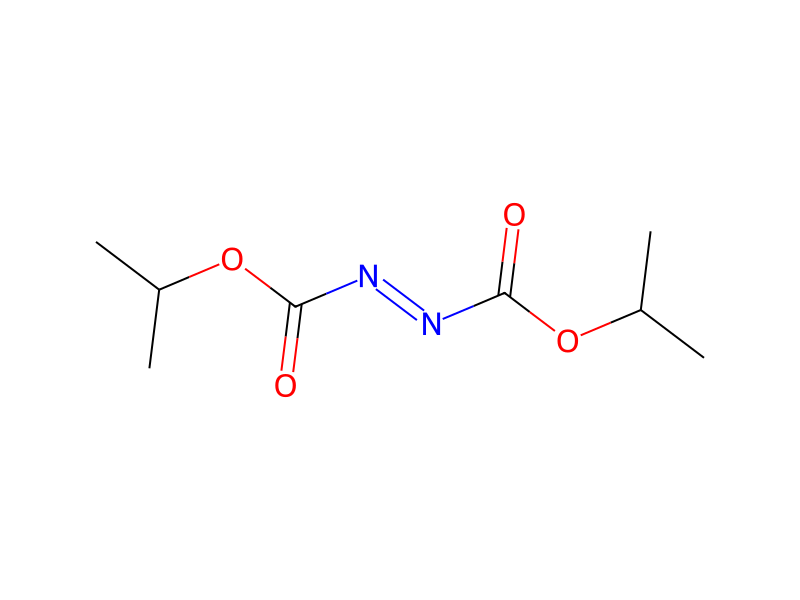
HCID 6809PhthalimideHCID 11776TriphenylphosphineHCID 75555Diisopropyl diazene-1,2-dicarboxylateHCID 21781545Schembl9851176

Product 1

HCID 19899204HCID 19899204, compoundYield 94.3%

Reagents, catalysts & solvents 1

HCID 8028
Tetrahydrofuran
Solvent

Procedure

5.7 ml of diisopropyl azodicarboxylate is added, dropwise, to a mixture of 6.0 g of 2-(RS)-(2-hydroxyethyl)-2,3-dihydro-5-benzyloxy-4,6,7-trimethylbenzofurane cold to 0° C., 7.6 g of triphenylphosphine and 3.1 g of phthalimide in 35 ml of anhydrous tetrahydrofurane. After these additions, the mixture is brought to room temperature and stirred for 2 hours. After the solvent has been evaporated, the residue is purified with chromatography column (SiO2), which produces 8.0 g of N-[2-(2,3-dihydro-5-benzyloxy-4,6,7-trimethyl-2-benzofuranyl)ethyl]phthalimide m.p. 108°-110° C.: IR(KBr): 1772, 1716 cm-1 (νO=CNC=O). The phthalimide thus obtained is solubilized in a mixture of 50 ml of tetrahydrofurane and 20 ml of absolute ethanol. 3.2 ml of hydrated hydrazine are added dropwise and the mixture is kept under reflux with stirring for 2 hours. After the mixture has been brought to room temperature the formed phthalhydrazine is filtered out, and the filtrate is concentrated to a volume of about 20 ml. The additional phthalhydrazine which forms is filtered out. After the solvent is evaporated from the filtrate, the residue is treated with ethylic ether saturated with HCL to obtain the precipitate of the hydrochloride of the product. The precipitate is filtered under a vacuum, which gives 4.0 g of a white solid. m.p. 192°-193° C.; IR (KBr): 3032 cm-1 (νNH3 +); 1H-NMR (CD3OD): δ7.5-7.2 (5H,m), 4.7 (2H,s), 3.4-2.7 (4H,m), 2.4-2.2 (2H,m), 2.2 (6H,s), 2.1 (3H,s).

Workup

  1. customis brought to room temperature
  2. customAfter the solvent has been evaporated
  3. customthe residue is purified with chromatography column (SiO2), which

Sources & evidence

ORD record
ord-c8aed519f6904e2bab700c94dd2a3d29
Source dataset
uspto-grants-1992_05
DOI
10.6084/m9.figshare.5104873.v1
Patent number
US05114966

Reaction notes

On this pageParticipantsProcedureWorkupSources & evidenceReaction notes