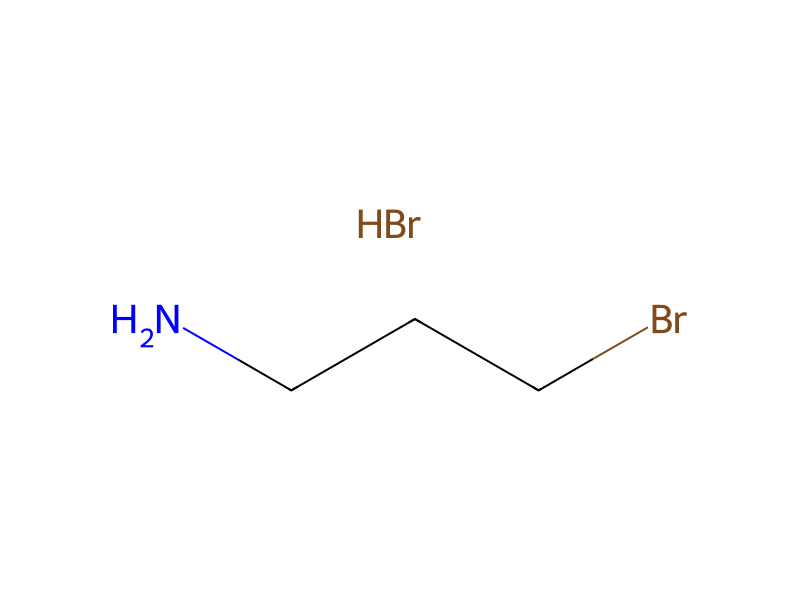
Br.[Br:2][CH2:3][CH2:4][CH2:5][NH2:6].C(N(CC)CC)C.[C:14]1([CH:20]([C:24]2[CH:29]=[CH:28][CH:27]=[CH:26][CH:25]=2)[C:21](Cl)=[O:22])[CH:19]=[CH:18][CH:17]=[CH:16][CH:15]=1>C(Cl)Cl>[Br:2][CH2:3][CH2:4][CH2:5][NH:6][C:21](=[O:22])[CH:20]([C:14]1[CH:19]=[CH:18][CH:17]=[CH:16][CH:15]=1)[C:24]1[CH:29]=[CH:28][CH:27]=[CH:26][CH:25]=1To a stirred mixture of 3-bromopropylamine hydrobromide (2.91 g, 13.3 mmol) in 10 mL of CH2Cl2 was added 2.8 mL of triethylamine (20.0 mmol). The reaction mixture was stirred at room temperature for 10 minutes, followed by addition of diphenyl acetyl chloride (2.56 g, 11.1 mmol) and triethylamine (2.8 mL, 20 mmol) in CH2Cl2 (10 mL). The reaction mixture was stirred for 40 minutes at room temperature and then diluted with 200 mL of CH2Cl2. The solution was washed with aqueous 0.5 N HCl (100 mL×3), water (50 mL), NaHCO3 (sat, 100 mL) and NaCl (sat), dried over MgSO4. Removal of solvent gave the crude product as a light yellow solid that was used in the next step without further purification (3.33 g, 91%): 1H NMR (400 MHz, CDCl3) δ 7.56–7.45 (m, 10H), 5.88–5.69 (br, 1H), 4.92 (s, 1H), 3.47–3.39 (m, 2H), 3.35 (t, 2H, J=6.4 Hz), 2.16–1.98 (m, 2H).