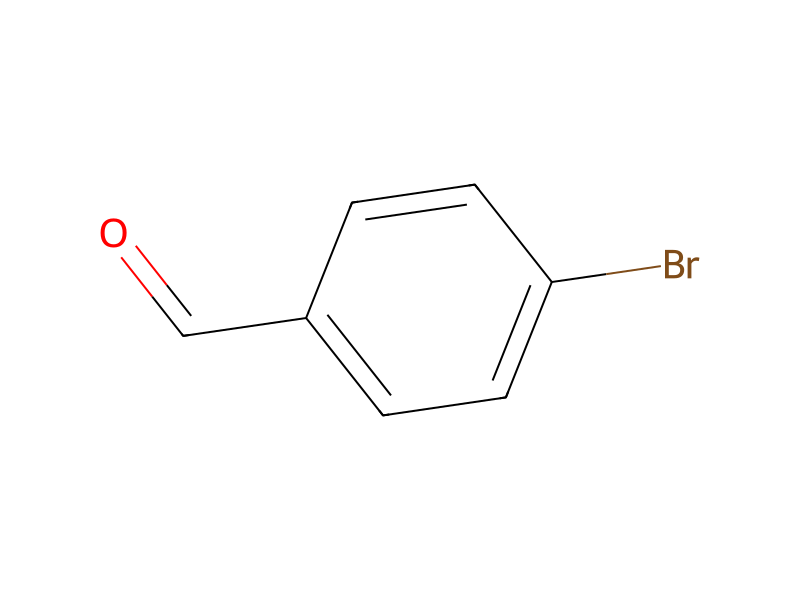
Reaction equation

Br[C:2]1[CH:9]=[CH:8][C:5]([CH:6]=[O:7])=[CH:4][CH:3]=1.[S:10]1[CH:14]=[CH:13][CH:12]=[CH:11]1.C([O-])(=O)C.[K+]>CC(N(C)C)=O.C1C=CC([P]([Pd]([P](C2C=CC=CC=2)(C2C=CC=CC=2)C2C=CC=CC=2)([P](C2C=CC=CC=2)(C2C=CC=CC=2)C2C=CC=CC=2)[P](C2C=CC=CC=2)(C2C=CC=CC=2)C2C=CC=CC=2)(C2C=CC=CC=2)C2C=CC=CC=2)=CC=1>[S:10]1[CH:14]=[CH:13][CH:12]=[C:11]1[C:2]1[CH:9]=[CH:8][C:5]([CH:6]=[O:7])=[CH:4][CH:3]=1Participants
Reactant 3


Product 1

Reagents, catalysts & solvents 2


Conditions
- Temperature
- 150 °C
Procedure
3.7 g (20 mmol) of 4-bromobenzaldehyde, 9.5 ml (120 mmol) of thiophene, 2.94 g (30 mmol) of potassium acetate and 1.16 g (1 mmol) of tetrakis(triphenylphosphine)palladium (Fluka, Buchs, Switzerland) in 50 ml of dimethylacetamide are placed in a pressure reactor and stirred at 150° C. under nitrogen for 16 hours. The reaction mixture is concentrated by evaporation; the residue is taken up in water and extracted three times with methylene chloride. After removal of the solvent, the residue is chromatographed on silica gel (hexane/ethyl acetate 4:1). The title compound is obtained in the form of a yellow solid. TLC: Rf =0.36 (hexane/ethyl acetate 4:1). HPLC20-100 : tRet =15.26. 1H-NMR (CD3OD; 200 MHz): 9.98/s (1H); 7.93 and 7.85/each d, J=9.5 (2×2H); 7.60/d, J=2.5 (1H); 7.52/d, J=5 (1H); 7.171dxd, J=2.5 and 5 (1H).
Workup
- concentrationThe reaction mixture is concentrated by evaporation
- extractionextracted three times with methylene chloride
- customAfter removal of the solvent
- customthe residue is chromatographed on silica gel (hexane/ethyl acetate 4:1)
Sources & evidence
- ORD record
- ord-716a42c32dcb4313a12d7a216b4bbe11
- Source dataset
- uspto-grants-2000_12
- Patent number
- US06166004
Linked notes
Loading…