Reaction equation
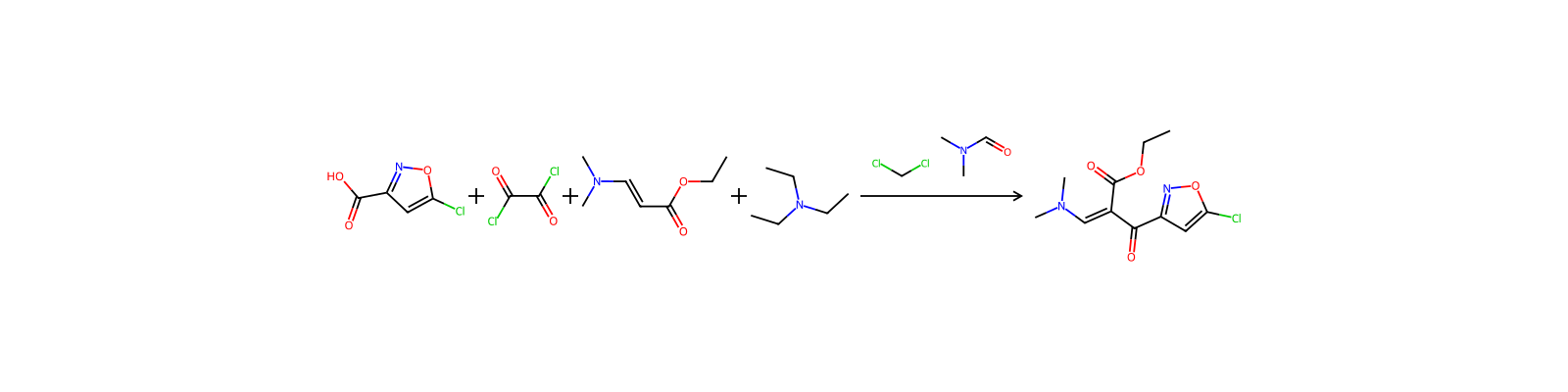
[Cl:1][C:2]1[O:6][N:5]=[C:4]([C:7]([OH:9])=O)[CH:3]=1.C(Cl)(=O)C(Cl)=O.[CH2:16]([O:18][C:19](=[O:25])[CH:20]=[CH:21][N:22]([CH3:24])[CH3:23])[CH3:17].C(N(CC)CC)C>ClCCl.CN(C)C=O>[CH2:16]([O:18][C:19](=[O:25])[C:20]([C:7]([C:4]1[CH:3]=[C:2]([Cl:1])[O:6][N:5]=1)=[O:9])=[CH:21][N:22]([CH3:24])[CH3:23])[CH3:17]Participants
Reactant 4



Product 1

Reagents, catalysts & solvents 2


Conditions
- Temperature
- 25 °C
Procedure
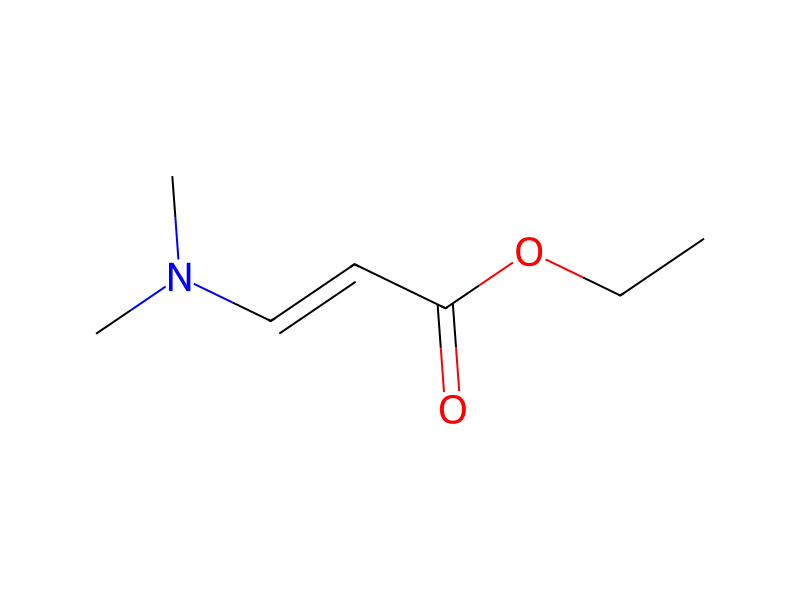
A solution of 5-chloro-isoxazole-3-carboxylic acid (791 mg, 5.43 mmol) (preparation described in WO03093250 A2) in dichloromethane (27.2 mL, 0.2M) cooled to 0° C. was treated with oxalyl chloride (0.71 mL, 8.15 mmol, 98%) followed by a few drops of N,N-dimethylformamide. The reaction was allowed to gradually warm up to 25° C. The reaction was stirred at 25° C. overnight. At this time, the reaction was concentrated in vacuo. The resulting residue was dissolved in dichloromethane and re-concentrated twice to remove residual oxalyl chloride. The residue was then dissolved in dichloromethane (16 mL, 0.34M) and treated dropwise with a solution of ethyl-3-(dimethylamino)acrylate (0.79 g, 5.51 mmol) in triethylamine (1.6 mL, 11.47 mmol). The resulting red/orange reaction solution was heated to 60° C. overnight. At this time, the reaction was cooled to 25° C. and then partitioned between water (50 mL) and dichloromethane (100 mL). The organics were then washed with water (50 mL) and a saturated aqueous sodium chloride solution (50 mL), dried over magnesium sulfate, filtered and concentrated in vacuo. Biotage chromatography (40M column, 50-60% ethyl acetate/hexanes) afforded 2-(5-chloroisoxazole-3-carbonyl)-3-dimethylamino-acrylic acid ethyl ester (300.6 mg, 20%) as a red oil.
Workup
- concentrationAt this time, the reaction was concentrated in vacuo
- dissolutionThe resulting residue was dissolved in dichloromethane
- concentrationre-concentrated twice
- customto remove residual oxalyl chloride
- dissolutionThe residue was then dissolved in dichloromethane (16 mL, 0.34M)
- temperatureThe resulting red/orange reaction solution was heated to 60° C. overnight
- temperatureAt this time, the reaction was cooled to 25° C.
- custompartitioned between water (50 mL) and dichloromethane (100 mL)
- washThe organics were then washed with water (50 mL)
- dry with materiala saturated aqueous sodium chloride solution (50 mL), dried over magnesium sulfate
- filtrationfiltered
- concentrationconcentrated in vacuo
Sources & evidence
- ORD record
- ord-57972fa04f69402a8ec056a98f60b3e7
- Source dataset
- uspto-grants-2010_06
- Patent number
- US07728029B2
Linked notes
Loading…