HomeMCPWorkbenchSkills
HomeWorkbenchNotificationsMe
llms.txt · MCP GuidePrivacy Policy · Terms of Service · Supportv1.8.0
  1. Home
  2. /Reaction

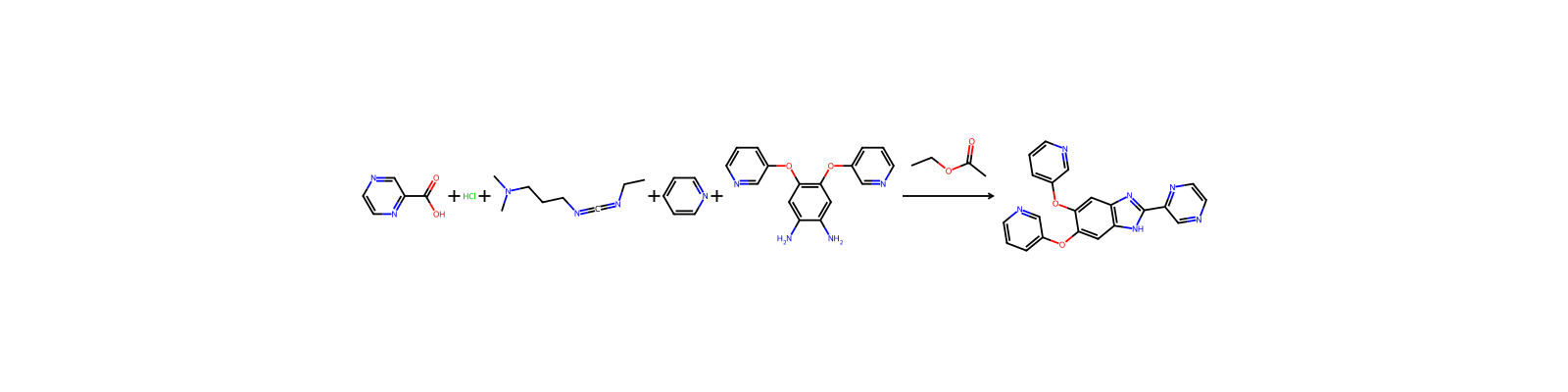
2-Pyrazinecarboxylic acid → 2-pyrazin-2-yl-5,6-bis(pyridin-3-yloxy)-1H-benzimidazole

HRID 13238
Notes
Print preview

Reaction equation

HRID 13238 reaction equation
[N:1]1[CH:6]=[CH:5][N:4]=[CH:3][C:2]=1[C:7](O)=O.Cl.CN(C)CCCN=C=NCC.N1C=CC=CC=1.[N:28]1[CH:33]=[CH:32][CH:31]=[C:30]([O:34][C:35]2[CH:36]=[C:37]([NH2:49])[C:38]([NH2:48])=[CH:39][C:40]=2[O:41][C:42]2[CH:43]=[N:44][CH:45]=[CH:46][CH:47]=2)[CH:29]=1>C(OCC)(=O)C>[N:1]1[CH:6]=[CH:5][N:4]=[CH:3][C:2]=1[C:7]1[NH:49][C:37]2[CH:36]=[C:35]([O:34][C:30]3[CH:29]=[N:28][CH:33]=[CH:32][CH:31]=3)[C:40]([O:41][C:42]3[CH:43]=[N:44][CH:45]=[CH:46][CH:47]=3)=[CH:39][C:38]=2[N:48]=1
ParticipantsProcedureWorkupSources & evidenceReaction notes

Participants

6

Reactant 4

HCID 10472-Pyrazinecarboxylic acidHCID 1049PyridineHCID 27239391,3-Propanediamine, N'-(ethylcarbonimidoyl)-N,N-dimethyl-, monohydrochlorideHCID 231454724,5-Bis(pyridin-3-yloxy)-benzene-1,2-diamine

Product 1

HCID 231451762-pyrazin-2-yl-5,6-bis(pyridin-3-yloxy)-1H-benzimidazole

Reagents, catalysts & solvents 1

HCID 8857
Ethyl Acetate
Solvent

Procedure

7.7 mg of pyrazine-2-carboxylic acid and 20 mg of 1-(3-dimethylaminopropyl)-3-ethylcarbodiimide monohydrochloride were added to a pyridine (1 ml) solution of 15 mg of 4,5-bis(pyridin-3-yloxy)-benzene-1,2-diamine obtained in Example 1 (step 3), and the reaction liquid was stirred overnight at room temperature. The reaction liquid was diluted with ethyl acetate, washed with saturated sodium bicarbonate solution, water and saturated saline in order, and dried with anhydrous sodium sulfate. The solvent was evaporated away under reduced pressure, and the resulting residue was suspended in 1 ml of phosphorus oxychloride, and the reaction liquid was stirred overnight at 100° C. Phosphorus oxychloride was evaporated away under reduced pressure, and this was diluted with ethyl acetate, washed with saturated sodium bicarbonate solution and saturated saline in order, and dried with anhydrous sodium sulfate. The solvent was evaporated away under reduced pressure, and the residue was purified through partitioning thin-layer chromatography (Kieselgel™ 60F254, Art 5744 (by Merck), chloroform/methanol=15/1+0.1% aqueous ammonia) to obtain the entitled compound as a yellow solid.
Workup

  1. customthe reaction liquid
  2. customThe reaction liquid
  3. washwashed with saturated sodium bicarbonate solution, water and saturated saline in order
  4. dry with materialdried with anhydrous sodium sulfate
  5. customThe solvent was evaporated away under reduced pressure
  6. customthe reaction liquid
  7. stirringwas stirred overnight at 100° C
  8. customPhosphorus oxychloride was evaporated away under reduced pressure
  9. additionthis was diluted with ethyl acetate
  10. washwashed with saturated sodium bicarbonate solution and saturated saline in order
  11. dry with materialdried with anhydrous sodium sulfate
  12. customThe solvent was evaporated away under reduced pressure
  13. customthe residue was purified
  14. customthrough partitioning thin-layer chromatography (Kieselgel™ 60F254, Art 5744 (by Merck), chloroform/methanol=15/1+0.1% aqueous ammonia)

Sources & evidence

ORD record
ord-8f8843c2d5024eabb85295ab8e2bd373
Source dataset
uspto-grants-2010_06
DOI
10.6084/m9.figshare.5104873.v1
Patent number
US07728025B2

Reaction notes

Loading…

On this pageParticipantsProcedureWorkupSources & evidenceReaction notes

