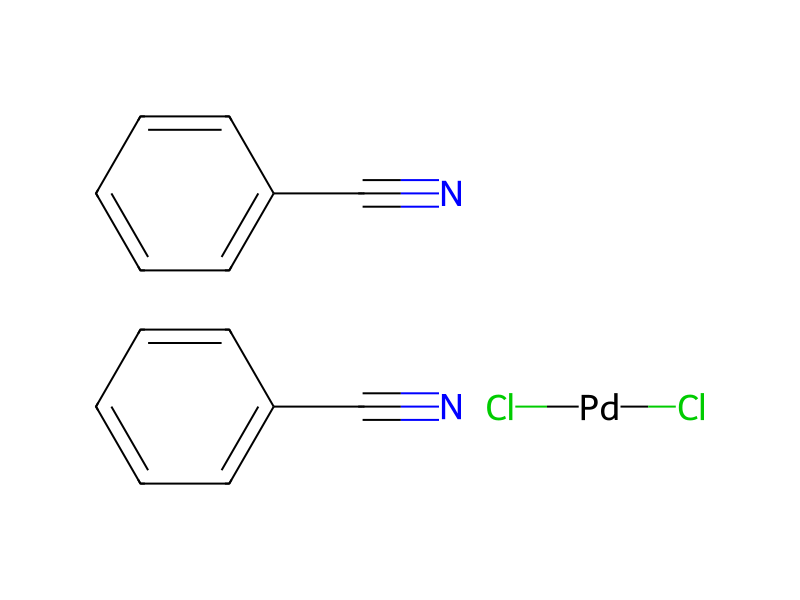
Br[C:2]1[CH:3]=[C:4]([CH:7]=[O:8])[S:5][CH:6]=1.N#N.[C:11]1([C:17]#[CH:18])[CH:16]=[CH:15][CH:14]=[CH:13][CH:12]=1>C(NC(C)C)(C)C.C1C=CC(C#N)=CC=1.C1C=CC(C#N)=CC=1.Cl[Pd]Cl.[Cu](I)I>[C:11]1([C:17]#[C:18][C:2]2[CH:3]=[C:4]([CH:7]=[O:8])[S:5][CH:6]=2)[CH:16]=[CH:15][CH:14]=[CH:13][CH:12]=1Under a N2 atmosphere, 4-bromothiophene-2-carbaldehyde (1.0 g, 5.2 mmol) was taken up in diisopropylamine (20 mL). TPP (549 mg, 2.1 mmol), bis(benzonitrile)palladium chloride ([Pd(PhCN)2]Cl2) (400 mg, 1.0 mmol), and copper iodide (199 mg, 1.0 mmol) were added. The mixture was degassed with N2 before phenylacetylene (1.15 mL, 10.4 mmol) was added, and the reaction was stirred at 70° C. for 16 h. The mixture was concentrated to a dark brown solid and chromatographed in 0-15% EtOAc in heptane to yield 4-(phenylethynyl)thiophene-2-carbaldehyde (981 mg, 88%). 1H NMR (400 MHz, CDCl3) δ (ppm): 9.93 (d, 1H), 7.88 (t, 1H), 7.85 (d, 1H), 7.53 (m, 2H), 7.38 (m, 3H).