HomeMCPWorkbenchSkills
HomeWorkbenchNotificationsMe
llms.txt · MCP GuidePrivacy Policy · Terms of Service · Supportv1.8.3
  1. Home
  2. /Reaction

Sodium Hydroxide → 3-(2-Fluoro-4-iodo-phenylamino)-thieno[3,2-c]pyridine-2-carboxylic acid (2-vinyloxy-ethoxy)-amide

HRID 1366788
Print

Reaction equation

HRID 1366788 reaction equation
C(O[C:4]([C:6]1[S:14][C:13]2[CH:12]=[CH:11][N:10]=[CH:9][C:8]=2[C:7]=1[NH:15][C:16]1[CH:21]=[CH:20][C:19]([I:22])=[CH:18][C:17]=1[F:23])=[O:5])C.[OH-].[Na+].[CH:26]([O:28][CH2:29][CH2:30][O:31][NH2:32])=[CH2:27].CCN=C=NCCCN(C)C.C1C=CC2N(O)N=NC=2C=1.CCN(C(C)C)C(C)C>C1COCC1.C(O)C>[CH:26]([O:28][CH2:29][CH2:30][O:31][NH:32][C:4]([C:6]1[S:14][C:13]2[CH:12]=[CH:11][N:10]=[CH:9][C:8]=2[C:7]=1[NH:15][C:16]1[CH:21]=[CH:20][C:19]([I:22])=[CH:18][C:17]=1[F:23])=[O:5])=[CH2:27]
ParticipantsConditionsProcedureWorkupSources & evidenceReaction notes

Participants

9

Reactant 6

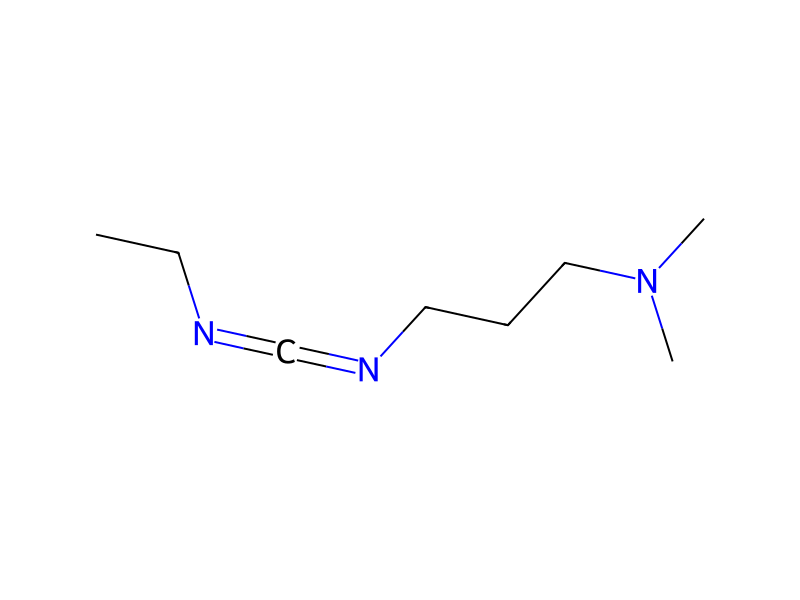
HCID 14798Sodium HydroxideHCID 159081-Ethyl-3-(3'-dimethylaminopropyl)carbodiimideHCID 757711-HydroxybenzotriazoleHCID 81531DiisopropylethylamineHCID 21867017O-(2-(Vinyloxy)ethyl)hydroxylamineHCID 597038713-(2-Fluoro-4-iodo-phenylamino)-thieno[3,2-c]pyridine-2-carboxylic acid ethyl ester

Product 1

HCID 250297783-(2-Fluoro-4-iodo-phenylamino)-thieno[3,2-c]pyridine-2-carboxylic acid (2-vinyloxy-ethoxy)-amideYield 65.1%

Reagents, catalysts & solvents 2

HCID 702EthanolSolventHCID 8028TetrahydrofuranSolvent

Conditions

Temperature
65 °C

Procedure

A mixture of 3-(2-fluoro-4-iodo-phenylamino)-thieno[3,2-c]pyridine-2-carboxylic acid ethyl ester (124 mg, 0.28 mmol), 1N aqueous NaOH solution (0.30 ml, 0.30 mmol) and ethanol (4 ml) was heated at 65° C. for 45 minutes. The reaction mixture was concentrated in vacuo then the resultant residue was azeotroped with toluene (2×2 ml) to give a solid residue. The solid residue was dissolved in anhydrous THF (4 ml) before O-(2-vinyloxy-ethyl)-hydroxylamine (58 mg, 0.56 mmol), EDCI (67 mg, 0.35 mmol), HOBt (53 mg, 0.39 mmol) and DIPEA (147 μl, 0.84 mmol) were added. After stirring for 18 hours at ambient temperature the solvent was evaporated and the resultant residue was diluted with water (20 ml), then extracted with ethyl acetate (30 ml) followed by dichloromethane (30 ml). The combined organic layers were dried over sodium sulfate, filtered and evaporated to give a yellow oil. The resultant yellow oil was purified by flash chromatography (Si-SPE, dichloromethane:methanol, gradient 100:0 to 98:2) to afford the title compound as a yellow solid (91 mg, 65%). LCMS (method B): RT=3.05 min, M+H+=500.

Workup

  1. concentrationThe reaction mixture was concentrated in vacuo
  2. customthe resultant residue was azeotroped with toluene (2×2 ml)
  3. customto give a solid residue
  4. additionwere added
  5. customwas evaporated
  6. additionthe resultant residue was diluted with water (20 ml)
  7. extractionextracted with ethyl acetate (30 ml)
  8. dry with materialThe combined organic layers were dried over sodium sulfate
  9. filtrationfiltered
  10. customevaporated
  11. customto give a yellow oil
  12. customThe resultant yellow oil was purified by flash chromatography (Si-SPE, dichloromethane:methanol, gradient 100:0 to 98:2)

Sources & evidence

ORD record
ord-a1eb52e5345e407ca997d187db18d626
Source dataset
uspto-grants-2011_02
DOI
10.6084/m9.figshare.5104873.v1
Patent number
US07893085B2

Reaction notes

On this pageParticipantsConditionsProcedureWorkupSources & evidenceReaction notes