HomeMCPWorkbenchSkills
HomeWorkbenchNotificationsMe
llms.txt · MCP GuidePrivacy Policy · Terms of Service · Supportv1.8.3
  1. Home
  2. /Reaction

Triphenylphosphine → 4-(2-Fluoro-4-nitrophenoxy)-5-methyl-6-(2-(4-methylpiperazin-1-yl)-ethoxy)pyrrolo[2,1-f][1,2,4]triazine

HRID 1393938
Print

Reaction equation

HRID 1393938 reaction equation
[F:1][C:2]1[CH:19]=[C:18]([N+:20]([O-:22])=[O:21])[CH:17]=[CH:16][C:3]=1[O:4][C:5]1[C:10]2=[C:11]([CH3:15])[C:12]([OH:14])=[CH:13][N:9]2[N:8]=[CH:7][N:6]=1.C1(P(C2C=CC=CC=2)C2C=CC=CC=2)C=CC=CC=1.[CH3:42][N:43]1[CH2:48][CH2:47][N:46]([CH2:49][CH2:50]O)[CH2:45][CH2:44]1.CC(OC(/N=N/C(OC(C)C)=O)=O)C>ClCCl.O1CCCC1>[F:1][C:2]1[CH:19]=[C:18]([N+:20]([O-:22])=[O:21])[CH:17]=[CH:16][C:3]=1[O:4][C:5]1[C:10]2=[C:11]([CH3:15])[C:12]([O:14][CH2:50][CH2:49][N:46]3[CH2:47][CH2:48][N:43]([CH3:42])[CH2:44][CH2:45]3)=[CH:13][N:9]2[N:8]=[CH:7][N:6]=1
ParticipantsConditionsProcedureWorkupSources & evidenceReaction notes

Participants

7

Reactant 4

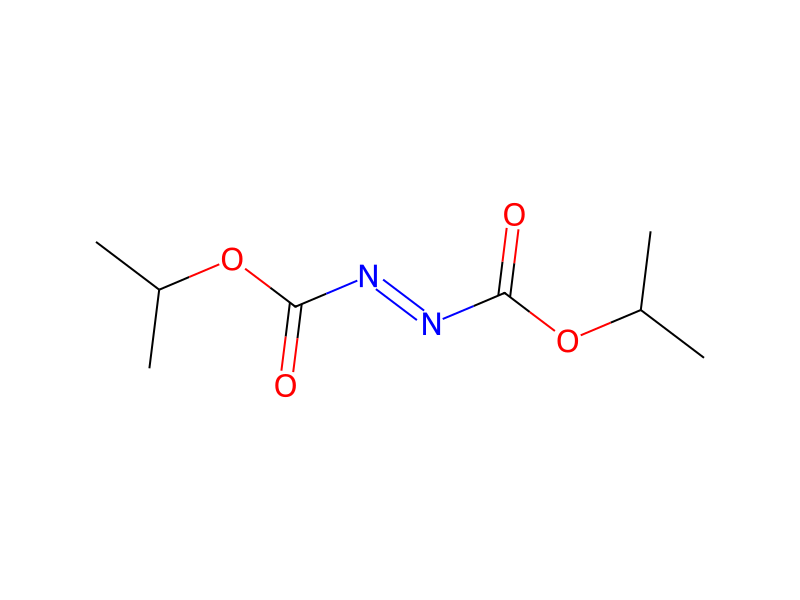
HCID 11776TriphenylphosphineHCID 2311841-(2-Hydroxyethyl)-4-methylpiperazineHCID 5363146Diisopropyl azodicarboxylateHCID 210816464-(2-Fluoro-4-nitrophenoxy)-5-methylpyrrolo[2,1-f][1,2,4]triazin-6-ol

Product 1

HCID 210816414-(2-Fluoro-4-nitrophenoxy)-5-methyl-6-(2-(4-methylpiperazin-1-yl)-ethoxy)pyrrolo[2,1-f][1,2,4]triazine
Yield 24%

Reagents, catalysts & solvents 2

HCID 6344DichloromethaneSolvent2×HCID 8028TetrahydrofuranSolvent2×

Conditions

Temperature
0 °C

Procedure

To a homogeneous mixture of 4-(2-fluoro-4-nitrophenoxy)-5-methylpyrrolo[2,1-f][1,2,4]-triazin-6-ol (100 mg, 0.33 mmol) and triphenylphosphine (129 mg, 0.49 mmol) in 4 mL of 1:1 anhydrous dichlormethane/anhydrous tetrahydrofuran, cooled to 0° C. under a nitrogen atmosphere, was added dropwise a mixture of 2-(4-methylpiperazin-1-yl)ethanol (71 mg, 0.49 mmol) and diisopropylazodicarboxylate (0.10 μL, 0.49 mmol) in 2 mL of 1:1 anhydrous dichlormethane/anhydrous tetrahydrofuran. The mixture was stirred and allowed to warm to room temperature. The reaction was stirred for twelve hours before being concentrated in vacuo. The residue was purified by preparative HPLC (YMC S10 ODS, 30×500 mm, 30 minute gradient from 50% to 90% aqueous methanol with 0.1% TFA). The appropriate fractions were combined, neutralized with saturated aqueous sodium bicarbonate, and then concentrated in vacuo to remove methanol. The mixture was extracted with chloroform (3×10 mL). The combined organic layers were washed once each with water and brine, dried over anhydrous magnesium sulfate, and concentrated in vacuo to yield the title compound (34 mg, 24%) as a yellow solid. 1H NMR (CDCl3) δ 8.20-8.10 (m, 2H), 7.82 (s, 1H), 7.58-7.52 (m, 1H), 7.49 (s, 1H), 4.16 (t, 2H, J=5.7 Hz), 2.87 (t, 2H, J=5.7 Hz), 2.80-2.40 (m, 8H), 2.45 (s, 3H), 2.31 (s, 3H); MS(ESI+) m/z 431.3 (M+H)+.

Workup

  1. additionwas added dropwise
  2. temperatureto warm to room temperature
  3. stirringThe reaction was stirred for twelve hours
  4. concentrationbefore being concentrated in vacuo
  5. customThe residue was purified by preparative HPLC (YMC S10 ODS, 30×500 mm, 30 minute gradient from 50% to 90% aqueous methanol with 0.1% TFA)
  6. concentrationconcentrated in vacuo
  7. customto remove methanol
  8. extractionThe mixture was extracted with chloroform (3×10 mL)
  9. washThe combined organic layers were washed once each with water and brine
  10. dry with materialdried over anhydrous magnesium sulfate
  11. concentrationconcentrated in vacuo

Sources & evidence

ORD record
ord-0f12102d96e04124aaca6e35ca772540
Source dataset
uspto-grants-2008_03
DOI
10.6084/m9.figshare.5104873.v1
Patent number
US07348325B2

Reaction notes

On this pageParticipantsConditionsProcedureWorkupSources & evidenceReaction notes