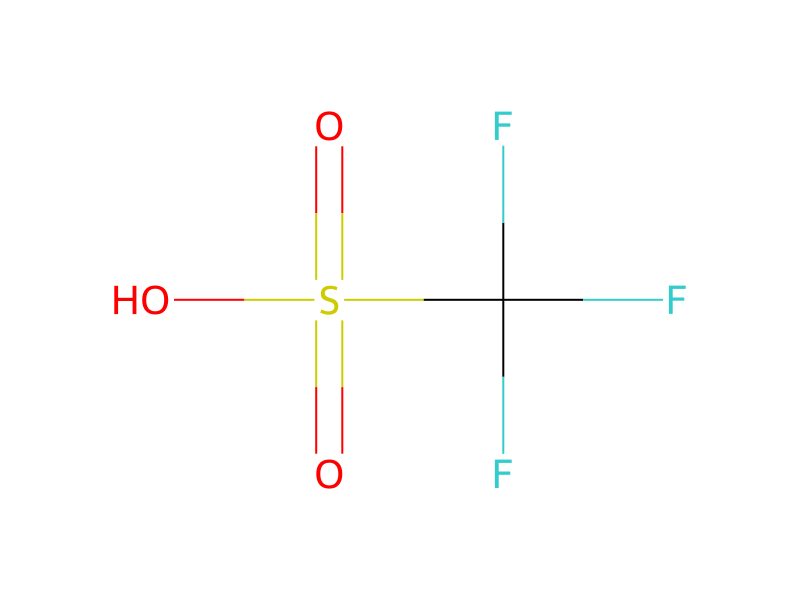
Using the general conditions described by H. Eguchi, H. Kawaguchi, S. Yoshinaga, A. Nishida, T. Nishiguchi, and S. Fujisaki (Bull. Chem. Soc. Jpn.., 1994, 67, 1918-1921), 1,3-dibromo-5,5-dimethylhydantoin (454 mg, 3.18 mmol) was added in one portion to a solution of 4-isopropyl-1-(trifluoromethyl)benzene (500 mg, 2.65 mmol) and trifluoromethanesulfonic acid (0.281 mL, 3.18 mmol) in dichloromethane (5.0 mL). The mixture was stirred in the dark at RT for 3 h. Saturated aqueous sodium bisulfite was added to the reaction mixture until the brown organic layer was decolorized. The mixture was neutralized by the addition saturated aqueous sodium bicarbonate solution (100 mL). The organic layer was separated, dried over sodium sulfate, and evaporated. The crude material was filtered through a column packed with silica gel and eluted with hexane to isolate a mixture containing the title compound.