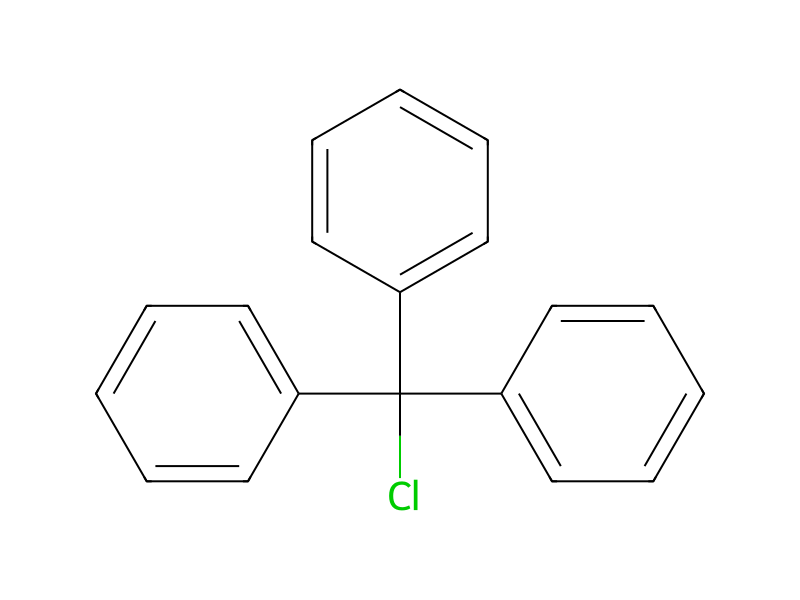
Trityl chloride → 4-(4-Bromophenyloxy)-1-trityl-imidazole
HRID 1421713
Reaction equation

[Br:1][C:2]1[CH:7]=[CH:6][C:5]([O:8][C:9]2[N:10]=[CH:11][NH:12][CH:13]=2)=[CH:4][CH:3]=1.C(N(CC)CC)C.[C:21](Cl)([C:34]1[CH:39]=[CH:38][CH:37]=[CH:36][CH:35]=1)([C:28]1[CH:33]=[CH:32][CH:31]=[CH:30][CH:29]=1)[C:22]1[CH:27]=[CH:26][CH:25]=[CH:24][CH:23]=1>CN(C=O)C>[Br:1][C:2]1[CH:3]=[CH:4][C:5]([O:8][C:9]2[N:10]=[CH:11][N:12]([C:21]([C:22]3[CH:27]=[CH:26][CH:25]=[CH:24][CH:23]=3)([C:34]3[CH:35]=[CH:36][CH:37]=[CH:38][CH:39]=3)[C:28]3[CH:29]=[CH:30][CH:31]=[CH:32][CH:33]=3)[CH:13]=2)=[CH:6][CH:7]=1Participants
5
Reactant 3


Product 1

Reagents, catalysts & solvents 1

Procedure
To a cold (0 ° C.) solution of 4-(4-bromophenyloxy)imidazole (1.2 g, 5.0 mmol) and triethylamine (0.76 mL, 5.5 mmol) in DMF (5 mL) under an atmosphere of argon, solid trityl chloride (1.46 g, 5.3 mmol) was added. The resultant mixture was stirred at room temp overnight. The product mixture was concentrated onto silica gel, loaded onto a column of silica gel, and eluted with a mixture of 9:1 chloroform and acetone. Collection and concentration of appropriate fractions provided the titled compound as white powder.