HomeMCPWorkbenchSkills
HomeWorkbenchNotificationsMe
llms.txt · MCP GuidePrivacy Policy · Terms of Service · Supportv1.8.3
  1. Home
  2. /Reaction

Cesium carbonate → 3-(4-Chloro-2-morpholin-4-yl-thiazol-5-yl)-2,6-dimethyl-8-(1-propyl-butyl)-imidazo[1,2-b]pyridazine

HRID 1432678
Print

Reaction equation

HRID 1432678 reaction equation
I[C:2]1[N:6]2[N:7]=[C:8]([CH3:18])[CH:9]=[C:10]([CH:11]([CH2:15][CH2:16][CH3:17])[CH2:12][CH2:13][CH3:14])[C:5]2=[N:4][C:3]=1[CH3:19].[Cl:20][C:21]1[N:22]=[C:23]([N:26]2[CH2:31][CH2:30][O:29][CH2:28][CH2:27]2)[S:24][CH:25]=1.C([O-])([O-])=O.[Cs+].[Cs+].C1C=CC(P(C2C=CC=CC=2)C2C=CC=CC=2)=CC=1>C1C=CC(/C=C/C(/C=C/C2C=CC=CC=2)=O)=CC=1.C1C=CC(/C=C/C(/C=C/C2C=CC=CC=2)=O)=CC=1.[Pd].CN(C=O)C>[Cl:20][C:21]1[N:22]=[C:23]([N:26]2[CH2:27][CH2:28][O:29][CH2:30][CH2:31]2)[S:24][C:25]=1[C:2]1[N:6]2[N:7]=[C:8]([CH3:18])[CH:9]=[C:10]([CH:11]([CH2:15][CH2:16][CH3:17])[CH2:12][CH2:13][CH3:14])[C:5]2=[N:4][C:3]=1[CH3:19]
ParticipantsConditionsProcedureWorkupSources & evidenceReaction notes

Participants

7

Reactant 4

HCID 10796Cesium carbonateHCID 11776TriphenylphosphineHCID 534400954-(4-Chlorothiazol-2-YL)morpholineHCID 579329063-Iodo-2,6-dimethyl-8-(1-propyl-butyl)-imidazo[1,2-b]pyridazine

Product 1

HCID 579330703-(4-Chloro-2-morpholin-4-yl-thiazol-5-yl)-2,6-dimethyl-8-(1-propyl-butyl)-imidazo[1,2-b]pyridazine

Reagents, catalysts & solvents

2
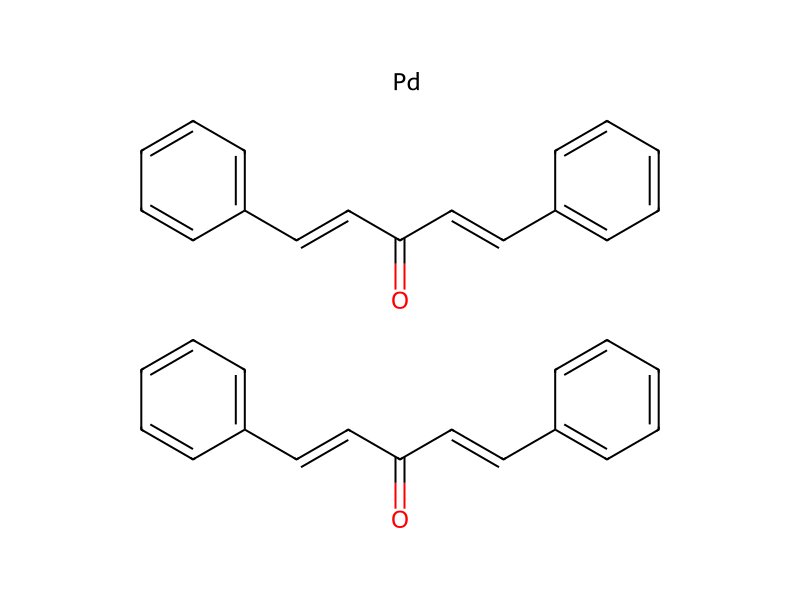
HCID 6505921(1E,4E)-1,5-diphenylpenta-1,4-dien-3-one; palladiumCatalystHCID 6228DimethylformamideSolvent

Conditions

Temperature
130 °C

Procedure

A 15 mL round bottom flask is charged with 3-iodo-2,6-dimethyl-8-(1-propyl-butyl)-imidazo[1,2-b]pyridazine (0.200 g, 0.000539 moles), 4-(4-chloro-thiazol-2-yl)-morpholine (0.165 g, 0.000808 moles), Cs2CO3 (0.361 g, 0.00108 moles, 2.0 equiv), Pd(dba)2 (0.0092 g, 0.0000161 moles, 0.03 equiv), PPh3 (0.00847 gram, 0.000323 moles, 0.060 equiv) and DMF (2.0 mL). Nitrogen is bubbled through the reaction mixture for 15 minutes; then, the reaction mixture is heated at 130° C. overnight. The next day, the reaction mixture is partitioned between Et2O and a saturated solution of NH4Cl. The aqueous layer is extracted twice more with Et2O. The organic extracts are combined, washed 2-3 times with H2O, washed once with brine, and dried over Na2SO4. The solvents are evaporated in vacuo and the crude reaction mixture is purified via silica gel chromatography. Yield=0.1737 g (72%). 1H-NMR (CDCl3), δ 0.87 (t, J=7 Hz, 6H), 1.14-1.37 (m, 4H), 1.74 (q, J=8 Hz, 4H), 2.54 (s, 3H), 2.50 (s, 3H), 3.48 (m, 1H), 3.53 (t, J=5 Hz, 4H), 3.83 (t, J=5 Hz, 4H), 6.71 (br s, 1H) ppm. LC/MS (m/z): calcd. for C22H30ClN5OS (M+H)+: 448; found: 448.

Workup

  1. customNitrogen is bubbled through the reaction mixture for 15 minutes
  2. customThe next day, the reaction mixture is partitioned between Et2O
  3. extractionThe aqueous layer is extracted twice more with Et2O
  4. washwashed 2-3 times with H2O
  5. washwashed once with brine
  6. dry with materialdried over Na2SO4
  7. customThe solvents are evaporated in vacuo
  8. customthe crude reaction mixture
  9. customis purified via silica gel chromatography

Sources & evidence

ORD record
ord-70f8952ef06148bcb87cbd7b286abbdb
Source dataset
uspto-grants-2009_11
DOI
10.6084/m9.figshare.5104873.v1
Patent number
US07612067B2

Reaction notes

On this pageParticipantsConditionsProcedureWorkupSources & evidenceReaction notes