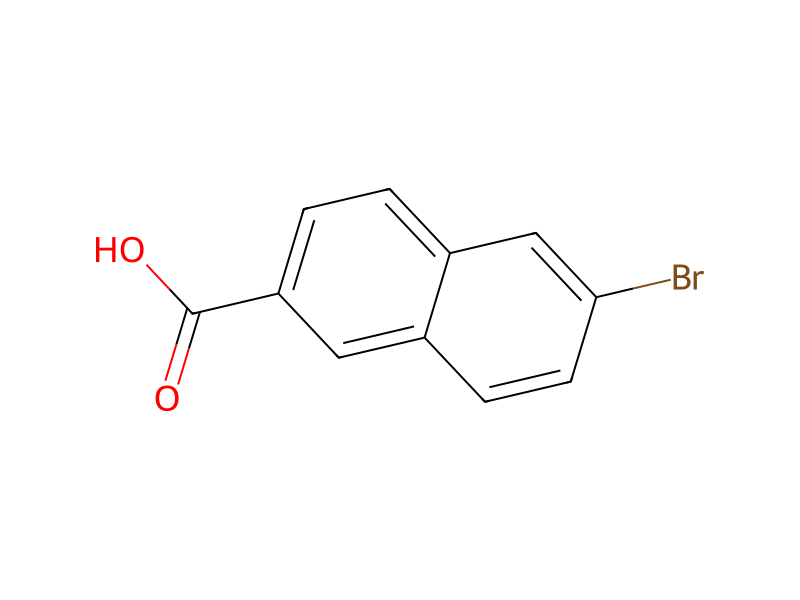
Br[C:2]1[CH:3]=[C:4]2[C:9](=[CH:10][CH:11]=1)[CH:8]=[C:7]([C:12]([OH:14])=[O:13])[CH:6]=[CH:5]2.[C:15]([C@@H:17]1[CH2:19][C@H:18]1[CH2:20][OH:21])#[CH:16].C(N(CC)CC)C>O1CCCC1.[Cu]I.[Cl-].[Cl-].C1(P(C2C=CC=CC=2)C2C=CC=CC=2)C=CC=CC=1.C1(P(C2C=CC=CC=2)C2C=CC=CC=2)C=CC=CC=1.[Pd+2]>[OH:21][CH2:20][C@@H:18]1[CH2:19][C@H:17]1[C:15]#[C:16][C:2]1[CH:3]=[C:4]2[C:9](=[CH:10][CH:11]=1)[CH:8]=[C:7]([C:12]([OH:14])=[O:13])[CH:6]=[CH:5]2To a stirring solution of 6-bromo-2-naphthoic acid (6.1, 1.0 g, 4.0 mmol), racemic ((trans)-2-ethynylcyclopropyl)methanol (1.7, 0.5 g, 5.2 mmol), copper(I) iodide (30 mg, 0.16 mmol) and palladium(II) bis(triphenylphosphine)dichloride (56 mg, 0.08 mmol) in tetrahydrofuran (7.5 mL) under a nitrogen atmosphere was added triethylamine (2.5 mL) and the reaction was stirred for 1 week. The reaction was partitioned between 2N aqueous sodium hydroxide and ethyl acetate. The aqueous layer was acidified with conc HCl and extracted with ethyl acetate. The organic layer was washed with water, saturated sodium chloride and dried over magnesium sulfate, filtered and concentrated under reduced pressure to give 6-(((trans)-2-(hydroxymethyl)cyclopropyl)ethynyl)-2-naphthoic acid (6.2, 1.0 g, 94%).