HomeMCPWorkbenchSkills
HomeWorkbenchNotificationsMe
llms.txt · MCP GuidePrivacy Policy · Terms of Service · Supportv1.8.3
  1. Home
  2. /Reaction

Diisopropylethylamine → 4-Chloro-5-cyclopropyl-pyridine-2-carboxylic acid (3-carbamoylmethyl-oxetan-3-yl)-amide

HRID 1480119
Print

Reaction equation

HRID 1480119 reaction equation
[Cl:1][C:2]1[C:7]([CH:8]2[CH2:10][CH2:9]2)=[CH:6][N:5]=[C:4]([C:11]([OH:13])=O)[CH:3]=1.CN(C(ON1N=NC2C=CC=CC1=2)=[N+](C)C)C.[B-](F)(F)(F)F.CCN(C(C)C)C(C)C.[NH2:45][C:46]1([CH2:50][C:51]([NH2:53])=[O:52])[CH2:49][O:48][CH2:47]1>CN(C=O)C.C(OCC)(=O)C>[C:51]([CH2:50][C:46]1([NH:45][C:11]([C:4]2[CH:3]=[C:2]([Cl:1])[C:7]([CH:8]3[CH2:9][CH2:10]3)=[CH:6][N:5]=2)=[O:13])[CH2:49][O:48][CH2:47]1)(=[O:52])[NH2:53]
ParticipantsProcedureWorkupSources & evidenceReaction notes

Participants

7

Reactant 4

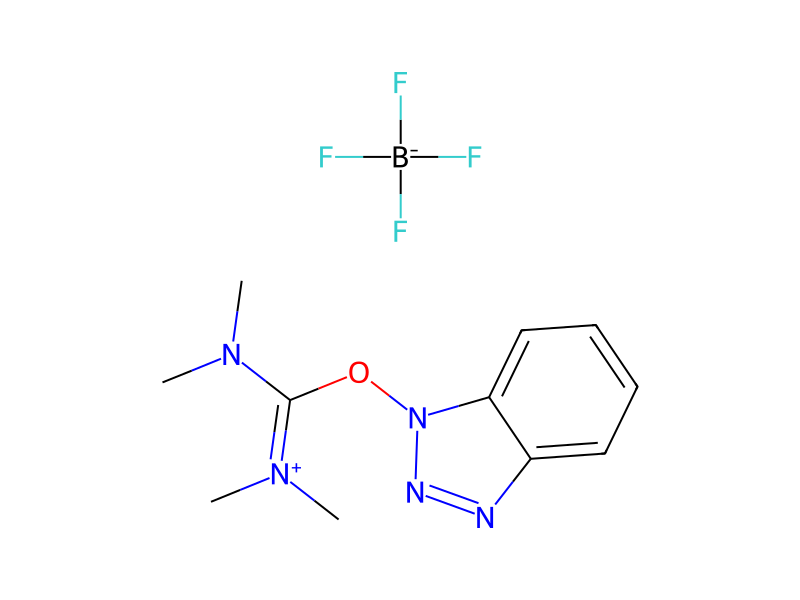
HCID 81531DiisopropylethylamineHCID 2733207O-(Benzotriazol-1-yl)-N,N,N',N'-tetramethyluronium tetrafluoroborateHCID 755375242-(3-Aminooxetan-3-yl)acetamideHCID 902035204-Chloro-5-cyclopropylpicolinic acid

Product 1

HCID 902149234-Chloro-5-cyclopropyl-pyridine-2-carboxylic acid (3-carbamoylmethyl-oxetan-3-yl)-amide
Yield 26%

Reagents, catalysts & solvents 2

HCID 6228DimethylformamideSolventHCID 8857Ethyl AcetateSolvent

Procedure

To a solution of 4-chloro-5-cyclopropyl-pyridine-2-carboxylic acid (Example 48b, 200 mg, 1.01 mmol) in DMF (4.0 ml) were added TBTU (357 mg, 1.11 mmol) and DIEA (654 mg, 866 μl, 5.06 mmol) and the reaction mixture was stirred at room temperature for 20 minutes. Addition of 2-(3-aminooxetan-3-yl)acetamide (158 mg, 1.21 mmol) and the reaction was stirred at room temperature for 18 hours. The reaction mixture was diluted with ethyl acetate and extracted with water. The organic phase was collected, dried over sodium sulfate and evaporated down to dryness. The crude material was purified by flash chromatography on silica, eluting with a ethyl acetate/heptane gradient to yield the title compound (80 mg, 26%) as a yellow solid. MS (ESI, m/z): 310.0 (M+H+).

Workup

  1. stirringthe reaction was stirred at room temperature for 18 hours
  2. extractionextracted with water
  3. customThe organic phase was collected
  4. dry with materialdried over sodium sulfate
  5. customevaporated down to dryness
  6. customThe crude material was purified by flash chromatography on silica
  7. washeluting with a ethyl acetate/heptane gradient

Sources & evidence

ORD record
ord-33c2e61cd2814e7f93a08fb8690863c1
Source dataset
uspto-grants-2016_08
DOI
10.6084/m9.figshare.5104873.v1
Patent number
US09409866B2

Reaction notes

On this pageParticipantsProcedureWorkupSources & evidenceReaction notes