Reaction equation
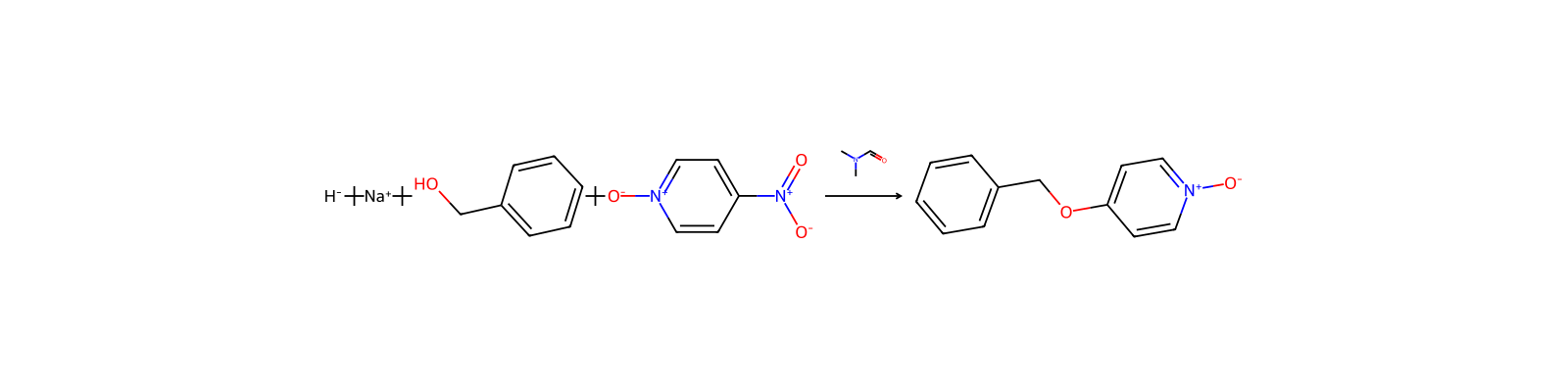
[H-].[Na+].[CH2:3]([OH:10])[C:4]1[CH:9]=[CH:8][CH:7]=[CH:6][CH:5]=1.[N+]([C:14]1[CH:19]=[CH:18][N+:17]([O-:20])=[CH:16][CH:15]=1)([O-])=O>CN(C=O)C>[CH2:3]([O:10][C:14]1[CH:19]=[CH:18][N+:17]([O-:20])=[CH:16][CH:15]=1)[C:4]1[CH:9]=[CH:8][CH:7]=[CH:6][CH:5]=1Participants
5
Reactant 3



Product 1

Reagents, catalysts & solvents 1

Procedure
To a DMF suspension (200 mL) of sodium hydride (60% oilyness, 7.50 g, 0.188 mmol), benzyl alcohol (20.3 mL) was added under cooling with ice, and stirred for an hour at room temperature. Then 4-nitropyridine 1-oxide (25.5 g, 182 mmols) was added little by little under stirring, followed by an hour's stirring at room temperature. The solvent was concentrated under reduced pressure and chloroform (1 L) was added to the resulting residue. The insoluble matter was filtered using Celite (100 g). The filtrate was concentrated and to which acetone was added to provide the title compound (24.8 g, 69%).
Workup
- temperatureunder cooling with ice
- stirringunder stirring
- waitfollowed by an hour
- stirring's stirring at room temperature
- concentrationThe solvent was concentrated under reduced pressure and chloroform (1 L)
- additionwas added to the resulting residue
- filtrationThe insoluble matter was filtered
- concentrationThe filtrate was concentrated and to which acetone
- additionwas added
Sources & evidence
- ORD record
- ord-c43af34c914f4fb79783195755e66732
- Source dataset
- uspto-grants-2010_06
- Patent number
- US07732456B2
Linked notes
Loading…