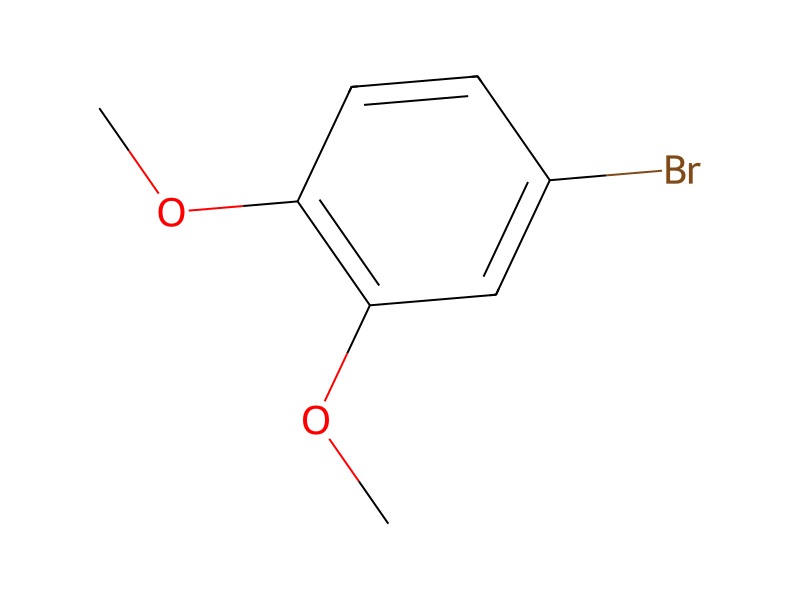
Br[C:2]1[CH:7]=[CH:6][C:5]([O:8][CH3:9])=[C:4]([O:10][CH3:11])[CH:3]=1.[C:12](#[N:15])[CH:13]=[CH2:14].C([O-])(=O)C.[Na+].C1(C)C=CC=CC=1P(C1C=CC=CC=1C)C1C=CC=CC=1C>[Br-].C([N+](CCCC)(CCCC)CCCC)CCC.CC(N(C)C)=O.[Pd]>[CH3:11][O:10][C:4]1[CH:3]=[C:2](/[CH:14]=[CH:13]/[C:12]#[N:15])[CH:7]=[CH:6][C:5]=1[O:8][CH3:9]A mixture of 5 g of 4-bromo-1,2-dimethoxybenzene (3.31 mL, 23 mmoles), 3.2 g of acrylonitrile (3.9 mL, 60 mmoles, 2.6 eq.), 2.3 g of sodium acetate (27.6 mmoles, 1.2 eq.), 7.4 g of tetrabutylammonium bromide (23 mmoles, 1 eq.), 0.7 g of tri(o-tolyl)phosphine (2.3 mmoles, 0.1 eq.) and 4.9 g of palladium 5% on carbon (2.3 mmoles, 0.1 eq.) in 25 mL of DMAC is prepared. The black suspension is stirred at reflux for 12 hours. The reaction mixture is brought back to ambient temperature and filtered. The solid residue is rinsed twice with toluene. The filtrates are combined and evaporated under reduced pressure. The crude reaction product is purified on a silica column (eluant: methylcyclohexane:ethyl acetate 6:4) to yield 1.4 g of the expected product.