HomeMCPSkillsWorkbenchOpenChem
HomeWorkbenchNotificationsMe
llms.txt · skill.md · MCP GuidePrivacy Policy · Terms of Service · Supportv1.8.5
  1. Home
  2. /Reaction

Ammonia → DL-cysteine

HRID 1650609
Print

Reaction equation

[CH2:1]1[S:5][CH2:4][NH:3][CH:2]1[C:6]([OH:8])=[O:7].[Na].N.[CH2:11]1[S:15][CH2:14][NH:13][C@H:12]1[C:16]([OH:18])=[O:17]>>[C:6]([CH:2]([NH:3][CH2:4][CH2:14][NH:13][CH:12]([C:16]([OH:18])=[O:17])[CH2:11][SH:15])[CH2:1][SH:5])([OH:8])=[O:7].[NH2:3][CH:2]([C:6]([OH:8])=[O:7])[CH2:1][SH:5].[CH2:6]=[O:7]
ParticipantsProcedureSources & evidenceReaction notes

Participants

7

Reactant 4

HCID 222AmmoniaHCID 9934Timonacic2×HCID 198253Timonacic, (S)-HCID 5360545Sodium

Product 3

HCID 594DL-cysteineHCID 712Formaldehyde
HCID 123770
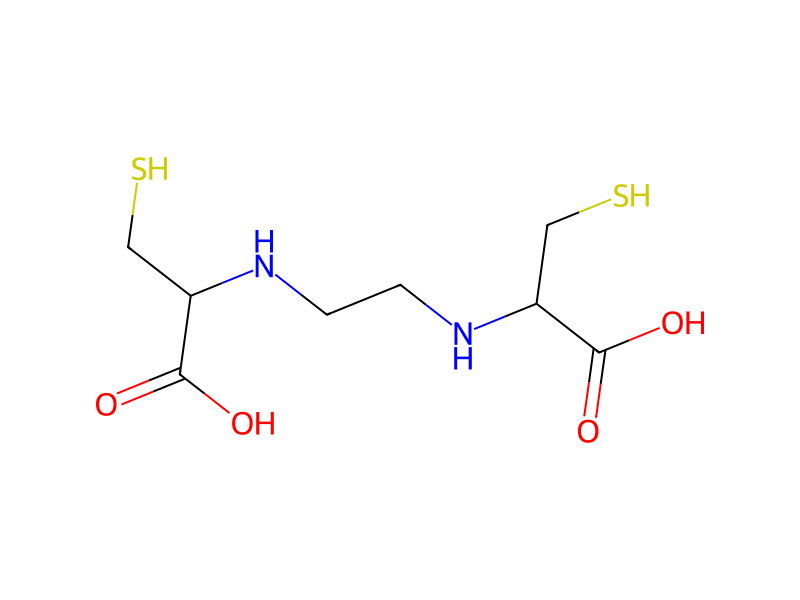
2-[2-[(1-Carboxy-2-sulfanylethyl)amino]ethylamino]-3-sulfanylpropanoic acid

Procedure

The L,L-isomer of the title compound is prepared by reductive dimerisation of L-thiazolidine-4-carboxylic acid under the influence of sodium in liquid ammonia, as described in Blondeau et al in Can. J. Chem. 45 (1), 49-52 (1967). The corresponding D,D-isomer and the meso form (L,L-isomer) are prepared in a corresponding manner from D-thiazolidine-4-carboxylic acid and racemic thiazolidine-4-carboxylic acid, respectively. These thiazolidine carboxylic acids are obtained by reaction of L-, D- or DL-cystein with formaldehyde according to Nagasama et al, J. Med. Chem. 27, 591 (1984).

Sources & evidence

ORD record
ord-c032a8e4059e496d9ac986e8316051f1
Source dataset
uspto-grants-1990_05
DOI
10.6084/m9.figshare.5104873.v1
Patent number
US04925650

Reaction notes

On this pageParticipantsProcedureSources & evidenceReaction notes