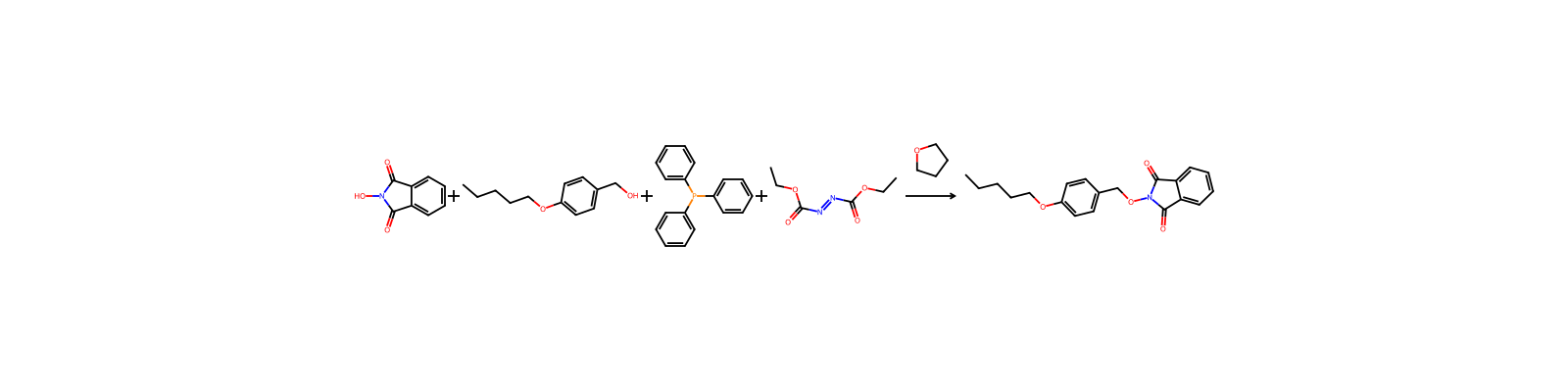
[OH:1][N:2]1[C:6](=[O:7])[C:5]2=[CH:8][CH:9]=[CH:10][CH:11]=[C:4]2[C:3]1=[O:12].[CH2:13]([O:18][C:19]1[CH:26]=[CH:25][C:22]([CH2:23]O)=[CH:21][CH:20]=1)[CH2:14][CH2:15][CH2:16][CH3:17].C1(P(C2C=CC=CC=2)C2C=CC=CC=2)C=CC=CC=1.N(C(OCC)=O)=NC(OCC)=O>C1COCC1>[CH2:13]([O:18][C:19]1[CH:26]=[CH:25][C:22]([CH2:23][O:1][N:2]2[C:3](=[O:12])[C:4]3[C:5](=[CH:8][CH:9]=[CH:10][CH:11]=3)[C:6]2=[O:7])=[CH:21][CH:20]=1)[CH2:14][CH2:15][CH2:16][CH3:17]To a stirred solution N-hydroxyphthalimide (2.45 g), 4-pentyloxybenzyl alcohol (Aldrich, 2.92 g) and triphenylphosphine (4.72 g) in THF was added drop-wise diethyl azodicarboxylate (1.2 eq.). The reaction mixture was stirred at room temperature for 2 hours. The solvent was evaporated under reduced pressure and the residue was subjected to column chromatography on silica gel (petroleum ether/EtOAc, 1/2, v/v) and gave 2-(4-pentyloxy-benzyloxy)-isoindole-1,3-dione. This phthalimide intermediate (4.35 g) was dissolved in dichloromethane and methyl-hydrazine (1.1 eq.) was added. The reaction mixture stirred at room temperature for 60 minutes and the formed solid material was removed by filtration. The filtrate was evaporated under reduced pressure and the residue was subjected to column chromatography on silica gel (petroleum ether/EtOAc, 5/1, v/v), and gave the title compound (2.55 g). 13C-NMR (CDCl3) δ 159.1, 130.1, 129.2, 114.5, 77.7, 68.0, 29.0, 28.2, 22.5, 14.0.
Loading…