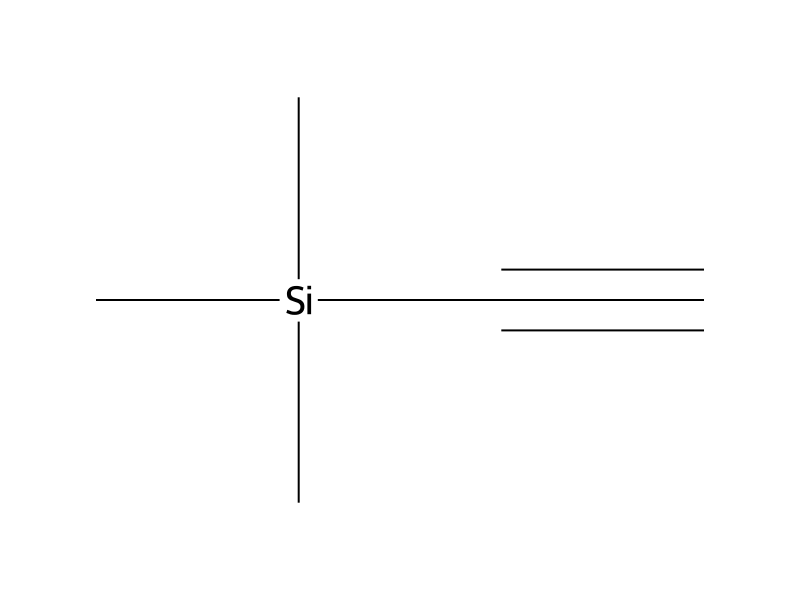
FC(F)(F)S(O[C:7]1[CH:8]=[N:9][C:10]([C:13]([F:16])([F:15])[F:14])=[N:11][CH:12]=1)(=O)=O.[CH3:19][Si:20]([C:23]#[CH:24])([CH3:22])[CH3:21].[Al]>[Cu]I.Cl[Pd](Cl)([P](C1C=CC=CC=1)(C1C=CC=CC=1)C1C=CC=CC=1)[P](C1C=CC=CC=1)(C1C=CC=CC=1)C1C=CC=CC=1.C(N(CC)CC)C>[F:14][C:13]([F:16])([F:15])[C:10]1[N:9]=[CH:8][C:7]([C:24]#[C:23][Si:20]([CH3:22])([CH3:21])[CH3:19])=[CH:12][N:11]=12-(Trifluoromethyl)pyrimidine-5-yl trifluoromethanesulfonate (0.45 g, 1.5 mmol) and dry triethylamine (1.0 mL) were mixed in a screw-cap vial. The solution was purged with dry argon for 10 minutes. Trimethylsilylacetylene (0.43 mL, 3.0 mmol), finely ground CuI (0.010 g, 0.05 mmol) and PdCl2(PPh3)2 (0.020 g, 0.030 mmol) were added. The vial was sealed and heated in an aluminum block at 80° C. After stirring for 5 hours the volatiles were evaporated at room temperature (the product sublimes at 35-40° C./10 mbar). The black residue was taken up in EtOAc (20 mL) and concentrated with silica (about 5 to 10 g) to dryness. Flash chromatography on silica with EtOAc/heptane (1:30) afforded 2-(trifluoromethyl)-5-[(trimethylsilyl)ethynyl]pyrimidine as a white solid (0.35 g, 95%), m.p. 75.5-76.0° C.