HomeMCPWorkbenchSkills
HomeWorkbenchNotificationsMe
llms.txt · MCP GuidePrivacy Policy · Terms of Service · Supportv1.8.0
  1. Home
  2. /Reaction

4-Methylmorpholine → N-[N-Phthalimido-3-(2-thienyl)-L-alanyl]-6-hydroxy-L-norleucine, methy ester

HRID 1683343
Notes
Print preview

Reaction equation

HRID 1683343 reaction equation
CN1CCOCC1.Cl.[OH:9][CH2:10][CH2:11][CH2:12][CH2:13][C@@H:14]([C:16]([O:18][CH3:19])=[O:17])[NH2:15].[C:20]1(=[O:41])[N:24]([NH:25][C@H:26]([C:33](O)=[O:34])[CH2:27][C:28]2[S:29][CH:30]=[CH:31][CH:32]=2)[C:23](=[O:36])[C:22]2=[CH:37][CH:38]=[CH:39][CH:40]=[C:21]12.OC1C2N=NNC=2C=CC=1.C(N=C=NCCCN(C)C)C>C(Cl)Cl.CN(C)C=O>[C:23]1(=[O:36])[N:24]([NH:25][C@H:26]([C:33]([NH:15][C@H:14]([C:16]([O:18][CH3:19])=[O:17])[CH2:13][CH2:12][CH2:11][CH2:10][OH:9])=[O:34])[CH2:27][C:28]2[S:29][CH:30]=[CH:31][CH:32]=2)[C:20](=[O:41])[C:21]2=[CH:40][CH:39]=[CH:38][CH:37]=[C:22]12
ParticipantsConditionsProcedureWorkupSources & evidenceReaction notes

Participants

8

Reactant 5

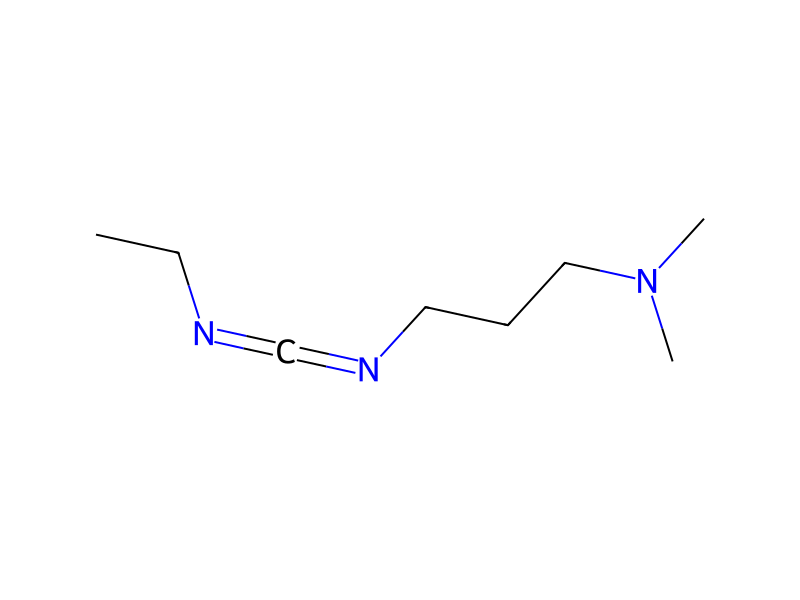
HCID 79724-MethylmorpholineHCID 159081-Ethyl-3-(3'-dimethylaminopropyl)carbodiimideHCID 11680005methyl (2S)-2-amino-6-hydroxyhexanoate hydrochlorideHCID 70051103HCID 70051103, compoundHCID 178418300HCID 178418300, compound

Product 1

HCID 131719431
N-[N-Phthalimido-3-(2-thienyl)-L-alanyl]-6-hydroxy-L-norleucine, methy ester

Reagents, catalysts & solvents 2

HCID 6228DimethylformamideSolventHCID 6344DichloromethaneSolvent

Conditions

Temperature
0 °C

Procedure

N-Methylmorpholine (1.51 ml., 14.5 mmol.) was added to a solution of 6-hydroxy-L-norleucine, methyl ester, hydrochloride (8.53 mmol.) in methylene chloride (34 ml)/dimethylformamide (9 ml.) at room temperature under argon. The resulting mixture was cooled to 0° C. and N-phthalimido-3-(2-thienyl)-L-alanine (2.57 g., 8.54 mmol.), hydroxybenzotriazole (1.19 g., 8.80 mmol.) and 1-ethyl-3-(3-dimethylaminopropyl)-carbodiimide (1.80 g., 9.4 mmol.) were added sequentially. After stirring at 0° C. for 30 minutes, the mixture was warmed to room temperature and stirred for 1.5 hours. The volatiles were evaporated and the residue was partitioned between ethyl acetate and water. The organic layer was washed successively with 0.5 N hydrochloric acid, water, saturated sodium bicarbonate, and brine, and the organic layer was dried (sodium sulfate), filtered, and concentrated. The residue was flash chromatographed (Merck silica gel) eluting with 2:1 ethyl acetate/hexane to give 3.13 g. of title compound as a white foam. TLC (5% acetic acid in ethyl acetate) Rf =0.68.


Workup

  1. temperaturethe mixture was warmed to room temperature
  2. stirringstirred for 1.5 hours
  3. customThe volatiles were evaporated
  4. customthe residue was partitioned between ethyl acetate and water
  5. washThe organic layer was washed successively with 0.5 N hydrochloric acid, water, saturated sodium bicarbonate, and brine
  6. dry with materialthe organic layer was dried (sodium sulfate)
  7. filtrationfiltered
  8. concentrationconcentrated
  9. customchromatographed (Merck silica gel)
  10. washeluting with 2:1 ethyl acetate/hexane
  11. customto give 3.13 g

Sources & evidence

ORD record
ord-075c8a8bd0d2438a82bc6f2098a3aa84
Source dataset
uspto-grants-1997_06
DOI
10.6084/m9.figshare.5104873.v1
Patent number
US05637698

Reaction notes

Loading…

On this pageParticipantsConditionsProcedureWorkupSources & evidenceReaction notes