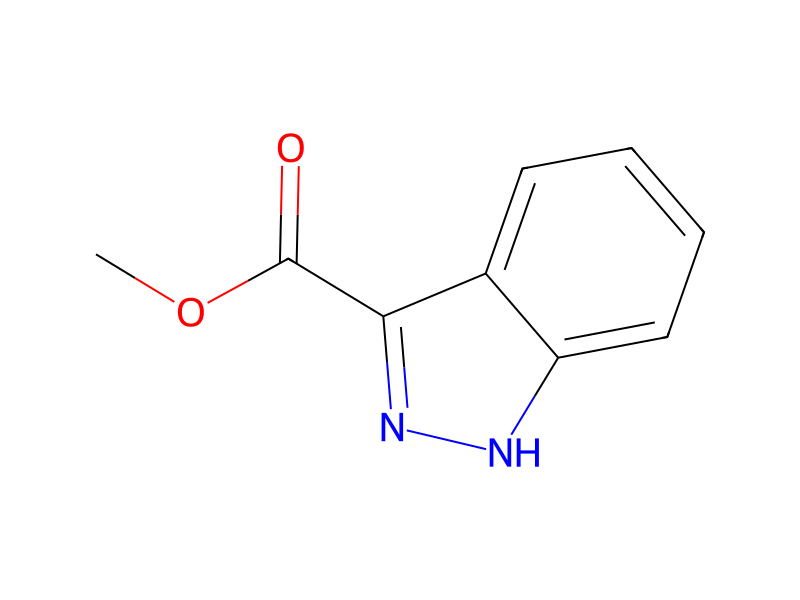
[H-].[Na+].[NH:3]1[C:11]2[C:6](=[CH:7][CH:8]=[CH:9][CH:10]=2)[C:5]([C:12]([O:14][CH3:15])=[O:13])=[N:4]1.[CH2:16](Br)[C:17]1[CH:22]=[CH:21][CH:20]=[CH:19][CH:18]=1.O>C1COCC1>[CH2:16]([N:3]1[C:11]2[C:6](=[CH:7][CH:8]=[CH:9][CH:10]=2)[C:5]([C:12]([O:14][CH3:15])=[O:13])=[N:4]1)[C:17]1[CH:22]=[CH:21][CH:20]=[CH:19][CH:18]=1To a suspension of sodium hydride (60% in oil, 55 mg, 1.22 mM) in dry THF (10 ml) stirring at 0° C. was added a solution of methyl indazole-3-carboxylate (von Auwers et al, Ber., 52, pg 1345 (1919), 210 mg, 1.22 mM) in dry THF (10 ml). After 10 min benzyl bromide (0.15 ml, 1.22 mM) was added and the solution left stirring at room temperature overnight. Water (2 ml) was added and the solvent removed in vacuo. The residue was partitioned between water and ethyl acetate and the combined organic dried over magnesium sulfate and evaporated. Column chromatography (ethyl acetate/cyclohexane 1:4) provided methyl 1 benzyl-indazole-3-carboxylate as a yellow powder (250 mg, 77%). M.pt. 181° C.