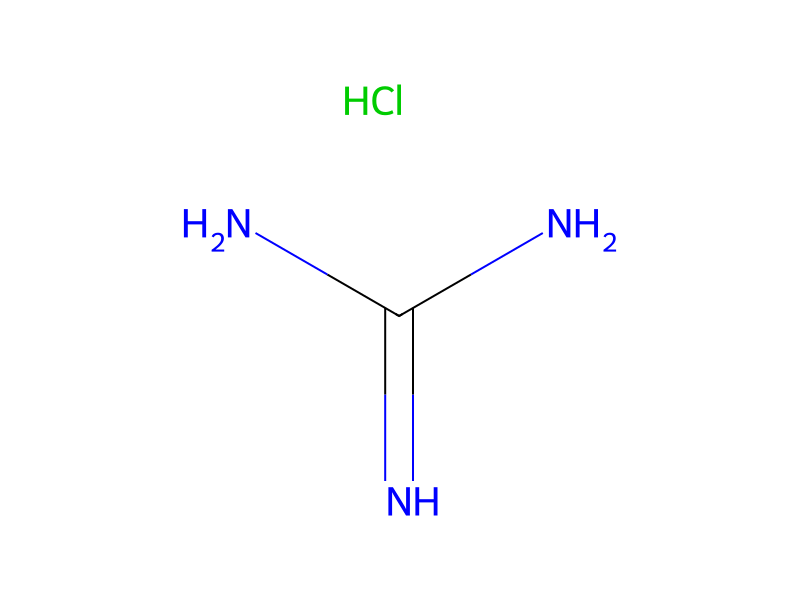
[ClH:1].[NH2:2][C:3]([NH2:5])=[NH:4].C[O-].[Na+].[C:9]1([C:19]2[CH:20]=[C:21]([CH:37]=[CH:38][CH:39]=2)[C:22](OCC(C)(NS(C(F)(F)F)(=O)=O)C)=[O:23])[C:18]2[C:13](=[CH:14][CH:15]=[CH:16][CH:17]=2)[CH2:12][CH2:11][CH:10]=1.C(OCC)(=O)C>CN(C)C=O.O>[ClH:1].[C:9]1([C:19]2[CH:20]=[C:21]([CH:37]=[CH:38][CH:39]=2)[C:22]([NH:4][C:3]([NH2:5])=[NH:2])=[O:23])[C:18]2[C:13](=[CH:14][CH:15]=[CH:16][CH:17]=2)[CH2:12][CH2:11][CH:10]=1To a solution of guanidine hydrochloride (0.87 g) in N,N-dimethylformamide (5 ml) was added sodium methoxide (1.6 ml, 28% in methanol) under nitrogen atmosphere. After being stirred for 30 minutes at room temperature, to the reaction mixture was added a solution of 2-methyl-2-trifluoromethylsulfonylaminopropyl 3-(3,4-dihydro-1-naphthyl)benzoate (0.59 g) in N,N-dimethylformamide (5 ml). After being stirred for 21 hours at room temperature, the reaction mixture was poured into a mixture of ethyl acetate and water. The organic layer was successively washed with brine and dried over magnesium sulfate. The solvent was evaporated in vacuo, and the residue was dissolved in ethyl acetate and crystallized from slight excess 4N-hydrogen chloride-ethyl acetate. The crystalline was triturated with diethyl ether to give [3-(3,4-dihydro-1-naphthyl)benzoyl]guanidine hydrochloride (0.25 g).