Reaction equation
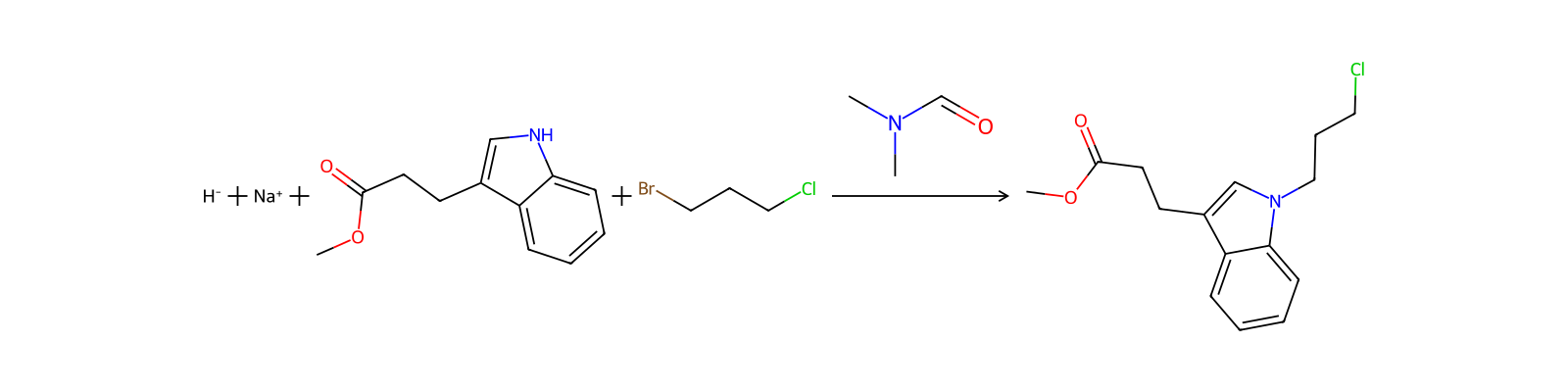
[H-].[Na+].[NH:3]1[C:11]2[C:6](=[CH:7][CH:8]=[CH:9][CH:10]=2)[C:5]([CH2:12][CH2:13][C:14]([O:16][CH3:17])=[O:15])=[CH:4]1.Br[CH2:19][CH2:20][CH2:21][Cl:22]>CN(C)C=O>[Cl:22][CH2:21][CH2:20][CH2:19][N:3]1[C:11]2[C:6](=[CH:7][CH:8]=[CH:9][CH:10]=2)[C:5]([CH2:12][CH2:13][C:14]([O:16][CH3:17])=[O:15])=[CH:4]1Participants





Conditions
- Temperature
- 55 °C
Procedure
Sodium hydride (60% dispersion) (236 mg, 5.91 mmol, 1.2 equiv) was slowly added to a cold mixture of methyl 3-(1H-indol-3-yl)propanoate (2 g, 4.92 mmol, 1 equiv) in N,N-dimethylformamide. After all the sodium hydride has reacted, 1-bromo-3-chloropropane (1.94 ml, 19.68 mmol, 4 equiv) was added and the reaction stirred at 55° C. for 16 h. Upon cooling the reaction was partitioned between water and ethyl acetate. The organic layer was further washed with 1N hydrogen chloride, brine, dried over MgSO4, filtered and concentrated in vacuo. The crude residue was purified using the Biotage flash chromatography system (SNAP 50 g cartridge, Rf=0.5, gradient—1%-10% ethyl acetate in hexanes) to afford the title compound as a yellow oil (1.154 g, 83%); 1H NMR (400 MHz, DMSO-d6): δ 2.12-2.27 (m, 2H); 2.65-2.70 (m, 2H); 2.93-2.98 (m, 2H); 3.38-3.54 (m, 2H); 3.58 (s, 3H); 4.08-4.12 (m, 2H); 4.21-4.25 (m, 2H); 7.02 (t, 1H, J=7.6 Hz); 7.12-7.15 (m, 2H); 7.43 (dd, 1H, J=3.2 and 2.8 Hz); 7.52-7.55 (m, 1H); MS for C15H18ClNO2 m/z 280 (M+H)+.
Workup
- temperatureUpon cooling the reaction
- customwas partitioned between water and ethyl acetate
- washThe organic layer was further washed with 1N hydrogen chloride, brine
- dry with materialdried over MgSO4
- filtrationfiltered
- concentrationconcentrated in vacuo
- customThe crude residue was purified
Sources & evidence
- ORD record
- ord-fbff82ca74b243a2b27329d672660f54
- Source dataset
- uspto-grants-2015_10
- Patent number
- US09156840B2
Linked notes
Loading…