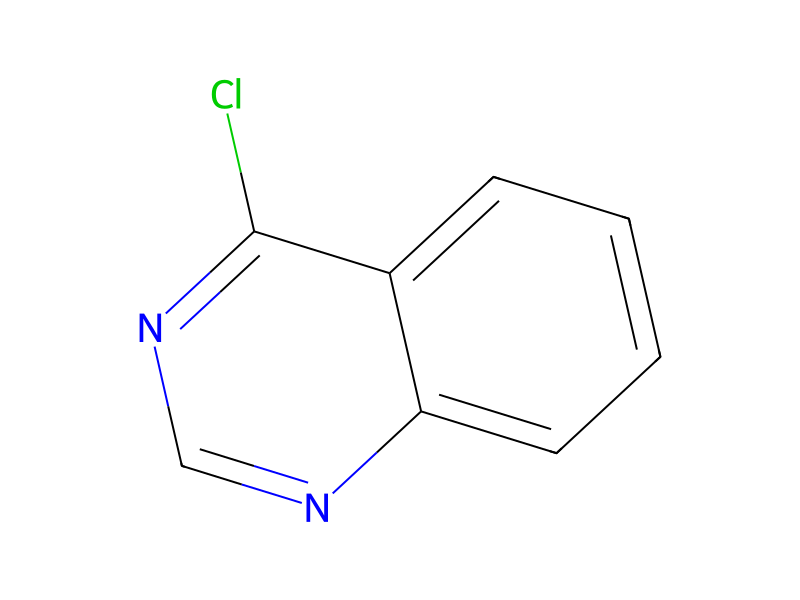
A dry 50 mL flask was fitted with an addition funnel. To the flask were added 4-chloroquinazoline (592 mg, 3.6 mmol), anhydrous tetrahydrofuran (10 mL), and 60 wt % sodium hydride (187 mg, 4.7 mmol). A solution of Example 1B (800 mg, 3.6 mmol) in anhydrous tetrahydrofuran (10 mL) was added dropwise using the addition funnel. The reaction was stirred for 3.5 hours. The reaction was diluted with ethyl acetate and quenched by the addition of aqueous 0.1 N hydrochloric acid. The mixture was transferred to a separatory funnel and washed with brine. The organic layer was dried over magnesium sulfate, filtered, and concentrated. Column chromatography [silica gel; eluent hexanes-ethyl acetate (4:1)] provided the desired product (538 mg, 43%). 1H(CDCl3) δ(ppm): 1.92-1.98 (m, 2H); 2.33 (t, 2H); 2.64 (t, 2H); 3.19 (t, 2H); 3.66 (s, 3H); 4.79 (t, 2H); 7.15 (d, 2H); 7.27 (d, 2H); 7.57 (t, 1H); 7.83 (t, 1H); 7.94 (d, 1H); 8.15 (d, 1H); 8.80 (s, 1H). 26.68, 33.59, 34.93, 35.03, 51.67, 67.89, 116.48, 123.72, 127.23, 127.82, 128.87, 129.24, 133.74, 135.76, 139.90, 151.08, 154.56, 166.89, 174.10.