HomeMCPSkillsWorkbenchOpenChem
HomeWorkbenchNotificationsMe
llms.txt · skill.md · MCP GuidePrivacy Policy · Terms of Service · Supportv1.8.5
  1. Home
  2. /Reaction

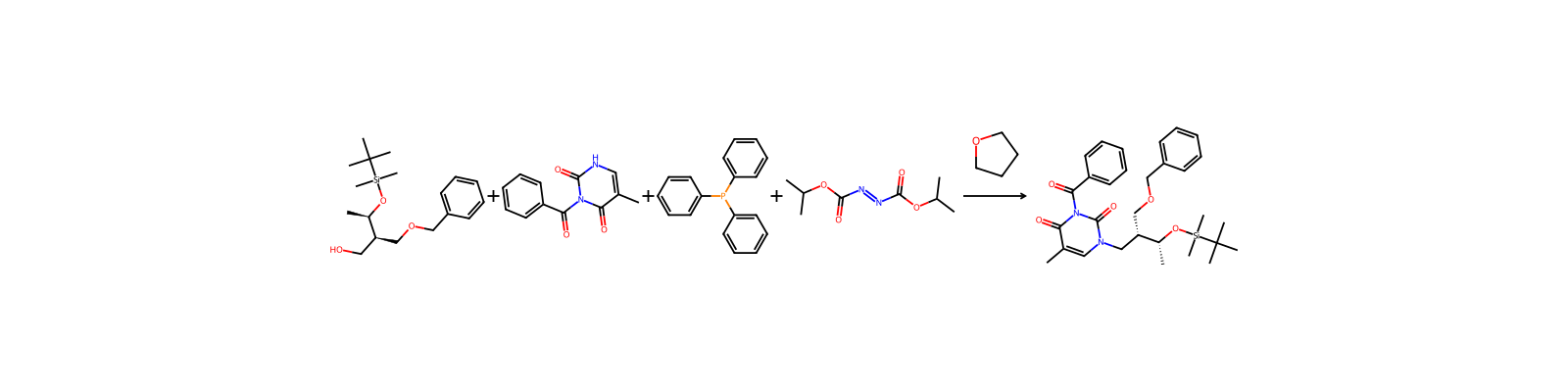
Triphenylphosphine → (2R,3R)-1-Benzyloxy-3-(tert-butyldimethylsiloxy)-2-((3-benzoyl-3,4-dihydro-5-methyl-2,4-dioxopyrimidin-1(2H)-yl)methyl)butane

HRID 1754595
Print

Reaction equation

[CH2:1]([O:8][CH2:9][C@H:10]([C@H:13]([O:15][Si:16]([C:19]([CH3:22])([CH3:21])[CH3:20])([CH3:18])[CH3:17])[CH3:14])[CH2:11]O)[C:2]1[CH:7]=[CH:6][CH:5]=[CH:4][CH:3]=1.[C:23]([N:31]1[C:36](=[O:37])[C:35]([CH3:38])=[CH:34][NH:33][C:32]1=[O:39])(=[O:30])[C:24]1[CH:29]=[CH:28][CH:27]=[CH:26][CH:25]=1.C1(P(C2C=CC=CC=2)C2C=CC=CC=2)C=CC=CC=1.CC(OC(/N=N/C(OC(C)C)=O)=O)C>C1COCC1>[CH2:1]([O:8][CH2:9][C@@H:10]([CH2:11][N:33]1[CH:34]=[C:35]([CH3:38])[C:36](=[O:37])[N:31]([C:23](=[O:30])[C:24]2[CH:25]=[CH:26][CH:27]=[CH:28][CH:29]=2)[C:32]1=[O:39])[C@H:13]([O:15][Si:16]([C:19]([CH3:22])([CH3:21])[CH3:20])([CH3:18])[CH3:17])[CH3:14])[C:2]1[CH:7]=[CH:6][CH:5]=[CH:4][CH:3]=1
ParticipantsProcedureWorkupSources & evidenceReaction notes

Participants

6

Reactant 4

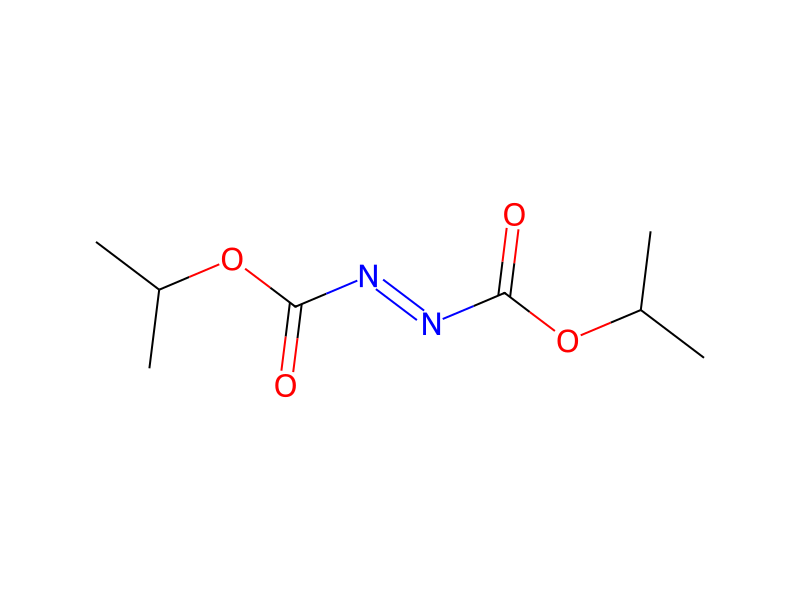
HCID 11776TriphenylphosphineHCID 5363146Diisopropyl azodicarboxylateHCID 10933275N3-benzoylthymineHCID 11067317(2R,3R)-2-((benzyloxy)methyl)-3-(tert-butyldimethylsiloxy)butan-1-ol

Product 1

HCID 90410666(2R,3R)-1-Benzyloxy-3-(tert-butyldimethylsiloxy)-2-((3-benzoyl-3,4-dihydro-5-methyl-2,4-dioxopyrimidin-1(2H)-yl)methyl)butane
Yield 81%

Reagents, catalysts & solvents 1

HCID 8028TetrahydrofuranSolvent

Procedure

To a cold (ice/water bath) solution of (2R,3R)-2-((benzyloxy)methyl)-3-(tert-butyldimethylsiloxy)butan-1-ol (4) (W.-H. Ham et al. J. Org. Chem. 2000, 65, 8372-8374) 1.5 g, 4.6 mmol), 3-benzoylthymine (1.5 g, 6.5 mmol) and triphenylphosphine (1.71 g, 6.5 mmol) in 50 ml of anhydrous THF was added dropwise via syringe with stirring (1.26 ml, 6.5 mmol) of diisopropylazodicarboxylate. The reaction was removed from the bath and stirred at room temperature for 2 hrs and then concentrated. The reaction was diluted with ether (50 ml) and hexane (50 ml) to precipitate some of triphenylphosphine oxide and the DIPADC by-product. The solids were filtered off and the filtrate concentrated. The resultant crude product, which still contained some Ph3PO, was chromatographed on silica eluting with 20% ethyl acetate in hexane. Concentration of the pure product fractions afforded 2.0 g (81%) of 5 as a colorless viscous srup. 1H NMR (CDCl3): δ 7.85 (d, J=8.4 Hz, 2H), 7.58 (t, J=7.5 Hz, 1H), 7.42 (t, J=7.8 Hz, 2H), 7.35-7.25 (m, 5H), 7.06 (d, J=1.2 Hz, 1H), 4.42 (s, 2H), 3.98 (m, 2H), 3.61 (m, 1H), 3.46 (d, J=5.7 Hz, 2H), 2.08 (m, 1H), 1.83 (s, 3H), 1.16 (d, J=6.6 Hz, 3H), 0.84 (s, 9H), 0.02 (s, 3H), 0.00 (s, 3H).

Workup

  1. customThe reaction was removed from the bath
  2. concentrationconcentrated
  3. additionThe reaction was diluted with ether (50 ml) and hexane (50 ml)
  4. customto precipitate some of triphenylphosphine oxide
  5. filtrationThe solids were filtered off
  6. concentrationthe filtrate concentrated
  7. customwas chromatographed on silica eluting with 20% ethyl acetate in hexane

Sources & evidence

ORD record
ord-6367e2a10f124a00bf0b6ba058e24a95
Source dataset
uspto-grants-2015_10
DOI
10.6084/m9.figshare.5104873.v1
Patent number
US09169256B2

Reaction notes

On this pageParticipantsProcedureWorkupSources & evidenceReaction notes