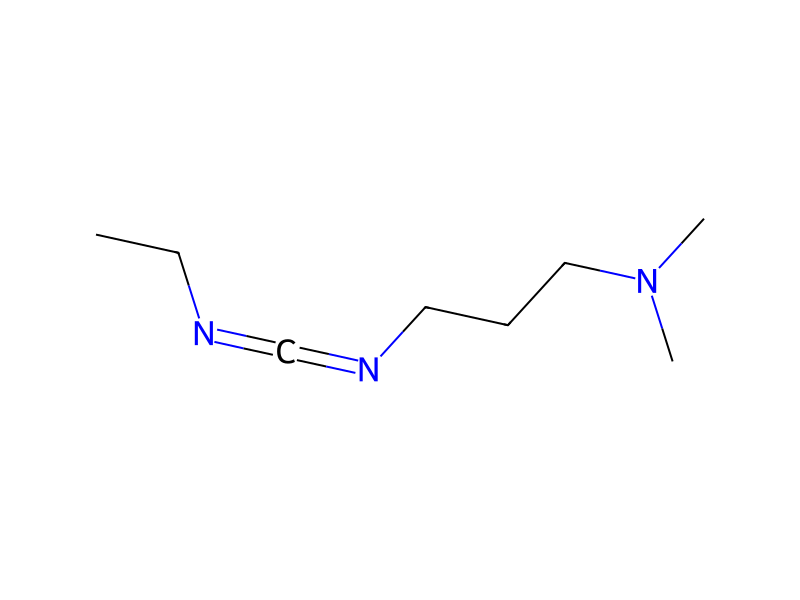
C(O[C:6]([N:8]1[C:20]2[C:11](=[C:12]3[C:17](=[C:18]([OH:21])[CH:19]=2)[N:16]=[CH:15][CH:14]=[CH:13]3)[CH:10]([CH2:22][Cl:23])[CH2:9]1)=[O:7])(C)(C)C.Cl.[CH3:25][O:26][C:27]1[CH:37]=[CH:36][C:30]([CH:31]=[CH:32]C(O)=O)=[CH:29][CH:28]=1.CCN=C=NCCCN(C)C>O1CCOCC1.CC(N(C)C)=O>[Cl:23][CH2:22][CH:10]1[C:11]2=[C:12]3[C:17](=[C:18]([OH:21])[CH:19]=[C:20]2[N:8]([C:6](=[O:7])/[CH:32]=[CH:31]/[C:30]2[CH:36]=[CH:37][C:27]([O:26][CH3:25])=[CH:28][CH:29]=2)[CH2:9]1)[N:16]=[CH:15][CH:14]=[CH:13]3A suspension of 16 (0.10 g, 0.30 mmol) in dioxane (5 mL) was saturated with HCl, stirred at r.t. over 5 h and evaporated. 4-Methoxycinnamic acid (predominantly trans) (0.064 g, 0.36 mmol), EDCI (0.29 g, 1.50 mmol) and DMA (3 mL) were added to the remaining yellow solid, and the red mixture was stirred at r.t. for 3 h. The mixture was partitioned between CH2Cl2 and cold 5% KHCO3 solution. The aqueous layer was extracted with CH2Cl2 (×3). The CH2Cl2 extracts were dried (brine, Na2SO4). Flash chromatography (CH2Cl2/MeOH; 93:7) followed by recrystallisation (CH2Cl2/Et2O) gave 18e (0.02 g, 17%) as a yellow solid: mp 208–211° C.; 1H NMR [(CD3)2SO]δ 9.96 (bs, 1 H), 8.73 (d, J=3.3, 1 H), 8.35 (d, J=7.7, 1 H), 8.18 (bs, 1 H), 7.78 (d, J=8.7, 2 H), 7.67 (d, J=15.3, 1 H), 7.54 (dd, J=8.5, 4.1, 1 H), 7.08 (d, J=15.4, 1 H), 7.01 (d, J=8.7, 2 H), 4.54 (dd, J=10.3, 9.5, 1 H), 4.45 (m, 1 H), 4.27 (m, 1 H), 3.99 (dd, J=11.1, 3.2, 1 H), 3.88 (dd, J=11.1, 7.3, 1 H), 3.82 (s, 3 H). C22H20ClN2O3 requires M+H 395.1163, 397.1133. Found (FAB) 395.1161, 397.1169.