HomeMCPWorkbenchSkills
HomeWorkbenchNotificationsMe
llms.txt · MCP GuidePrivacy Policy · Terms of Service · Supportv1.8.3
  1. Home
  2. /Reaction

Hydrochloric Acid → dicyclohexylammonium (R)-3-hydroxytetradecanoate

HRID 1830447
Print

Reaction equation

HRID 1830447 reaction equation
[O:1]=[C:2]([CH2:8][CH2:9][CH2:10][CH2:11][CH2:12][CH2:13][CH2:14][CH2:15][CH2:16][CH2:17][CH3:18])[CH2:3][C:4]([O:6]C)=[O:5].Cl.[Li+].[OH-].[CH:22]1([NH:28][CH:29]2[CH2:34][CH2:33][CH2:32][CH2:31][CH2:30]2)[CH2:27][CH2:26][CH2:25][CH2:24][CH2:23]1>CO.CCN(CC)CC>[OH:1][C@H:2]([CH2:8][CH2:9][CH2:10][CH2:11][CH2:12][CH2:13][CH2:14][CH2:15][CH2:16][CH2:17][CH3:18])[CH2:3][C:4]([O-:6])=[O:5].[CH:29]1([NH2+:28][CH:22]2[CH2:23][CH2:24][CH2:25][CH2:26][CH2:27]2)[CH2:30][CH2:31][CH2:32][CH2:33][CH2:34]1
ParticipantsProcedureWorkupSources & evidenceReaction notes

Participants

7

Reactant 4

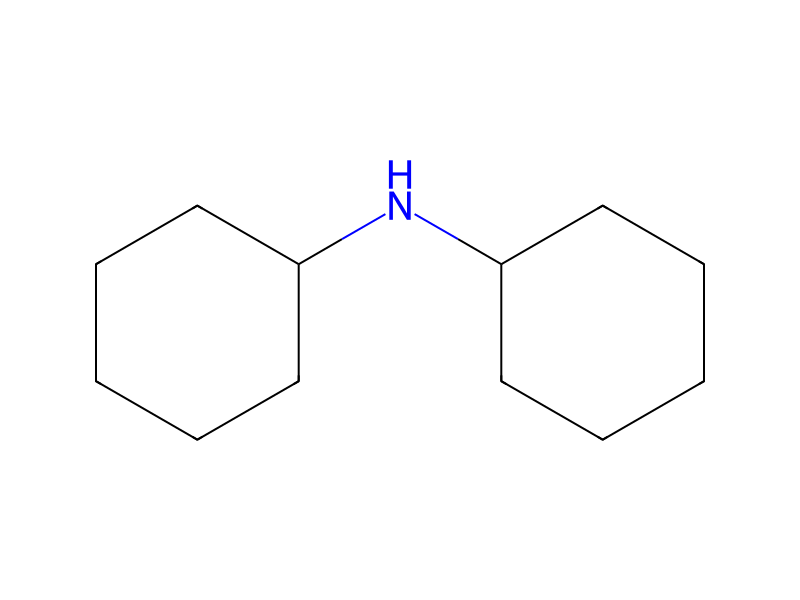
HCID 313Hydrochloric AcidHCID 3939Lithium HydroxideHCID 7582DicyclohexylamineHCID 89670Methyl 3-oxotetradecanoate

Product 1

HCID 86585082dicyclohexylammonium (R)-3-hydroxytetradecanoateYield 91%

Reagents, catalysts & solvents 2

HCID 8471
Triethylamine
Catalyst
HCID 887MethanolSolvent

Procedure

A solution of methyl 3-oxotetradecanoate (19 g, 0.074 mol) in MeOH (100 mL) was degassed by sparging with argon (15 min). [(R)-Ru(Binap)Cl]2.NEt3 catalyst (0.187 g, 0.111 mmol) and 2 N aqueous HCl (0.5 mL) were added and the resulting mixture was hydrogenated at 60 psig and 40–50° C. for 18 h. The reaction was diluted with hexanes (250 mL), filtered through a short column of silica gel, and concentrated. The crude product was dissolved in tetrahydrofuran (THF; 200 mL), treated 2.4 N aqueous LiOH (83 mL, 0.2 mol) and stirred vigorously at room temperature for 4 h. The resulting slurry was partitioned between ether (200 mL) and 1 N aqueous HCl (200 mL) and the layers separated. The aqueous layer was extracted with ether (100 mL) and the combined ethereal extracts were dried (Na2SO4) and concentrated. The crude hydroxy acid was dissolved in hot acetonitrile (250 mL), treated with dicyclohexylamine (DCHA; 17 mL, 0.085 mol) and stirred at 60° C. for 1 h. The product that crystallized upon cooling was collected and recrystallized from acetonitrile (650 mL) to yield 28.6 g (91%) of dicyclohexylammonium (R)-3-hydroxytetradecanoate as a colorless solid: mp 94–95° C.; 1H NMR (CDCl3) δ 0.88 (˜t, 3 H, J˜6.5 Hz), 1.05–1.58 (m, 24 H), 1.65 (m, 2 H), 1.80 (m, 4 H), 2.01 (br d, 4 H) 2.18 (dd, 1 H, J=15.7, 9.4 Hz), 2.36 (dd, 1 H, J=15.7, 2.6 Hz), 2.94 (m, 2 H), 3.84 (m, 1 H)


Workup

  1. customby sparging with argon (15 min)
  2. filtrationfiltered through a short column of silica gel
  3. concentrationconcentrated
  4. dissolutionThe crude product was dissolved in tetrahydrofuran (THF; 200 mL)
  5. customThe resulting slurry was partitioned between ether (200 mL) and 1 N aqueous HCl (200 mL)
  6. customthe layers separated
  7. extractionThe aqueous layer was extracted with ether (100 mL)
  8. dry with materialthe combined ethereal extracts were dried (Na2SO4)
  9. concentrationconcentrated
  10. dissolutionThe crude hydroxy acid was dissolved in hot acetonitrile (250 mL)
  11. stirringstirred at 60° C. for 1 h
  12. customThe product that crystallized
  13. temperatureupon cooling
  14. customwas collected
  15. customrecrystallized from acetonitrile (650 mL)

Sources & evidence

ORD record
ord-3d9decd67766400a8687d31ffcfc9391
Source dataset
uspto-grants-2006_06
DOI
10.6084/m9.figshare.5104873.v1
Patent number
US07063967B2

Reaction notes

On this pageParticipantsProcedureWorkupSources & evidenceReaction notes