HomeMCPSkillsWorkbenchOpenChem
HomeWorkbenchNotificationsMe
llms.txt · skill.md · MCP GuidePrivacy Policy · Terms of Service · Supportv1.8.5
  1. Home
  2. /Reaction

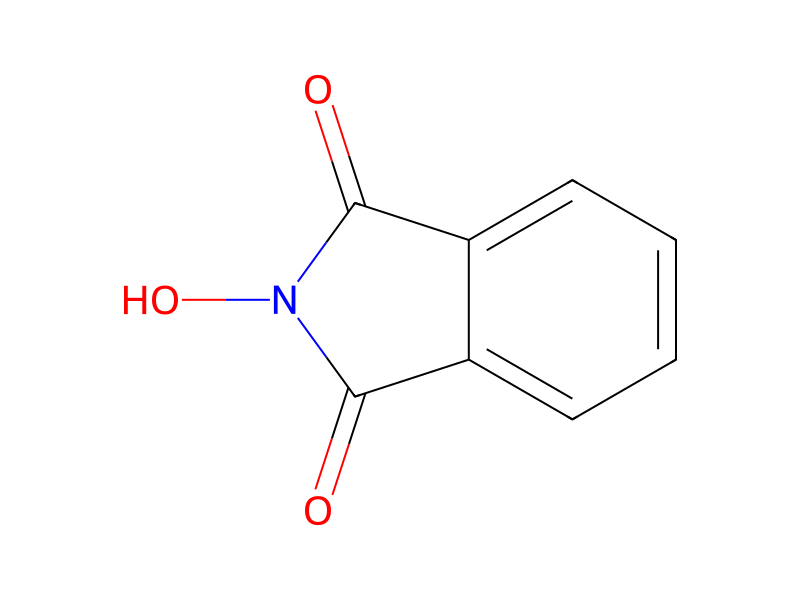
N-Hydroxyphthalimide → (S)-N-(2,2-Dimethyl-1,3-dioxolan-4-ylmethoxy)phthalimide

HRID 1835648
Print

Reaction equation

[OH:1][N:2]1[C:6](=[O:7])[C:5]2=[CH:8][CH:9]=[CH:10][CH:11]=[C:4]2[C:3]1=[O:12].C1(P(C2C=CC=CC=2)C2C=CC=CC=2)C=CC=CC=1.[CH3:32][C:33]1([CH3:40])[O:37][C@H:36]([CH2:38]O)[CH2:35][O:34]1.N(C(OCC)=O)=NC(OCC)=O>O1CCCC1>[CH3:32][C:33]1([CH3:40])[O:37][C@H:36]([CH2:38][O:1][N:2]2[C:3](=[O:12])[C:4]3[C:5](=[CH:8][CH:9]=[CH:10][CH:11]=3)[C:6]2=[O:7])[CH2:35][O:34]1
ParticipantsProcedureWorkupSources & evidenceReaction notes

Participants

6

Reactant 4

HCID 10665N-HydroxyphthalimideHCID 11776TriphenylphosphineHCID 220568ethyl N-ethoxycarbonyliminocarbamateHCID 736056(R)-Solketal

Product 1

HCID 14814201(S)-N-(2,2-Dimethyl-1,3-dioxolan-4-ylmethoxy)phthalimideYield 97.5%

Reagents, catalysts & solvents 1

HCID 8028
Tetrahydrofuran
Solvent

Procedure

A 3-L round-bottomed flask equipped with mechanical stirrer and additional funnel was charged with N-hydroxyphthalimide (68.0 g, 0.416 mol) and tetrahydrofuran (1.2 L) under nitrogen atmosphere. To this solution was added triphenylphosphine (109.2 g, 0.416 mol) and (R)-(2,2-dimethyl-[1,3]dioxolan-4-yl)-methanol (55.0 g, 0.416 mol). The mixture was cooled to 3° C. to 5° C. and diethyl azodicarboxylate (85.2 mL, 0.541 mol) was added dropwise, while keeping the inner temperature below 15° C. The reaction mixture was warmed to ambient temperature, and stirred for 18 hours. The tetrahydrofuran was evaporated under reduced pressure. To the remaining orange solid was added dichloromethane (0.5 L) and the mixture was stirred for 1 hour. The white solid (Ph3PO) was filtered and washed with dichloromethane (0.1 L). The solvent was removed and ethanol (0.5 L) was added to the resulting solid. The mixture was stirred for 2 hours at 3° C. to 5° C. The white solid was filtered, washed with a small amount of cold EtOH and dried in vacuum oven at 40° C. to give (S)-2-(2,2-dimethyl-[1,3]dioxolan-4-ylmethoxy)-isoindole-1,3-dione (112.5 g, 97%) as a white solid: 1H NMR (CDCl3): δ 1.33 (s, 3H), 1.99 (s, 3H), 3.96 (m, 1H), 4.15 (m, 2H), 4.30 (m, 1H), 4.48 (m, 1H), 7.59 (m, 2H), 7.84 (m, 2H); MS (APCI+)=278 (M++1).

Workup

  1. customA 3-L round-bottomed flask equipped with mechanical stirrer and additional funnel
  2. temperatureThe mixture was cooled to 3° C. to 5° C.
  3. customthe inner temperature below 15° C
  4. customThe tetrahydrofuran was evaporated under reduced pressure
  5. additionTo the remaining orange solid was added dichloromethane (0.5 L)
  6. stirringthe mixture was stirred for 1 hour
  7. filtrationThe white solid (Ph3PO) was filtered
  8. washwashed with dichloromethane (0.1 L)
  9. customThe solvent was removed
  10. additionethanol (0.5 L) was added to the resulting solid
  11. stirringThe mixture was stirred for 2 hours at 3° C. to 5° C
  12. filtrationThe white solid was filtered
  13. washwashed with a small amount of cold EtOH
  14. customdried in vacuum oven at 40° C.

Sources & evidence

ORD record
ord-2e109fda7dbc49fa83152e2e1b256dba
Source dataset
uspto-grants-2004_08
DOI
10.6084/m9.figshare.5104873.v1
Patent number
US06770778B2

Reaction notes

On this pageParticipantsProcedureWorkupSources & evidenceReaction notes


