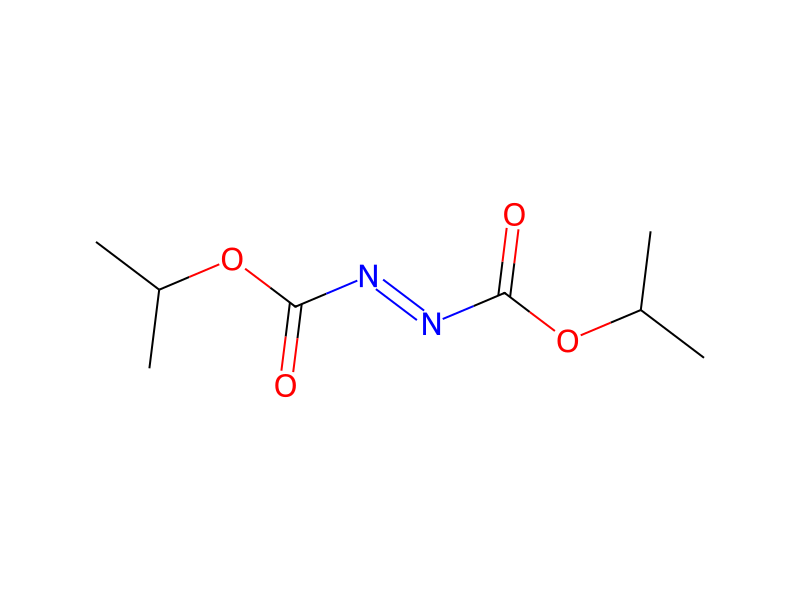
[CH2:1]([O:3][CH2:4][C:5]1[N:6]([OH:18])[C:7]2[C:16]3[CH:15]=[CH:14][CH:13]=[CH:12][C:11]=3[N:10]=[CH:9][C:8]=2[N:17]=1)[CH3:2].[C:19]([O:23][C:24](=[O:29])[NH:25][CH2:26][CH2:27]O)([CH3:22])([CH3:21])[CH3:20].C1(P(C2C=CC=CC=2)C2C=CC=CC=2)C=CC=CC=1.CC(OC(/N=N/C(OC(C)C)=O)=O)C>O1CCCC1>[CH2:1]([O:3][CH2:4][C:5]1[N:6]([O:18][CH2:27][CH2:26][NH:25][C:24](=[O:29])[O:23][C:19]([CH3:22])([CH3:21])[CH3:20])[C:7]2[C:16]3[CH:15]=[CH:14][CH:13]=[CH:12][C:11]=3[N:10]=[CH:9][C:8]=2[N:17]=1)[CH3:2]To a stirred slurry of 2-(ethoxymethyl)-1H-imidazo[4,5-c]quinolin-1-ol (3.80 g, 15.6 mmol), N-(2-hydroxyethyl)carbamic acid tert-butyl ester (3.9 g, 24 mmol), and triphenylphosphine (6.3 g, 24 mmol) in tetrahydrofuran (120 mL) at 0° C. was added diisopropylazodicarboxylate (4.7 mL, 24 mmol). After 1 hour, the solution was allowed to warm to room temperature. More N-(2-hydroxyethyl)carbamic acid tert-butyl ester (3.9 g, 24 mmol) and triphenylphosphine (6.3 g, 24 mmol) were added, then a solution of diisopropylazodicarboxylate (4.7 mL, 24 mmol) in tetrahydrofuran (10 mL). The reaction mixture was stirred over the weekend, then concentrated under reduced pressure. Dichloromethane (150 mL) was added and the solution was washed with water (2×25 mL). The organic layer was dried over potassium carbonate, filtered, and concentrated under reduced pressure. The solid was washed with diethyl ether/hexanes twice and dried to afford 1.5 g of crude tert-butyl 2-{[2-(ethoxymethyl)-1H-imidazo[4,5-c]quinolin-1-yl]oxy}ethylcarbamate, which was used without purification in Part D below.