HomeMCPWorkbenchSkills
HomeWorkbenchNotificationsMe
llms.txt · MCP GuidePrivacy Policy · Terms of Service · Supportv1.8.3
  1. Home
  2. /Reaction

Hydrochloric Acid → 4-((adamantan-2-yloxy)methyl)-5-cyclopropyl-2-fluoro-N-(methylsulfonyl)benzamide

HRID 1849513
Print

Reaction equation

HRID 1849513 reaction equation
[CH:1]12[CH2:10][CH:5]3[CH2:6][CH:7]([CH2:9][CH:3]([CH2:4]3)[CH:2]1[O:11][CH2:12][C:13]1[C:25](Cl)=[CH:24][C:16]([C:17]([NH:19][S:20]([CH3:23])(=[O:22])=[O:21])=[O:18])=[C:15]([F:27])[CH:14]=1)[CH2:8]2.[CH:28]1(B(O)O)[CH2:30][CH2:29]1.P([O-])([O-])([O-])=O.[K+].[K+].[K+].F[B-](F)(F)F.C1(P(C2CCCCC2)C2CCCCC2)CCCCC1.Cl>C1(C)C=CC=CC=1.O.C([O-])(=O)C.[Pd+2].C([O-])(=O)C>[CH:1]12[CH2:10][CH:5]3[CH2:6][CH:7]([CH2:9][CH:3]([CH2:4]3)[CH:2]1[O:11][CH2:12][C:13]1[C:25]([CH:28]3[CH2:30][CH2:29]3)=[CH:24][C:16]([C:17]([NH:19][S:20]([CH3:23])(=[O:22])=[O:21])=[O:18])=[C:15]([F:27])[CH:14]=1)[CH2:8]2


ParticipantsConditionsProcedureWorkupSources & evidenceReaction notes

Participants

9

Reactant 5

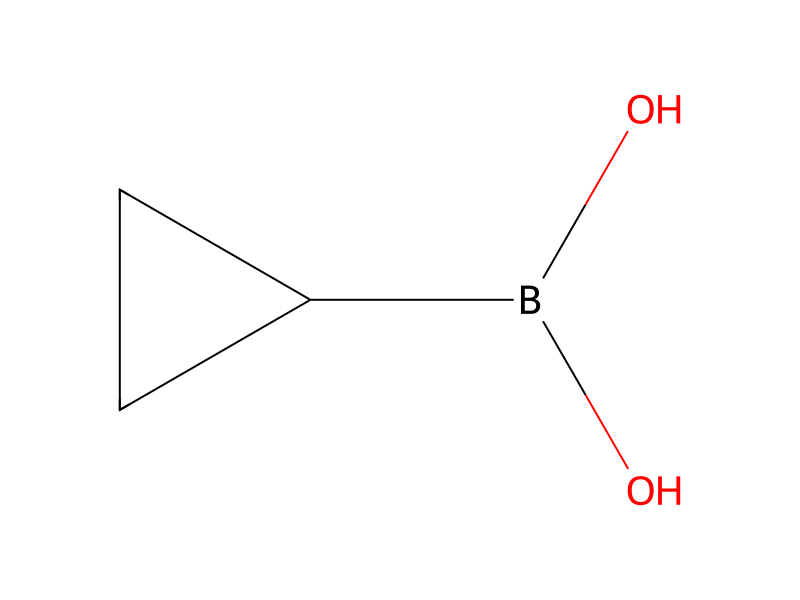
HCID 313Hydrochloric AcidHCID 62657Potassium Phosphate, TribasicHCID 2760897Cyclopropylboronic acidHCID 20066521Tri(cyclohexyl)phosphine tetrafluoroborateHCID 867028574-((adamantan-2-yloxy)methyl)-5-chloro-2-fluoro-N-(methylsulfonyl)benzamide

Product 1

HCID 86702856
4-((adamantan-2-yloxy)methyl)-5-cyclopropyl-2-fluoro-N-(methylsulfonyl)benzamide
Yield 62.6%

Reagents, catalysts & solvents 3

HCID 167845palladium(II) acetateCatalystHCID 962WaterSolventHCID 1140TolueneSolvent

Conditions

Temperature
100 °C

Procedure

To a solution of 4-((adamantan-2-yloxy)methyl)-5-chloro-2-fluoro-N-(methylsulfonyl)-benzamide (0.30 g, 0.72 mmol), cyclopropylboronic acid (0.40 g, 4.65 mmol) and potassium phosphate (2.55 g, 12.00 mmol) in toluene (10 mL) and water (0.5 mL) was bubbled with a nitrogen atmosphere for 10 min, tricyclohexylphosphine tetrafluoroborate (0.17 g, 0.48 mmol) and palladium acetate (0.05 g, 0.22 mmol) was added to this reaction mixture. The reaction mixture was heated to 100° C. for 18 h under a nitrogen atmosphere and then cooled to ambient temperature. 5% aqueous hydrochloric acid (20 mL) was added and the mixture was extracted with ethyl acetate (100 mL×3), the combined organics were washed with brine; dried over anhydrous sodium sulfate and concentrated in vacuo. Purification of the residue by column chromatography (10% to 30% gradient ethyl acetate in hexanes) afforded the title compound as a colorless solid (0.19 g, 62%): 1H NMR (300 MHz, CDCl3) δ 8.81 (br s, 1H), 7.69 (d, J=7.8 Hz, 1H), 7.40 (d, J=13.5 Hz, 1H), 4.71 (s, 2H), 3.60 (br s, 1H), 3.41 (s, 3H), 2.16-2.03 (m, 4H), 1.90-1.51 (m, 11H), 0.97-0.90 (m, 2H), 0.68-0.62 (m, 2H); MS (ES−) m/z: 420.35 (M−1).

Workup

  1. temperaturecooled to ambient temperature
  2. extractionthe mixture was extracted with ethyl acetate (100 mL×3)
  3. washthe combined organics were washed with brine
  4. dry with materialdried over anhydrous sodium sulfate
  5. concentrationconcentrated in vacuo
  6. customPurification of the residue by column chromatography (10% to 30% gradient ethyl acetate in hexanes)

Sources & evidence

ORD record
ord-5da55189cd7f4d2ab749827153fd38b1
Source dataset
uspto-grants-2015_02
DOI
10.6084/m9.figshare.5104873.v1
Patent number
US08952169B2

Reaction notes

On this pageParticipantsConditionsProcedureWorkupSources & evidenceReaction notes