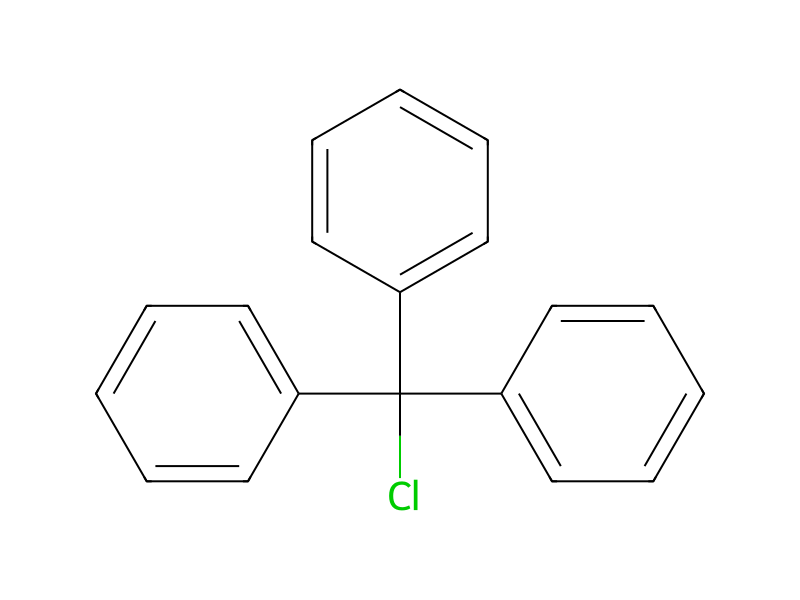
[Br:1][C:2]1[CH:11]=[CH:10][C:5]2[NH:6][C:7](=[O:9])[O:8][C:4]=2[CH:3]=1.C(N(CC)CC)C.[C:19](Cl)([C:32]1[CH:37]=[CH:36][CH:35]=[CH:34][CH:33]=1)([C:26]1[CH:31]=[CH:30][CH:29]=[CH:28][CH:27]=1)[C:20]1[CH:25]=[CH:24][CH:23]=[CH:22][CH:21]=1.CCOC(C)=O>C(Cl)Cl>[Br:1][C:2]1[CH:11]=[CH:10][C:5]2[N:6]([C:19]([C:20]3[CH:25]=[CH:24][CH:23]=[CH:22][CH:21]=3)([C:32]3[CH:33]=[CH:34][CH:35]=[CH:36][CH:37]=3)[C:26]3[CH:27]=[CH:28][CH:29]=[CH:30][CH:31]=3)[C:7](=[O:9])[O:8][C:4]=2[CH:3]=1To a solution of 6-bromo-3H-benzoxazol-2-one (15 g; ca. 0.07 mol, containing 8-9% 3H-benzooxazol-2-one) and triethylamine (11.1 mL, 0.08 mol) in DCM (250 mL) was added trityl chloride (21.5 g, 0.08 mol). The solution was stirred at room temperature for 18 h and was then washed with distilled water (3×250 mL), brine (250 mL) and dried (MgSO4), filtered and evaporated to give an off-white colored solid. The product was dissolved in refluxing EtOAc then allowed to cool to room temperature with constant stirring for several hours. The solids were collected (21.16 g) and the filtrate was concentrated until precipitation occurred, re-heated (reflux) for several hours and allowed to cool with stirring to encourage a second crystallization (7.88 g).