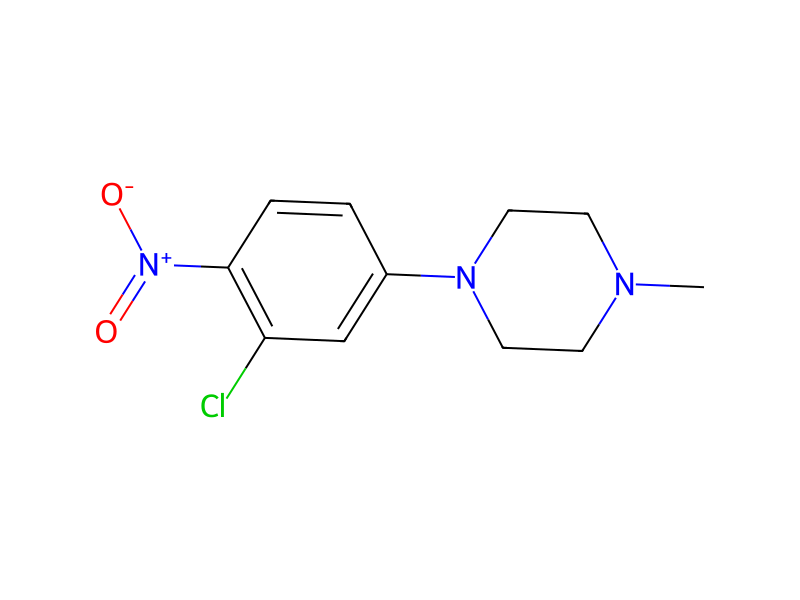
2-chloro-4-fluoronitrobenzene (1.0 eq, 1 g, 5.7 mmol), N-methyl piperazine (1.2 eq, 1.18 g, 6.84 mmol), potassium carbonate (2.0 eq, 1.6 g, 11.6 mmol) were stirred at 100° C. in DMF for 3 hours. The mixture was cooled down and diluted with water. The material was extracted with ethyl acetate. The organic layer was washed with brine, dried over Na2SO4 and the solvent evaporated in vacuo. After trituration in diethylether and filtration, 1-(3-chloro-4-nitrophenyl)-4-methylpiperazine was isolated as a solid (0.9 g, 62%). LCMS (ES): m/z 256 [M+1]+. This material was suspended in MeOH (20 ml) with Raney Nickel (0.2 g) and stirred under hydrogen atmosphere overnight. The catalyst was filtered off through celite. Evaporation of the solvents provided 2-chloro-4-(4-methylpiperazin-1-yl)aniline as a dark brown oil (0.68 g, 86%). LCMS (ES): m/z 226 [M+1]+.