HomeMCPWorkbenchSkills
HomeWorkbenchNotificationsMe
llms.txt · MCP GuidePrivacy Policy · Terms of Service · Supportv1.8.3
  1. Home
  2. /Reaction

4-Methylmorpholine → 1-(3-(2-(2-ethyl-1H-benzo[d]imidazol-1-yl)-9-methyl-6-morpholino-9H-purin-8-yl)-3-methoxyazetidin-1-yl)-2-hydroxy-2-methylpropan-1-one

HRID 1946175
Print

Reaction equation

HRID 1946175 reaction equation
[CH2:1]([C:3]1[N:7]([C:8]2[N:16]=[C:15]3[C:11]([N:12]=[C:13]([C:18]4([O:22][CH3:23])[CH2:21][NH:20][CH2:19]4)[N:14]3[CH3:17])=[C:10]([N:24]3[CH2:29][CH2:28][O:27][CH2:26][CH2:25]3)[N:9]=2)[C:6]2[CH:30]=[CH:31][CH:32]=[CH:33][C:5]=2[N:4]=1)[CH3:2].[OH:34][C:35]([CH3:40])([CH3:39])[C:36](O)=[O:37].C1C=CC2N(O)N=NC=2C=1.CN1CCOCC1.CCN=C=NCCCN(C)C>C1COCC1.C(Cl)Cl>[CH2:1]([C:3]1[N:7]([C:8]2[N:16]=[C:15]3[C:11]([N:12]=[C:13]([C:18]4([O:22][CH3:23])[CH2:21][N:20]([C:36](=[O:37])[C:35]([OH:34])([CH3:40])[CH3:39])[CH2:19]4)[N:14]3[CH3:17])=[C:10]([N:24]3[CH2:29][CH2:28][O:27][CH2:26][CH2:25]3)[N:9]=2)[C:6]2[CH:30]=[CH:31][CH:32]=[CH:33][C:5]=2[N:4]=1)[CH3:2]

ParticipantsProcedureWorkupSources & evidenceReaction notes

Participants

8

Reactant 5

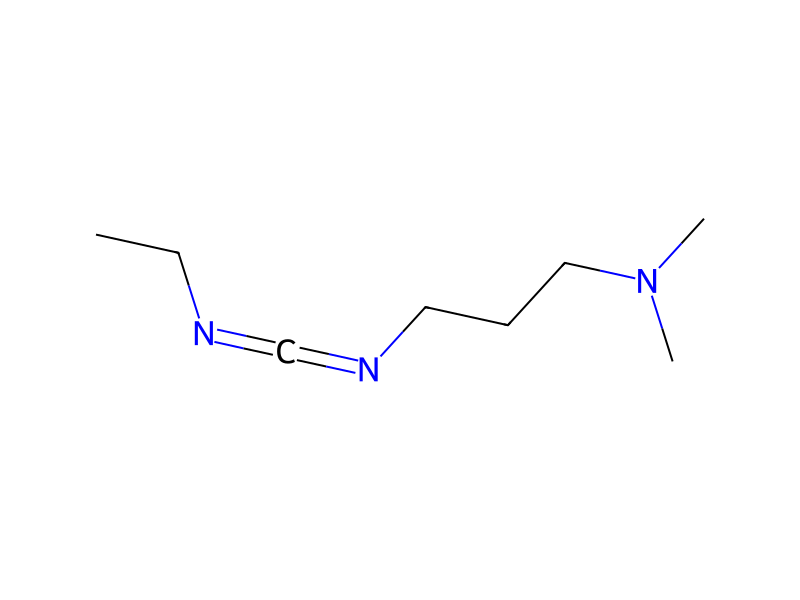
HCID 79724-MethylmorpholineHCID 116712-Hydroxyisobutyric acidHCID 159081-Ethyl-3-(3'-dimethylaminopropyl)carbodiimideHCID 757711-HydroxybenzotriazoleHCID 596058342-(2-Ethylbenzoimidazol-1-yl)-8-(3-methoxyazetidin-3-yl)-9-methyl-6-morpholin-4-yl-9H-purine

Product 1

HCID 59605356
1-(3-(2-(2-ethyl-1H-benzo[d]imidazol-1-yl)-9-methyl-6-morpholino-9H-purin-8-yl)-3-methoxyazetidin-1-yl)-2-hydroxy-2-methylpropan-1-one
Yield 61.2%

Reagents, catalysts & solvents 2

HCID 6344DichloromethaneSolventHCID 8028TetrahydrofuranSolvent

Procedure

A mixture of 2-(2-ethylbenzoimidazol-1-yl)-8-(3-methoxyazetidin-3-yl)-9-methyl-6-morpholin-4-yl-9H-purine (150 mg, 0.33 mmol), 2-hydroxy-2-methylpropionic acid (52 mg, 0.50 mmol), HOBt (50 mg, 0.37 mmol), NMM (81 μL, 0.74 mmol) and EDCI (96 mg, 0.50 mmol) in THF (3 mL) was allowed to stir at r.t. for 4 h. The resulting mixture was diluted with DCM and washed with sat. aq. NaHCO3, dried (phase separator) and concentrated in vacuo. The resulting residue was purified by column chromatography (Si—PCC, THF:EtOAc, 0-50%) then triturated with Et2O/cyclohexane. The resulting solid was collected by filtration and dried in vacuo affording 811 (108 mg, 60%). LCMS (method I): RT 3.21 min, [M+H]+ 535.3. 1H NMR (DMSO, 400 MHz): δ 8.06-8.05 (1 H, m), 7.64-7.63 (1 H, m), 7.26-7.25 (2 H, m), 5.23 (1 H, s), 5.05 (1 H, d, J=10.74 Hz), 4.67 (1 H, d, J=10.76 Hz), 4.55 (1 H, d, J=10.69 Hz), 4.29 (4 H, brd s), 4.16 (1 H, d, J=10.75 Hz), 3.79 (4 H, t, J=4.62 Hz), 3.73 (3 H, s), 3.29-3.27 (2 H, m), 3.09 (3 H, s), 1.35 (3 H, t, J=7.43 Hz), 1.30 (3 H, s), 1.25 (3 H, s)

Workup

  1. washwashed with sat. aq. NaHCO3
  2. customdried (phase separator)
  3. concentrationconcentrated in vacuo
  4. customThe resulting residue was purified by column chromatography (Si—PCC, THF:EtOAc, 0-50%)
  5. customthen triturated with Et2O/cyclohexane
  6. filtrationThe resulting solid was collected by filtration
  7. customdried in vacuo

Sources & evidence

ORD record
ord-cd15ff8d09374d6799132dbc1820417a
Source dataset
uspto-grants-2013_03
DOI
10.6084/m9.figshare.5104873.v1
Patent number
US08394796B2

Reaction notes

On this pageParticipantsProcedureWorkupSources & evidenceReaction notes