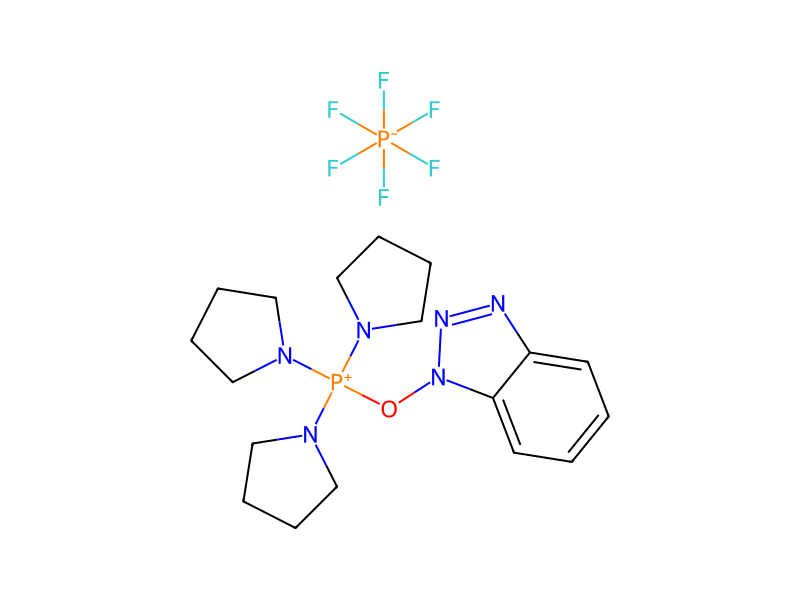
[Cl:1][C:2]1[CH:3]=[C:4]([C:8]2[N:9]=[C:10]([C:22]([OH:24])=O)[S:11][C:12]=2[C:13]2[CH:18]=[C:17]([F:19])[CH:16]=[C:15]([C:20]#[N:21])[CH:14]=2)[CH:5]=[CH:6][CH:7]=1.C1CN([P+](ON2N=[N:49][C:44]3C=CC=CC2=3)(N2CCCC2)N2CCCC2)CC1.F[P-](F)(F)(F)(F)F.C([N:61](CC)C(C)C)(C)C.[O:67]1CC[CH2:69][CH2:68]1>ClCCl>[Cl:1][C:2]1[CH:3]=[C:4]([C:8]2[N:9]=[C:10]([C:22]([N:61]3[CH2:69][C:68](=[O:67])[NH:49][CH2:44]3)=[O:24])[S:11][C:12]=2[C:13]2[CH:14]=[C:15]([C:20]#[N:21])[CH:16]=[C:17]([F:19])[CH:18]=2)[CH:5]=[CH:6][CH:7]=190.0 mg of the compound from Example 40A having a purity of 90% (0.226 mmol), 49.7 mg (0.248 mmol) of the compound from Example 20A and 176 mg (0.339 mmol) of PyBOP are provided in 5.0 ml of tetrahydrofuran, and 126 μl (0.722 mmol) of N,N-diisopropylethylamine are added at room temperature. The reaction solution is stirred at room temperature overnight, diluted with dichloromethane and subsequently washed with a 1N aqueous hydrogen chloride solution. The organic phase is dried over magnesium sulfate, filtered and concentrated under reduced pressure, and the crude product is then purified by preparative HPLC (RP18 column; mobile phase: acetonitrile/water gradient). 62.0 mg (64% of theory) of the title compound are obtained.