Reaction equation
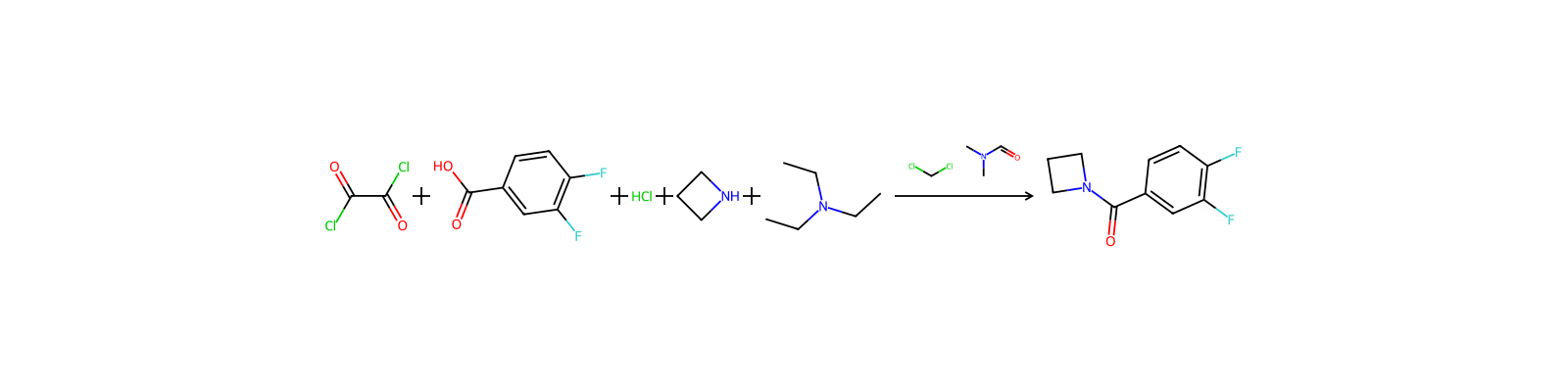
C(Cl)(=O)C(Cl)=O.[F:7][C:8]1[CH:9]=[C:10]([CH:14]=[CH:15][C:16]=1[F:17])[C:11]([OH:13])=O.Cl.[NH:19]1[CH2:22][CH2:21][CH2:20]1.C(N(CC)CC)C>C(Cl)Cl.CN(C=O)C>[F:7][C:8]1[CH:9]=[C:10]([CH:14]=[CH:15][C:16]=1[F:17])[C:11]([N:19]1[CH2:22][CH2:21][CH2:20]1)=[O:13]Participants






Procedure
Oxalyl chloride (1.05 mL, 12.0 mmol) was added to a solution of 3,4-difluorobenzoic acid (1.58 g, 10 mmol) in DCM (50 mL) containing DMF (1 drop). The reaction was stirred at ambient temperature for 16 h then evaporated to dryness. The residue was redissolved in DCM (25 mL) and azetidine hydrochloride (1.12 g, 12.0 mmol) added followed by triethylamine (4.18 mL, 30.0 mmol). The mixture was stirred at ambient temperature for 2 h then concentrated in vacuo. The residue was partitioned between ethyl acetate and 1N hydrochloric acid, the organic phase washed with a saturated aqueous solution of sodium bicarbonate followed by brine, dried (MgSO4), and concentrated in vacuo. The title compound was crystallized from an ethyl acetate/hexane mixture to give a white crystalline solid (1.0 g).
Workup
- customthen evaporated to dryness
- dissolutionThe residue was redissolved in DCM (25 mL)
- stirringThe mixture was stirred at ambient temperature for 2 h
- concentrationthen concentrated in vacuo
- customThe residue was partitioned between ethyl acetate and 1N hydrochloric acid
- washthe organic phase washed with a saturated aqueous solution of sodium bicarbonate
- dry with materialdried (MgSO4)
- concentrationconcentrated in vacuo
- customThe title compound was crystallized from an ethyl acetate/hexane mixture
Sources & evidence
- ORD record
- ord-35f62b13bbf54e95be508ca62a2d14d2
- Source dataset
- uspto-grants-2010_06
- Patent number
- US07745475B2
Linked notes
Loading…