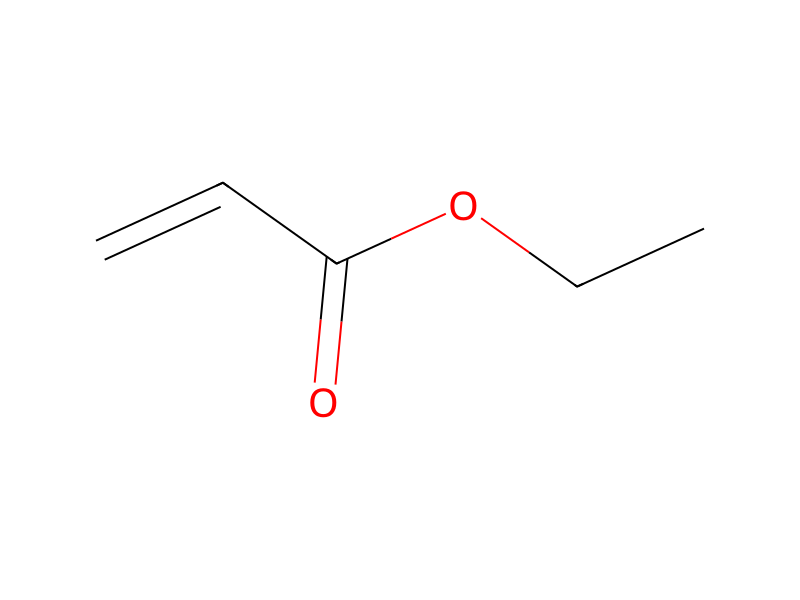
[C:1]([O:5][CH2:6][CH3:7])(=[O:4])[CH:2]=[CH2:3].N(OC(C)(C)C)=O.N[C:16]1[C:17]([Cl:33])=[CH:18][C:19]([F:32])=[C:20]([N:22]2[C:26](=[O:27])[N:25]([CH2:28][CH2:29][CH2:30][F:31])[N:24]=[N:23]2)[CH:21]=1.[ClH:34]>C(#N)C.[Cu](Cl)Cl>[Cl:34][CH:2]([CH2:3][C:16]1[CH:21]=[C:20]([N:22]2[C:26](=[O:27])[N:25]([CH2:28][CH2:29][CH2:30][F:31])[N:24]=[N:23]2)[C:19]([F:32])=[CH:18][C:17]=1[Cl:33])[C:1]([O:5][CH2:6][CH3:7])=[O:4]To an ice cold, stirred mixture of 5.54 g (0.0553 mole) of ethyl acrylate, 10 mL of acetonitrile, 0.43 g (0.0042 mole) of tert-butyl nitrite, and 0.45 g (0.0033 mole) of copper (II) chloride was added a solution of 0.80 g (0.0028 mole) of 1-(5-amino-4-chloro-2-fluorophenyl) -1,4-dihydro-4-(3-fluoropropyl)-5H-tetrazol-5-one (which may be prepared as described in International patent publication WO 87/03873, Example 1 A-E) in 10 mL of acetonitrile. The reaction mixture was stirred at room temperature for five hours and then was diluted with 2N hydrochloric acid. The acidic mixture was extracted with three portions of diethyl ether. The extracts were combined and dried over anhydrous magnesium sulfate. The dried organic phase was filtered and the filtrate was evaporated leaving a residue. This residue was purified by column chromatography on silica gel, eluting with n-heptane: ethyl acetate (2:1) to yield 1.1 g of ethyl 2-chloro-3-[2-chloro- 4-fluoro-5-[4-(3-fluoropropyl) -1,4-dihydro-5-oxo-5H-tetrazol-1-yl]phenyl]propionate as an oil, compound 3 of Table 1.