HomeMCPWorkbenchSkills
HomeWorkbenchNotificationsMe
llms.txt · MCP GuidePrivacy Policy · Terms of Service · Supportv1.8.3
  1. Home
  2. /Reaction

Dicyclohexylcarbodiimide → 2-cyclobutylidene-N-(4-methoxy-2,3-dimethylphenyl)acetamide

HRID 2103084
Print

Reaction equation

HRID 2103084 reaction equation
[C:1]1(=[CH:5][C:6]([OH:8])=O)[CH2:4][CH2:3][CH2:2]1.[CH3:9][C:10]1[C:11]([O:18][CH3:19])=[CH:12][CH:13]=[C:14]([C:16]=1[CH3:17])[NH2:15].CN(C)CCCN=C=NCC.C1(N=C=NC2CCCCC2)CCCCC1>CN(C)C1C=CN=CC=1.ClCCl.C(N(CC)CC)C>[C:1]1(=[CH:5][C:6]([NH:15][C:14]2[CH:13]=[CH:12][C:11]([O:18][CH3:19])=[C:10]([CH3:9])[C:16]=2[CH3:17])=[O:8])[CH2:2][CH2:3][CH2:4]1
ParticipantsProcedureWorkupSources & evidenceReaction notes

Participants

8

Reactant 4

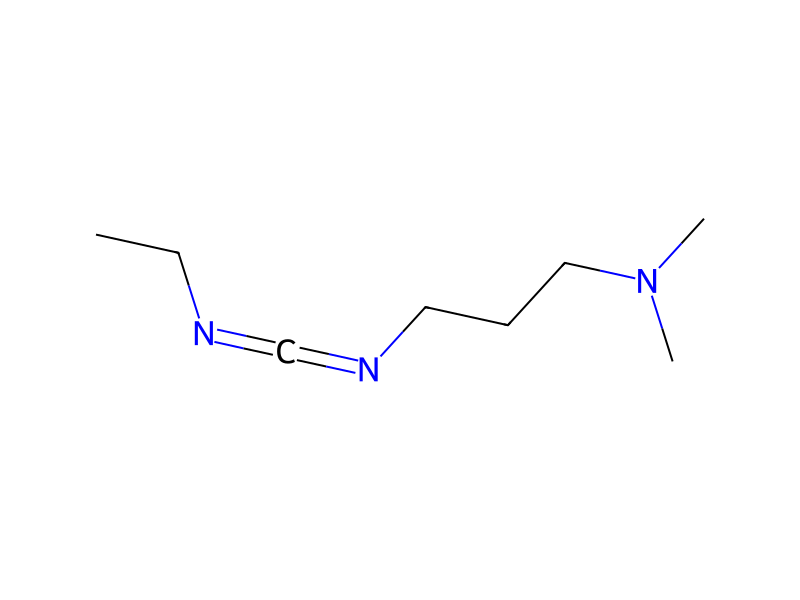
HCID 10868DicyclohexylcarbodiimideHCID 159081-Ethyl-3-(3'-dimethylaminopropyl)carbodiimideHCID 110948094-Methoxy-2,3-dimethylanilineHCID 219231732-Cyclobutylideneacetic acid

Product 1

HCID 690533272-cyclobutylidene-N-(4-methoxy-2,3-dimethylphenyl)acetamideYield 65.3%

Reagents, catalysts & solvents 3

HCID 142844-(Dimethylamino)pyridineCatalystHCID 6344DichloromethaneSolventHCID 8471TriethylamineSolvent

Procedure

Cyclobutylideneacetic acid (3.8 g), 5,6-dimethyl-4-methoxyaniline (5 g), 1-(3-dimethylaminopropyl)-3-ethylcarbodiimide (EDC) (4.7 g), 1,3-dicyclohexylcarbodiimide (DCC) (2.4 g), 4-dimethylaminopyridine (DMAP) (805 mg) and triethylamine (TEA) (7.3 g) were dissolved in dichloromethane (80 mL). The mixture was stirred at room temperature overnight, concentrated, and the residue dissolved in ethyl acetate. The organic phase was washed with water (3×20 mL) and 1M HCl (3×20 mL), and a white solid was filtered out. The organic solution was then dried out by evaporation giving 2-cyclobutylidene-N-(4-methoxy-2,3-dimethylphenyl)acetamide as a brown solid (5.3 g). The product was used in the next step without further purification. MS: (m/z)=246 (100, M+H+).

Workup

  1. concentrationconcentrated
  2. dissolutionthe residue dissolved in ethyl acetate
  3. washThe organic phase was washed with water (3×20 mL) and 1M HCl (3×20 mL)
  4. filtrationa white solid was filtered out
  5. customThe organic solution was then dried out by evaporation

Sources & evidence

ORD record
ord-e76f5d88b4074044a32e6ad90da2d763
Source dataset
uspto-grants-2009_08
DOI
10.6084/m9.figshare.5104873.v1
Patent number
US07576094B2

Reaction notes

On this pageParticipantsProcedureWorkupSources & evidenceReaction notes